
It looked like an island. At least that's what Jessica Jarratt thought when she first saw pictures of the Great Pacific Garbage Patch, a vast floating mass of trash in the North Pacific Ocean composed primarily of microplastics.
The images of the immense, murky soup of trash—twice the size of Texas, by some estimates—disturbed the then-high school student, prompting her to write a research paper on it. Her concern about microplastics in our oceans, though, began long before she saw pictures of "trash island."
As a little girl, she winced any time she saw footage of sea turtles with their necks and flippers entangled in plastic debris. "I was always the kid who was cutting up plastic six-pack rings and picking up trash so that marine animals wouldn't get harmed," Jarratt recalled.
Today, the University of Miami graduate is still concerned about microplastics, with recent research she conducted on the small synthetic particles promising to yield new knowledge of their toxicity in marine environments around the world.
In what is believed to be a first-of-its-kind study, Jarratt not only discovered high levels of mercury in microplastics recovered from the shore of a South Florida beach, but she also determined the mercury's isotopic signature—a scientific "fingerprint" that revealed that the chemical element did not originate solely from natural sources such as the air or surrounding sand but may have come from human activity.
"Plastic pollution is a significant and growing environmental threat, and it's getting worse due to the increasing production and use of plastic products in society," said Jarratt, who double majored in marine science and chemistry and recently graduated from the Rosenstiel School of Marine, Atmospheric, and Earth Science.
Smaller than a pencil eraser, microplastics originate either from larger plastic debris that degrades over time or from intentionally manufactured particles used in consumer products. They've been found in tap water and food, even embedded in the fatty plaque that clings to the walls of blood vessels.
Their presence in marine environments is ubiquitous and especially troubling, Jarratt said, because of the "potential role they play in acting as a source for the dispersion of toxic heavy metals such as mercury."
Just how much mercury is in microplastics and its source is what Jarratt wanted to find out.
So, as part of a beach cleanup organized by Miami Waterkeeper, she teamed up with other volunteers to collect several pounds of microplastics from the north end of Crandon Park Beach, bringing the samples back to the Rosenstiel School's Neptune Isotope Laboratory, where they were cleaned, pulverized in a commercial coffee grinder, then analyzed in a pickup-sized instrument called a Multi-Collector Inductively Coupled Plasma Mass Spectrometer. Jarratt also collected sand and air samples from the beach.
"We detected mercury in all the plastic, sand, and air samples, but the concentration of mercury we found in the microplastics substantially exceeded that found in the surrounding natural environment," Jarratt said.
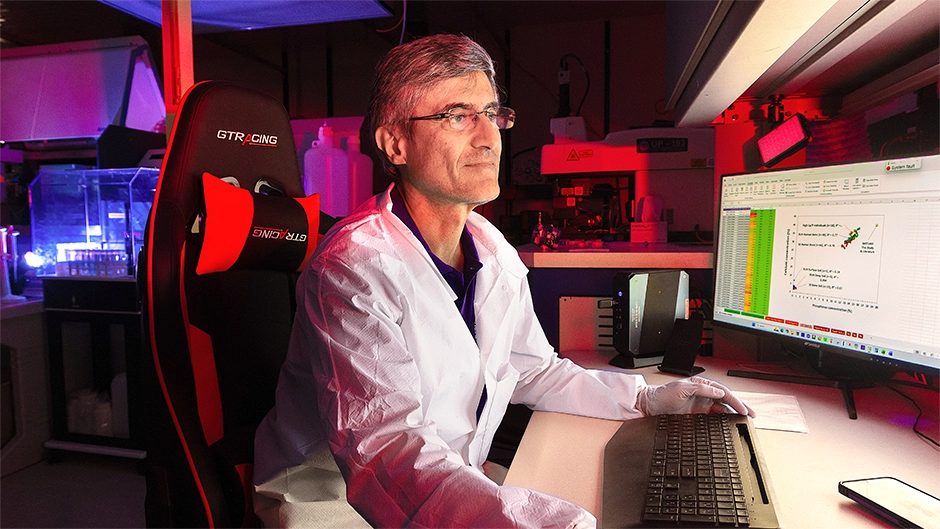
Using a special mass spectrometer, associate professor Ali Pourmand helped Jarratt test beached microplastics for the presence of elemental mercury. Photo: Joshua Prezant/University of Miami
"It wasn't even close," said Ali Pourmand, an associate professor in the Department of Marine Geosciences at the Rosenstiel School, who mentored Jarratt during her research project. "Jessica cleverly came back to the lab with jars full of sand from the beach where the plastic had been collected. But the sand barely had any mercury. Even in the amounts of mercury we discovered in the sand, its isotopic composition was nothing like that we detected in the microplastics."
Jarratt detected up to 25 nanograms of elemental mercury per gram of powdered plastic material. In contrast, the sand collected from the beach yielded a negligible amount, less than 0.005 nanograms of elemental mercury per gram of sand.
To examine atmospheric sources of mercury, she also analyzed air samples from the beach, finding little mercury present.
Jarratt's study defines the level of all undergraduate research conducted out of the Neptune Isotope Laboratory, Pourmand noted. "We're highly focused on fostering high-quality undergraduate research," he said. "Every student in my lab has done a senior thesis, with many of them going on to pursue Ph.D. degrees." Jarratt herself is now a first-year Ph.D. student at the University of Washington, investigating the spread of heavy metals and microplastics in natural creek environments and drinking water in the Pacific Northwest.
Her Rosenstiel School research on the presence and origin of mercury in beached microplastics sets the stage for future studies that could delve even deeper into the precise source and nature of the mercury found in microplastics, revealing whether it came from the dyes, additives, or petroleum used to make plastics.
"What we should be worried about is that millions of tons of plastic will be broken down over the next century across the planet and should be considered as a major source of mercury," Pourmand said. "If we can put a number on the average amount of mercury that leaches off of X amount of microplastic over X number of years, that would be a significant scientific contribution."
The isotopic fingerprinting used in Jarratt's study will prove to be a key component of any future research, he said. "Like your own fingerprint tells who you are, the isotopic fingerprint of microplastics could tell us what raw material it started with and perhaps even what refinery produced the material," Pourmand said. "This was a project built on the shoulders of a very talented undergrad, and it offers the opportunity to pass the baton to the next one."


