What the research is about
In most materials, lowering the temperature calms internal motion and leads to an orderly state. This is a basic rule of physics.
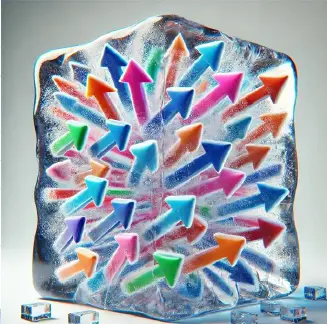
However, there is a class of materials that defies this rule: spin glasses. In spin glasses, tiny atomic magnets called spins cannot align neatly because of impurities in the material. As a result, the spins freeze in random directions, creating a magnetic state that is neither fully ordered nor completely disordered.
Scientists have been struggling to understand the nature of spin glasses for more than half a century. In 1975, a theoretical model was proposed, but it could not fully explain the behavior observed in real spin glasses. Paper-and-pencil calculations were not enough, so researchers began creating virtual spin glasses inside computers and performing repeated numerical experiments.
Large-scale computer simulations became an essential tool. By repeatedly changing the spins inside a simulated spin glass and observing their behavior, researchers identified two counterintuitive phenomena:
1) Reentrant transition: a paradoxical phenomenon in which cooling the system actually destroys order rather than creating it
2) Temperature chaos: a dramatic change in the system's state caused by only a tiny change in temperature
Until now, these two phenomena were treated as separate and unrelated mysteries within spin glass physics.
Why this matters
A research team led by Specially Appointed Professor Hidetoshi Nishimori at Institute of Science Tokyo (Science Tokyo) has, for the first time in the world, theoretically demonstrated that these two phenomena are in fact deeply connected.
The team developed a new theoretical model that allows precise control over the interactions among impurities and analyzed its behavior in detail. They showed mathematically that if a reentrant transition occurs, temperature chaos must necessarily appear as its logical consequence.
Why is uncovering this relationship important? Understanding the connection opens a new path toward theory-based prediction in complex systems. In the case of spin glasses, if experiments or simulations detect a reentrant transition, researchers can now predict that temperature chaos will follow.
Another major advance is that this relationship holds not only in idealized, easy-to-calculate cases, but also under complex conditions that more closely resemble real materials.
What's next
Spin glass theory, which seeks to explain the behavior of complex systems, is closely related to many challenging problems beyond physics. These include optimization problems that search for the best solution, reasoning processes in artificial intelligence, and studies that work backward to understand the spread of infectious diseases.
As mathematical understanding becomes more rigorous, simulation results become more reliable, and the theoretical foundations of other fields grow stronger. The analytical methods developed in this study are also expected to contribute to new research in information processing and data analysis.
Comment from the researcher
For decades, researchers believed these two phenomena were completely separate mysteries. Discovering that they are actually two sides of the same coin-and uncovering that connection through mathematics-was an unforgettable moment of excitement. Even in nature, which often appears random and chaotic, surprisingly simple and beautiful order can lie hidden beneath the surface. Beyond this discovery, we imagine a new world of physics that no one has seen before.
(Hidetoshi Nishimori: Specially Appointed Professor, Institute of Integrated Research, Institute of Science Tokyo)