
The growing pains of young planets as they enter their teenage phase have been captured in unprecedented detail by an international astronomical survey.
For the first time, astronomers have been able to obtain high-resolution images of a large sample of debris disks - the dusty belts left over after planets finish forming.
The pictures reveal a great diversity of morphologies, with some disks displaying multiple rings, wide smooth halos, sharp edges, and unexpected arcs and clumps. The observations include images tracing the light emitted by millimetre-sized dust grains (in amber colour) and the light emitted by carbon monoxide gas (in blue colour), offering further insight into the processes taking place.
The work was undertaken by a team of 60 researchers around the world, led by Dr Sebastian Marino at the University of Exeter, with the pictures obtained through the Atacama Large Millimeter/submillimeter Array (ALMA) in Chile. The findings of the ALMA survey to Resolve exoKuiper belt Substructures (ARKS) have been published in a series of papers in the journal Astronomy & Astrophysics.
"We're seeing real diversity-not just simple rings, but multi-ringed belts, halos, and strong asymmetries, revealing a dynamic and violent chapter in planetary histories," said Dr Marino, Associate Professor of Astrophysics at Exeter. "These disks are the cosmic equivalent of the teenage years for planetary systems – somewhat more mature than newborn, planet-forming disks, but not yet settled into adulthood."
Our own Solar System's counterpart to this phase is the Kuiper Belt, a ring of icy debris beyond Neptune that preserves a record of massive collisions and planetary migrations from billions of years ago.
Debris disks outside of our system have proven extremely difficult to observe because they are hundreds or even thousands of times dimmer than the bright, gas-rich disks where planets are born. The ARKS team, however, secured around 300 hours at the ALMA observatory between October 2022 to July 2024, and optimised its configurations to specifically obtain high fidelity images of debris disks.
Dr Marino, of Exeter's Department of Physics and Astronomy, processed and calibrated the data before delivering it to sub-teams at supporting institutions to analyse. The research team say the images, the highest resolution of debris disks ever obtained, set a "new gold standard" in the field.
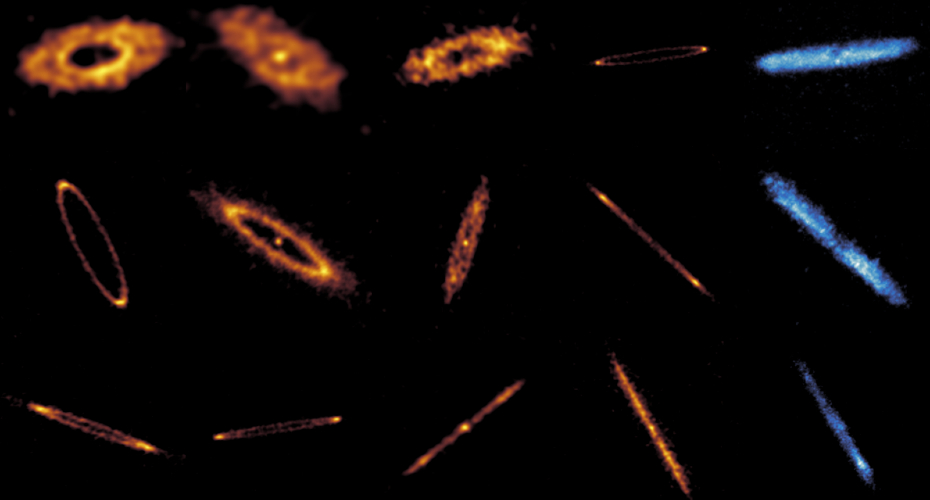
One-third of the observed disks show clear substructures, including multiple rings or distinct gaps, suggesting legacy features from earlier, planet-building stages or sculpted by planets over much longer timescales.
The disks are unexpectedly diverse, with some inheriting intricate structures from their earlier years, while others have 'mellowed out' and spread into broad belts, more like the Kuiper Belt than any known planet-forming disk.
The astronomers say that several disks have retained gas much longer than expected, which could shape the chemistry of growing planets, or even push dust into wide halos. And they add that many of the disks are lopsided, with bright arcs or eccentric shapes, hinting at gravitational shoves from unseen planets, or leftover birth scars from planetary migration, or the interactions between the gas and dust.
"We've often seen the 'baby pictures' of planets forming, but until now, the 'teenage years' have been a missing link," says Dr Meredith Hughes, an Associate Professor of Astronomy at Wesleyan University and co-lead of the study. "This project gives us a new lens for interpreting the craters on the Moon, the dynamics of the Kuiper Belt, and the growth of planets big and small. It's like adding the missing pages to the Solar System's family album."
By looking at dozens of disks around stars of different ages and types, ARKS has helped decode whether chaotic features are inherited, sculpted by planets, or arise from other cosmic forces. Answering these questions could reveal whether our Solar System's history was unique or the norm, particularly as the planets jostled for their final positions.
"These disks record a period when planetary orbits were being scrambled and huge impacts, like the one that forged Earth's Moon, were shaping young solar systems," adds Dr Luca Matrà, co-lead and Associate Professor at Trinity College Dublin.
The paper, ARKS I: Motivation, sample, data reduction, and results overview by Marino et al, is available via https://www.aanda.org/10.1051/0004-6361/202556489.


