
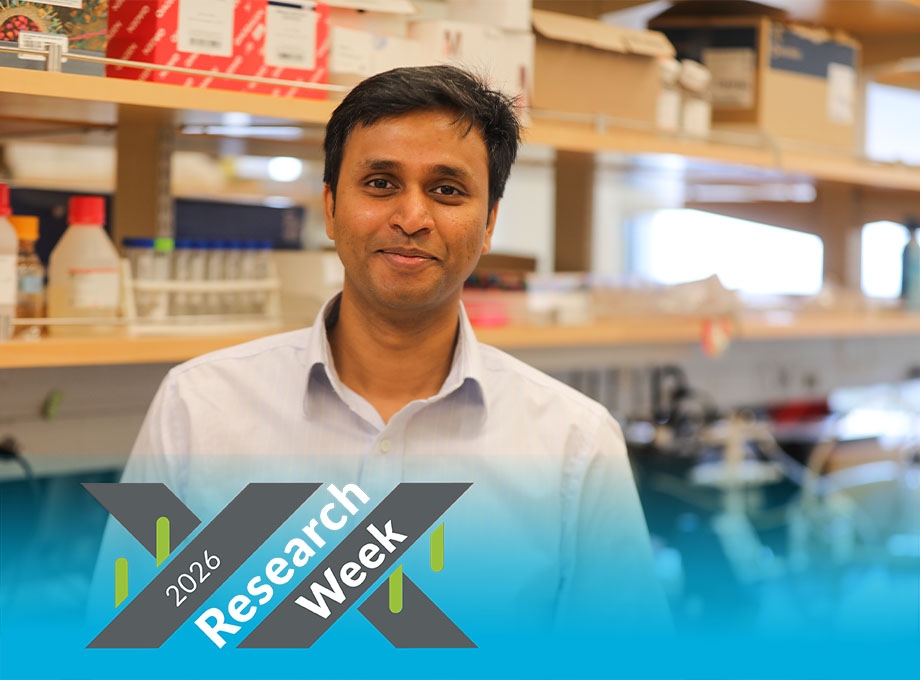
What if the origins of chronic childhood diseases — and targeted therapies to treat them — could be uncovered through a deeper understanding of cells and their pathways within the body?
That's what Manideep Chavali, Ph.D., hopes to discover through his research at Oregon Health & Science University.
Chavali is an assistant professor of pediatrics in the OHSU School of Medicine and the OHSU Doernbecher Children's Hospital Papé Family Pediatric Research Institute. Originally trained as a chemical engineer, Chavali says his diverse academic and professional background has fostered a deep curiosity about how systems work — and how breakdowns in those systems can create long-lasting, ripple effects.
He joined OHSU in 2022, establishing an independent research program aimed at understanding cellular, molecular and metabolic mechanisms of myelination — the development of protective, lipid-rich, insulating layers wrapping around nerve fibers — and how they are disrupted in neurological injuries and neurodegeneration.
The brain's white matter acts like wiring that connects different areas, enabling important functions such as movement, speech and memory. For this white matter wiring to function properly, it is essential to have a close metabolic partnership between a brain cell type called oligodendrocyte and the blood vessels that deliver oxygen, metabolites and nutrients.
When this metabolic partnership breaks down, it contributes to brain damage seen in a wide range of conditions, from early childhood injuries and metabolic diseases to neurodegenerative disorders, like multiple sclerosis and aging-related dementias.
Chavali's work aims to understand how these crucial components work together during normal brain development and how this relationship changes across different diseases and stages of life.
Multidisciplinary approach
More recently, he is focused on how disruptions in these cellular and metabolic partnerships impact preterm babies, who often suffer neonatal brain injuries.
"We want to understand what kind of cellular, molecular and metabolic alterations occur in preterm babies' brains," Chavali said. "We hope our work will help uncover how these processes fail in individuals with certain diseases, so we can then identify strategies to protect and repair white matter and optimize long-term brain health."
To understand how these pathways are impacted, Chavali and his team take a multidisciplinary approach. Their research leverages advanced genetic tools, leading-edge imaging and analysis methods, and human brain tissue samples to uncover the fundamental biological processes that keep the brain's wiring healthy.
"The more we study these cells, the more we discover about how dynamic and complex they are," Chavali explains.
"When there is a neurological issue, it was historically thought that the neurons themselves are the cells affected. But the more we study these pathologies the more we understand the glial cells and their role in driving the pathology, and that they also play critical roles in maintaining a healthy brain. It's an exciting shift in how we think about neurological disease."
Therapeutic targets
Chavali's lab has a strong commitment to translational neuroscience: They hope their work will ultimately help identify new, targeted therapies and treatments that could improve brain function and quality of life for people affected by various brain disorders.
"When we think about how this work will translate, we think about therapeutic targets, and how we can create therapies and treatments that target these specific pathways that we study in the lab," he says.
"Every clinical impact begins with years, decades even, of basic science research. Hopefully, in the next 10 to 15 years, we'll be able to bring these findings to actual patients."
Looking forward, Chavali plans to focus his research efforts on the shared mechanisms underlying brain injury in preterm babies and neurological disorders in adults, in hopes that these targeted therapies and treatments might be applicable to various patient populations.
He knows there is much more to discover, which is what fuels his passion for this work.
"The vast unknowns about the brain are what drive me," Chavali says. "The more you don't know, the humbler it makes you."


