
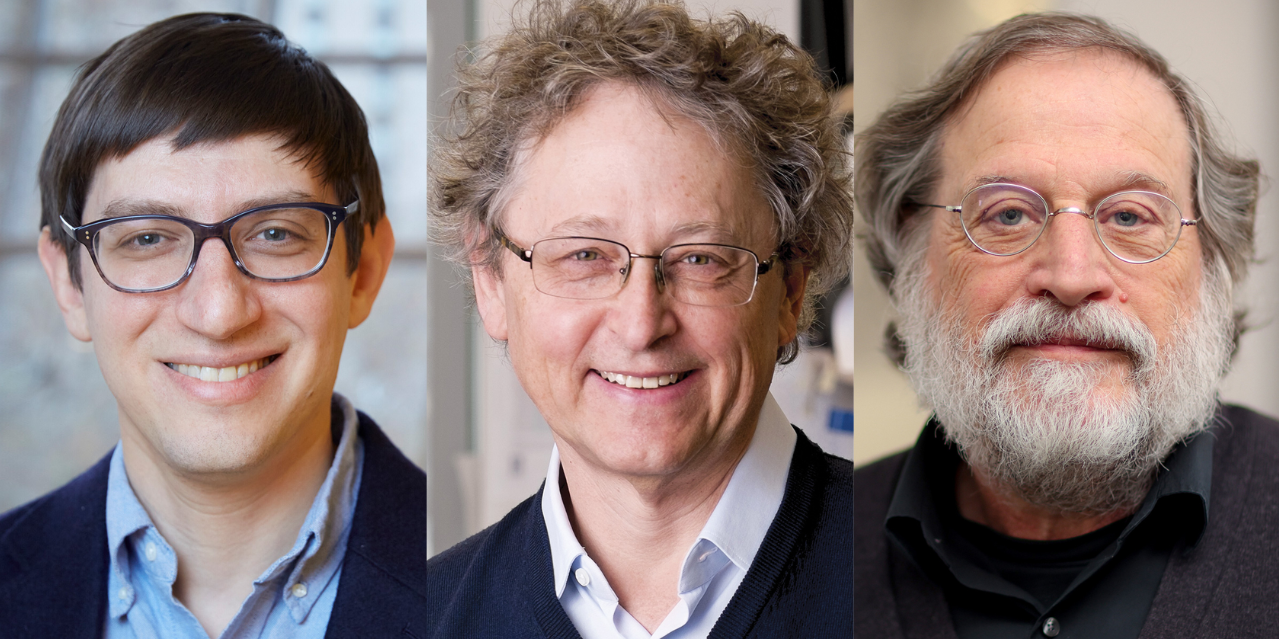
Gregory M. Alushin, Michel C. Nussenzweig, and Jeffrey V. Ravetch
Three Rockefeller researchers have been selected for the newest cohort of 11 scientists in the Immune Cell Reprogramming Program at Biohub New York, a biomedical research organization building the first large-scale initiative to combine frontier AI and frontier biology to solve disease. The cell reprogramming program aims to harness and engineer immune cells for the early detection, prevention, and treatment of a broad range of diseases. It provides three years of unrestricted funding, along with access to advanced tools, training, and a collaborative research community.
Rockefeller's Gregory M. Alushin, Michel C. Nussenzweig, and Jeffrey V. Ravetch join eight researchers from Yale University and Columbia University whose projects reflect Biohub NY's focus on novel therapeutic strategies, disease monitoring, and drug delivery.
Alushin will map how immune cells physically interact with other cells to better understand how they detect and respond to disease. Nussenzweig will engineer immune cells to act as long-term sensors that can deliver treatments in the body. Ravetch will focus on activating immune responses in hard-to-treat tumors, including ovarian and pancreatic cancers.
"We are at an extraordinary inflection point, where the convergence of AI, synthetic biology, and immunology is making it possible to move from observing the immune system to truly engineering it," said Andrea Califano, President of Immune Cell Reprogramming, and Head of Biohub NY. "Each of these investigators brings a distinct and essential perspective to that challenge, and together they will help us build the predictive and programmable tools we need to detect and prevent disease long before it takes hold."
Immune interactions
Alushin will use a powerful imaging method to capture near-molecular snapshots of how immune cells physically connect with other cells in the body, revealing how the machinery of immunity is physically organized. By mapping these contact points in unprecedented detail, his Laboratory of Structural Biophysics and Mechanobiology will aim to understand how immune cells sense and respond to disease.
He hopes to bring his lab's expertise in structural biology into close collaboration with immunologists across institutions, combining structural biology and immune science to tackle questions neither field could solve alone. "This is a new direction for the lab," Alushin says. "I'm a structural biologist. I expect to benefit from interacting with card-carrying immunologists who can teach me about the latest and greatest in their field, and I hope that my lab's perspective and technical specialization will help immunologists answer new questions."
Permanent surveillance
Nussenzweig aims to turn immune cells into long-term disease sentinels that can detect illness and deliver treatment from within the body. His Laboratory of Molecular Immunology will test whether B cells can be engineered to produce therapeutic proteins long-term, for conditions ranging from autoimmune diseases to hemophilia to rare genetic disorders. Nussenzweig hopes to extend this approach to T cells, creating a durable supply of cancer-fighting cells that don't wear out over time and are less likely to be rejected by the immune system. He will also explore ways to edit blood stem cells directly inside the body using injectable gene-editing tools.
Together, the work could lay the foundation for living therapies that continuously monitor health and respond to disease as it emerges. "Our ultimate goal is to investigate and create new innovative detection and treatment modalities for diseases that could benefit from our cell engineering approach," Nussenzweig says. "We have proposed a number of experiments that should encourage clinical translation, greatly increase the chances of creating accessible drugs, and provide means to establish permanent surveillance systems in the body."
Fighting cold tumors
Ravetch intends to activate immune responses in so-called "cold tumors"-cancers such as ovarian and pancreatic that typically evade detection by the immune system. His team will test the CD40-targeting drug developed in his Laboratory of Molecular Genetics and Immunology, both on its own and in combination with other therapies, to determine whether it can reorganize the tumor environment, form local immunity hubs, and reprogram immune cells to attack cancer. By studying how this approach reshapes key players in the immune system, such as such dendritic cells, Ravetch hopes to overcome treatment resistance, prevent tumor formation, and uncover new pathways to treatment.
"We aim to define the immune architecture of immunologically 'cold tumors' and to investigate whether this treatment drives immunity hub formation and reprograms immune cells," Ravetch says. "Our goal is to determine how the drug modulates dendritic cell function and define additional pathways that promote antitumor immunity in these cancers."


