
Gerald Klim, D.O., spent his career rehabilitating some of the most vulnerable patients in UK HealthCare's intensive care units, but he didn't fully understand the impact of his work until he became an ICU patient himself.
"I wish I could have experienced it sooner," Klim said. "It really opened my eyes to what good healthcare is all about."
Klim was admitted with a severe case of pneumonia. The illness was debilitating: his right chest cavity filled with pus, requiring the insertion of two chest tubes and an eventual surgical intervention called video-assisted thorascopic surgery, performed by Clinton T. Morgan, M.D., Ph.D.
"He and his team were fantastic," Klim said.
Klim was so weak he required the assistance of four staff members just to get out of bed. Luckily for Klim, he was being treated with advanced techniques developed by researchers at UK HealthCare's ICU Recovery Clinic - and in the process, providing important data to help refine interventions to improve recovery.
The care team even made sure to incorporate his wife, Paula, knowing that outcomes are better when they can extend into the home.
"The physical therapists and occupational therapists came in and explained to her what I needed to do," Klim said. "It was a team effort, and they included her as part of it."
The inclusion of family caregivers is a cornerstone of the clinic's approach, as social support is one of the three major factors that determine a patient's success after leaving the hospital, the other two being pre-existing lifestyle and health status, and the ICU experience itself.
Klim said this comprehensive effort extended to the pharmacy staff, who ensured Paula understood his medications, and the surgical team's fellows, who provided contact information and walked the couple through post-discharge concerns, such as a fever Klim developed two days after leaving the hospital. Because of the proactive communication, Paula was able to create a healing environment beyond the hospital, monitoring his exercise and blood pressure to ensure his continued progress.
The science of survivorship
Although Klim was mostly focused on his immediate recovery, he also observed the enhancements to patient care that have been made since his retirement.
Researchers like Kirby P. Mayer, D.P.T., Ph.D., are investigating why some patients return to their normal lives after a critical illness while others face lifelong physical, emotional and cognitive impairments. This research is vital as the number of ICU admissions continues to grow. In the United States, approximately 6 million people are admitted to an ICU every year, and in Kentucky, those numbers are in the thousands.
The team at the UK HealthCare ICU Recovery Clinic is, by nature, interdisciplinary, reflecting a university-wide emphasis on multidisciplinary collaboration. It includes physical therapists like Felipe González-Seguel, researchers like Luisa A. Summers, Ph.D., muscle biologists, intensivists, pulmonologists, advanced practice providers like Amy Lynn Salyer, D.N.P., doctoral students, residents and undergraduate researchers. The clinic is led by critical care physicians Anna G. Kalema, M.D., director of the UK HealthCare medicine ICUs, and Ashley A. Montgomery-Yates, M.D., senior vice chair in the UK College of Medicine's Department of Internal Medicine. They are working to identify the biological mechanisms driving disability and how social or environmental factors influence a patient's trajectory.
The work being done at the clinic is currently supported by significant National Institutes of Health grants. Two of these are R01 grants, one from the National Institute of Arthritis and Musculoskeletal and Skin Diseases and one from the National Institute on Aging, focused on the trajectories of recovery, Esther DuPont, Ph.D., serves as the principal investigator on one and Mayer serves as principal investigator on the other. The projects specifically examine skeletal muscle and physical function to understand why some individuals regain their strength and others do not.
Klim's participation in this research was extensive. During his follow-up appointments, he underwent functional testing, deep breathing exercises and a muscle biopsy. He also participated in a study comparing gold standard respiratory equipment - which involves a mask and tubes - to a new, portable ear-mounted oximeter. The goal was to verify if the portable device could provide the same accurate data as traditional equipment, which would make testing significantly easier in standard clinic settings.
"In the past, we were working in the blind," Klim said regarding the importance of these studies. He explained that by identifying biological markers in blood work or muscle tissue, clinicians could develop alerts that a patient is at risk for pneumonia or blood clots before the complications become severe.
Impact on the Commonwealth
The prevalence of chronic disease and an aging population makes this research especially relevant in Kentucky. The team recognizes that recovery is often hampered by a lack of resources in rural areas.
"Some cities and counties still don't have home healthcare therapy," Mayer said. To combat this, the research team often travels to meet patients where they are, rather than requiring them to drive hours to Lexington.
Mayer and González-Seguel, who is a doctoral student, recently traveled to Shelbiana, a community near Pikeville, and the team frequently visits Hazard to maintain contact with study participants. These longitudinal studies follow patients for three to five years to track long-term risks, such as the development of dementia or increased mortality following an ICU stay. This commitment to meeting people where they are is essential for ensuring that the research reflects the diverse population of Kentucky.
Beyond recovery
The expertise and friendliness of the research staff made a lasting impression on Klim. He described the team as professional and appreciated their transparency in explaining the goals of their work.
"The activities they were testing me on were things that really, I was needing to do from a rehabilitation standpoint," he said.
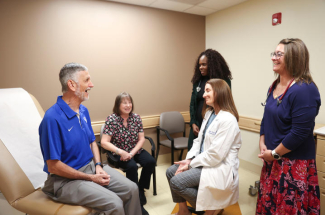
The ultimate goal of the ICU Recovery Clinic is to move beyond just understanding disability to providing interventions that prevent it. By co-designing outcomes with patients and their families, the team ensures they are focusing on what matters most to the survivors - whether that is walking a certain distance or simply being able to stand up independently.
As more patients survive critical illnesses due to advancements in medical technology, the need for specialized survivorship care will only increase. Through the participation of patients like Klim and the dedication of multidisciplinary researchers, the University of Kentucky is setting a new standard for how to care for the state's most vulnerable populations long after they leave the ICU.
Research reported in this publication was supported by the National Institute of Arthritis and Musculoskeletal and Skin Diseases of the National Institutes of Health under Award Numbers R01AR081002 and K23AR079583, the National Institute on Aging of the National Institutes of Health under Award Number R01AG097476, and the National Center for Advancing Translational Sciences of the National Institutes of Health under Award Number UL1TR001998. The content is solely the responsibility of the authors and does not necessarily represent the official views of the National Institutes of Health.


