
"Degradable Living Plastics Programmed by Engineered Microbial Consortia" ACS Applied Polymer Materials
Many plastic products are designed to be used only once, yet the material itself lasts for years. But a new strategy is addressing this problem by creating products that self-destruct on command, known as living plastics. These materials incorporate activatable, plastic-degrading microbes alongside the polymers. One team reporting in ACS Applied Polymer Materials used two bacterial strains that worked together and completely broke down the material within just six days, without making microplastics.
Could we build degradation directly into the material's life cycle?" - Zhuojun Dai
Zhuojun Dai, a corresponding author on the paper, explains that "the realization that traditional plastics persist for centuries, while many applications, like packaging, are short-lived, led us to ask: Could we build degradation directly into the material's life cycle?"
Many microbes can break long polymeric chains into smaller pieces using enzymes. Because plastics are polymers, these enzymes or the microbes that make them could be incorporated into living plastics.
Adapted from ACS Applied Polymer Materials 2026, DOI: 10.1021/acsapm.5c04611
"By embedding these microbes, plastics could effectively 'come alive' and self-destruct on command, turning durability from a problem into a programmable feature," explains Dai.
While previous attempts relied primarily on a single enzyme, Dai, Jin Geng, Dianpeng Qi and colleagues wanted to improve the destruction efficiency. So, they engineered Bacillus subtilis to produce two cooperative, polymer-degrading enzymes. One enzyme acts as a random chopper, snipping the long polymer chains into smaller pieces, while the other slowly chews these pieces into their monomer building units from each end.
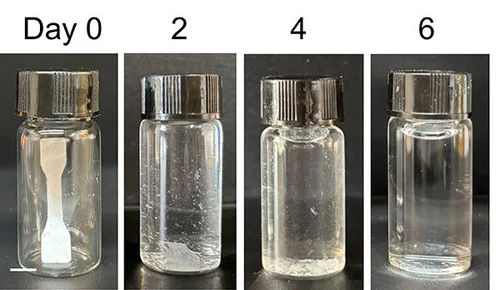
The team mixed the dormant spore form of B. subtilis with polycaprolactone (a polymer common in 3D printing and some surgical sutures) to protect the microbes before they were needed. The resulting living plastic had mechanical properties similar to those of plain polycaprolactone films. However, once a nutrient broth at 122 degrees Fahrenheit (50 degrees Celsius) was added, the spores activated, breaking the plastic all the way down to its base building blocks after just six days. The cooperation between the enzymes was so efficient, it even prevented microplastic particles from being created during the degradation process.
Adapted from ACS Applied Polymer Materials 2026, DOI: 10.1021/acsapm.5c04611
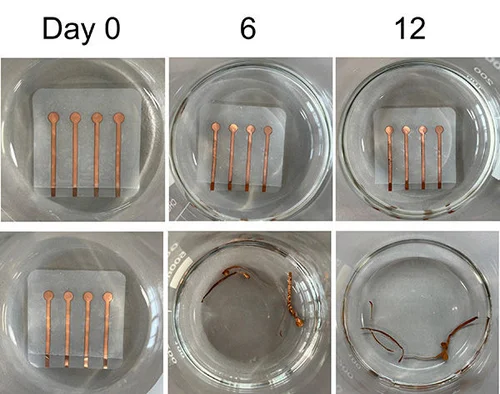
As a proof-of-concept, the researchers created a wearable plastic electrode out of their living plastic and found it performed as expected, degrading completely within two weeks.
In future work, the researchers hope to develop a trigger for the spores in water, where a large portion of plastic pollution ends up. And though this work focused on just one polymer, a similar strategy could be used in other plastic types, including those commonly found in single-use plastics.
The authors acknowledge funding from the National Key Research and Development Program of China, the Shenzhen Medical Research Fund, the National Natural Science Foundation of China, the Guangdong Natural Science Funds for Distinguished Young Scholars, and the Shenzhen Science and Technology Program.


