When veterans walk through the doors of USF Health's Hyperbaric Oxygen Therapy (HBOT) Center, they often carry wounds that are not visible.
They may be experiencing sleepless nights, sudden anger, persistent headaches or another lingering effect of traumatic brain injury and post-traumatic stress.
Healing those invisible wounds is at the heart of one of the most comprehensive studies ever conducted on hyperbaric oxygen therapy for veterans with traumatic brain injury.
Funded by a $28 million investment from the state of Florida, USF Health is partnering with some of the top experts from the James A. Haley Veterans' Hospital. The study aims to determine whether the treatment can improve the lives of veterans living with the often-invisible consequences of traumatic brain injury.
Since launching in 2024, the study has enrolled more than 300 veterans, with 192 randomized to begin treatment. Half of the participants will receive pure oxygen in a pressurized environment at twice the normal air pressure with the other half receiving regular air in the same chamber. At the end of treatment, those who did not receive actual HBOT will be given the opportunity to receive a full course at no cost.
The high concentration of oxygen dissolves into the bloodstream, reaching damaged tissues with the goal of promoting brain healing and reducing inflammation.
While the hyperbaric oxygen therapy has been used to treat other health issues, such as carbon monoxide poisoning, this study aims to determine if it can help reduce the long-term effects of traumatic brain injury.
According to Dr. Harry van Loveren, director and Genshaft and Greenbaum endowed chair of the USF Health Morsani College of Medicine Department of Neurosurgery, Brain and Spine, traumatic brain injury and post-traumatic stress rarely affect just one part of a veteran's life. Symptoms often overlap, influencing sleep, emotional regulation, relationships and overall well-being.
"PTSD is their worst, but most invisible injury. Their life is ruined by something that's invisible. People can't see it. People don't understand it. They lose their wife, their children, their family, their job," he said.
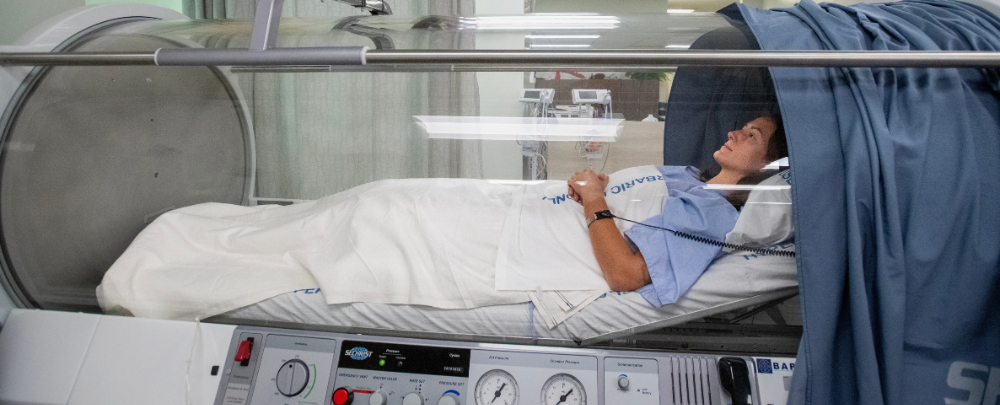
HBOT study participants go through a 40-treatment cycle in which their blood, oxygen and other physiological signs are closely monitored. Participants who received the placebo will be offered the option to be treated with hyperbaric oxygen at the end of their study cycle. (Photo by Ryan Rossy)
While the main HBOT trial is designed to determine whether hyperbaric oxygen therapy improves symptoms associated with traumatic brain injury and post-traumatic stress, researchers are also trying to understand why those improvements occur.
"The goal is not only to determine whether hyperbaric oxygen therapy works, but to understand what changes are occurring when patients improve," van Loveren said.
To better understand those changes, researchers have launched several substudies examining sleep, hearing, balance, brain activity and other biological markers.
Why sleep matters
For many veterans, sleep problems are more than an inconvenience. They affect mood, memory, concentration and overall quality of life.
Shannon Miles, associate professor in the Department of Neurosurgery, Brain and Spine, and Kelli Kessack, director, co-lead the sleep substudy and are monitoring participants' sleep patterns throughout the trial.
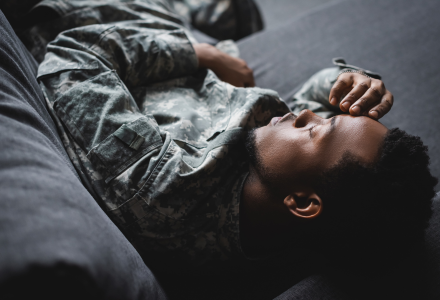
"Sleep impacts everything," Kessack said. "Your mental well-being, your physical well-being, patience tolerance, recovery, the ability to handle future stress. If you can improve sleep, you can improve a multitude of different types of symptoms."
Using wearable technology, they are collecting data beyond what participants can report themselves, tracking sleep duration, quality and other patterns. The information may help explain not only whether hyperbaric oxygen therapy improves symptoms, but how recovery occurs throughout the trial.
"We know if you're not sleeping, it's very hard to regulate your emotions," Miles said. "Sleep is a strong predictor of outcomes after traumatic brain injury and post-traumatic stress disorder in pretty much almost all domains."
Because sleep may influence nearly every aspect of a veteran's health, it is one of many other hidden challenges researchers are examining in the HBOT study.
How hearing and balance impact social connections
Victoria Sanchez, associate professor in the Department of Otolaryngology Head & Neck Surgery, is leading a substudy examining hearing and balance issues among veterans participating in the HBOT trial.
She and her team are evaluating participants' hearing and balance function to better understand how traumatic brain injury affects communication and mobility, and whether improvements in those areas may accompany recovery. Participants complete speech-in-noise testing, answer questions about how hearing and balance affect their daily lives and undergo balance assessments that objectively measure stability and movement.
According to Sanchez, more than 75% of participants indicated hearing difficulties and most participants indicated mild or moderate dizziness and imbalance. Nearly 40% of participants have a clinically measured speech-in-noise impairment, suggesting listening difficulties may be more common than veterans realize and may influence how they engage in the world. She adds that many veterans in the study may hear perfectly in a quiet room but struggle to follow a conversation in a restaurant, workplace or family gathering.
"Many veterans don't realize communication and mobility issues may be connected to their traumatic brain injury," Sanchez said.
"When communication becomes difficult, people often begin avoiding situations where they have to work harder to understand what others are saying."
Over time, those communication challenges may lead to more social isolation, according to Sanchez.
"Something as simple as better hearing and balance might help individuals to be more engaged with everything else that is meaningful for them," Sanchez said. "Better hearing and balance support social, physical, emotional and cognitive engagement."
By quantifying those often-overlooked communication and mobility challenges, Sanchez and her team hope to better understand another piece of the recovery process.
The body's second brain: The gut
While hearing and balance challenges can affect veterans' ability to stay connected, researchers are also looking at biological changes that may be occurring elsewhere in the body.
Another, less obvious factor influencing veterans' health is the ongoing communication between the digestive system and the brain.
"PTSD has always been treated as something that happens in the head. What we're seeing is that the gut may be an active participant, not just a bystander," said Hariom Yadav, professor in the Department of Neurosurgery, Brain and Spine and director of the USF Center for Microbiome Research.
He and his team are examining whether changes in the gut microbiome, inflammation and intestinal health may contribute to symptoms such as poor sleep, cognitive difficulties and emotional regulation, and whether those factors improve alongside recovery.
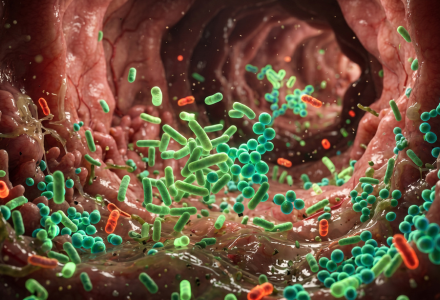
"The gut and the brain are in constant two-way conversation, through the vagus nerve, the immune system and chemical messengers that gut bacteria produce. We call this the gut-brain axis," Yadav said. "Trauma doesn't just change the brain, it can change gut physiology too, through stress hormones and inflammation. So, we started asking the reverse question: Could gut changes be feeding back into the symptoms we see in PTSD, not just resulting from it?"
His substudy could help reshape how researchers think about PTSD, treating it as a whole-body condition rather than one confined solely to the brain.
To investigate those connections, Yadav's team is analyzing participants' gut microbiomes and biological markers of inflammation throughout the study, looking for patterns that may be linked to PTSD symptoms and treatment response. Early findings suggest veterans with PTSD have lower levels of bacteria known to help regulate inflammation, alongside signs of a less robust intestinal barrier.
"What stood out wasn't one dramatic finding, it was a pattern," Yadav said. "Veterans with PTSD consistently showed lower levels of bacteria known for calming inflammation, alongside signs their gut barrier wasn't holding as tight a seal as it should."
Finding a new mission through research
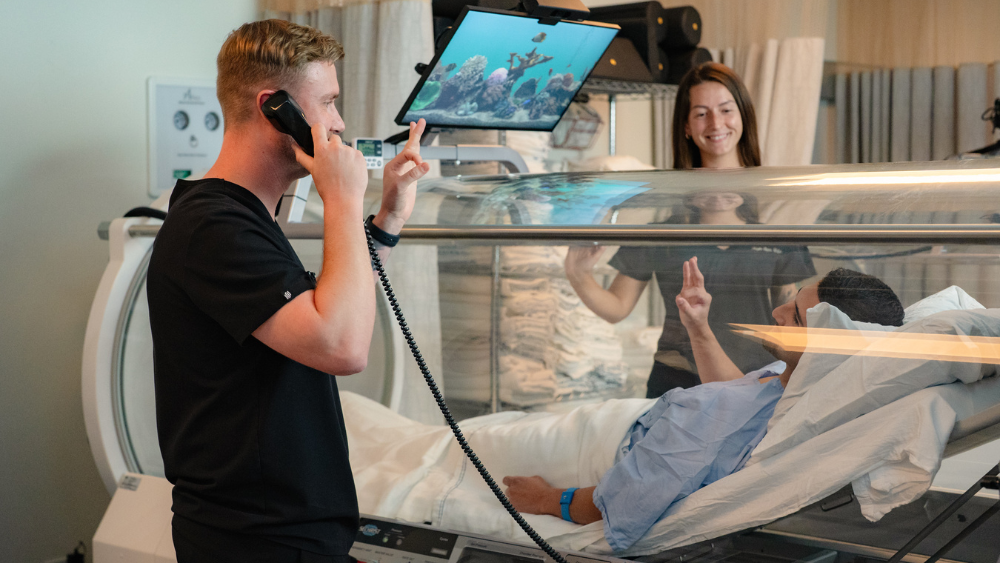
The HBOT study is recognized nationally as one of the most rigorous studies of its kind that could position hyperbaric oxygen therapy as a treatment of neurological diseases. (Photo by Ryan Rossy)
According to van Loveren, the substudies give researchers a way to identify the biological and behavioral changes occurring during recovery, from sleep and hearing to inflammation, brain connectivity and blood biomarkers.
"The goal is not only to determine whether hyperbaric oxygen therapy works, but to understand what changes are occurring when patients improve," van Loveren said.
Beyond the data, the study's ability to bring veterans together on a mission to find new treatments is something that has stood out to van Loveren, who said participants often volunteer for the study knowing they may not receive the active treatment as a way to give back.
"The participants are happy to meet with other veterans coming for their treatments," van Loveren said. "For many, this study is a second chance to serve."
For veterans Erik Velasquez and Justin Helm, the mission of the study is deeply personal. Both work on the study helping fellow veterans navigate a journey they understand firsthand.
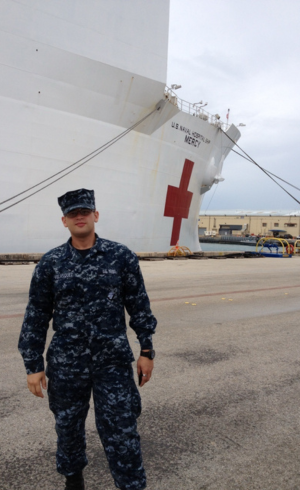
Veteran Erik Velasquez during his time in the Navy. (Photo courtesy of Erik Velasquez)
After seven years in the Navy as a hospital corpsman, Velasquez struggled with the transition to civilian life and felt like he had lost a part of himself when he returned home.
"My identity was my service. My identity was my rank -HM2. It wasn't Erik," Velasquez said.
After serving six years in the U.S. Air Force as a linguist and intelligence specialist, Helm understands the unique bond that exists between service members.
"Veterans speak the same language," he said. "There's an understanding that's hard to explain to someone who hasn't experienced it. Participants step back into that camaraderie. A lot feel like they've lost all their companions and all the people who can connect with them and who understand them."
That shared experience often helps study participants feel comfortable opening up about symptoms that can be difficult to discuss, including challenges with sleep, memory, concentration and relationships.
For Velasquez, the impact of that service is often visible in the veterans he meets along the way.
"The participants that stick out to me are the veterans who tell me they're becoming the person their spouses married again," he said. "They're starting to see who they used to be again."
The study aims to enroll 420 veterans. Additional details about eligibility, participation and enrollment are available on the HBOT trial page.