
It's human nature to look at the night sky and feel full of wonder, but University of Oregon physicist Tien-Tien Yu takes that to the next level.
When Yu gazes up at stars and galaxies, she's thinking about one of the greatest unsolved mysteries of the universe: dark matter.
Dark matter is a mysterious material that has eluded scientists for over a century. Certain observations suggest that visible matter - like trees, stars and the house next door - makes up only about 15 percent of the matter in the universe, while dark matter is the remaining 85 percent. But despite making up most of the universe - not counting energy - its true identity remains unknown.
Fascinated by the unexplored corners of the universe since childhood, Yu has made dark matter the pillar of her research career. In her quest to understand, she's co-founded a major experiment in collaboration with physicists at other institutions, all of whom are trying try to bring light to the dark.
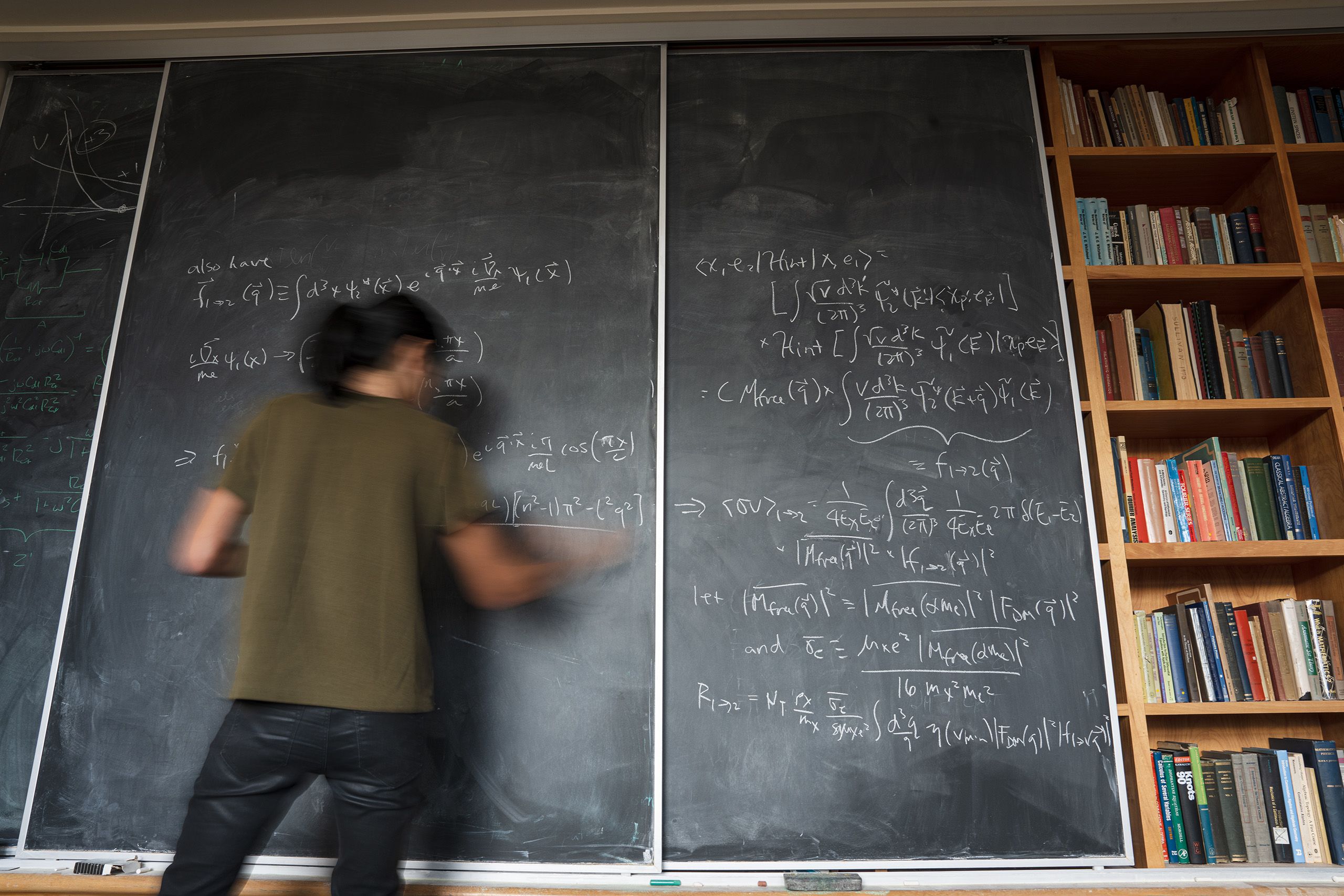
"One reason why I find dark matter so exciting is because if you didn't have dark matter, you wouldn't be able to form stars or galaxy clusters - where stars are born - and since we come from stardust, dark matter is fundamental to our existence," Yu said. "So if you want to think about big, existential questions - like why are we here? What are we doing here? What is our role in the universe? - dark matter plays a really important part."
Mysterious matter
Part of what makes dark matter so complicated is that it doesn't absorb, reflect or emit any light, so it's impossible to see, Yu said.
While it may be invisible, scientists have been able to determine that it has some kind of gravitational influence on the formation of stars and galaxies, like the glue holding the universe together. Physicists can map out the mass of galaxies along with the gases between galaxies, and it's clear that something is unaccounted for because the mass isn't high enough to explain the motions they are measuring.
"Things don't match up, so we know that there's more matter than what we're seeing," Yu explained. "All of the evidence we have for dark matter is through these gravitational effects."
"One reason why I find dark matter so exciting is because if you didn't have dark matter, you wouldn't be able to form stars or galaxy clusters ... and since we come from stardust, dark matter is fundamental to our existence,"
Tien-Tien Yu
UO physics professor
As a particle physicist, Yu is trying to unlock new information about dark matter through the lens of particles. She said everything in the universe is composed of particles, like protons and electrons, but dark matter likely falls outside of the known collection of particles.
Yu is approaching the problem like a detective. She formulates hypotheses about dark matter based on piecing together clues about its properties and then tests her theories through experiments, usually in collaboration with experimental physicists. She's undeterred by the uncertainty of dark matter and the inevitable dead ends she encounters in research, thanks to a deep-seated tenacity and persistence she's developed through years of long-distance running.
She points to what's known as the standard model of particle physics as a helpful baseline, because it provides the mathematical language for how particles interact with other particles through forces. It describes all the known fundamental particles and their interactions, but it doesn't explain dark matter.
The working theory is that dark matter is a new particle that should also interact with known particles through forces, but those forces haven't been detected or defined. So physicists like Yu are formulating different theories about what those interactions could be to see if they can uncover more information about dark matter.
"Our goal is to have working hypotheses about how dark matter interacts with things that we can measure," she explained. "Once you have that, the world is your oyster, and you can keep formulating new ideas about how to look for measurable interactions."
To test some promising and under-explored theories, Yu co-founded an experiment called SENSEI with a group of theoretical and experimental physicists. The experiment adopts a novel approach in dark matter. It uses highly sensitive detectors similar to those found in digital cameras to look for dark matter candidates and interactions.
"It's like taking a picture of dark matter that lets us examine its interactions with electrons," Yu said.
The approach allows Yu and her collaborators to explore a compelling class of candidates for dark matter, one in which dark matter is some kind of particle that is lighter than a proton.
It's been challenging to study because such a particle could be so light that its interactions with heavier particles during experiments, like the nucleus of an atom, are not detectable, she said. Yu likens some simulations to trying to move a bowling ball with a ping-pong ball.
Her current work through the collaboration aims to get dark matter to interact with other ping-pong-ball-like particles, such as the electrons that surround the nucleus of an atom. Because Yu and her colleagues understand the properties of electrons, they can work backwards to piece together information about what must be true about dark matter based on the observations they're making.
And if a theory doesn't offer new insights into dark matter, Yu tries again.
"You have to be really creative as a theorist," she said. "Like if something doesn't work out, you want to find another way into the problem and you have to think outside the box."
Uncharted territory
It might not be surprising that Yu is drawn to one of the greatest mysteries of the universe, given her earliest interests in science.
When Yu was young she wanted to be a marine biologist because she was fascinated by the ocean, especially the deep sea, which accounts for about 70 percent of the Earth's surface yet remains largely unexplored.
"I loved thinking about how there was this world that was so close to us but also very foreign," she said. "The deep sea seemed fascinating because it's a really cool but totally strange place that we know very little about because it's hard to access, even though it's right there."
"Our goal is to have working hypotheses about how dark matter interacts with things that we can measure. Once you have that, the world is your oyster."
Tien-Tien Yu
When Yu got into physics she was drawn to the cosmos for similar reasons, but she didn't love the day-to-day research of astrophysics. A more intriguing path presented itself when the Large Hadron Collider, the world's largest particle accelerator, was turned on right as she started graduate school at the University of Wisconsin-Madison. She saw an opportunity to expand her research into particle physics.
She later completed a postdoctoral fellowship with the theoretical physics group at the European Council for Nuclear Research, also known as CERN, in Geneva, Switzerland, where the Large Hadron Collider is housed. The collider allows scientists to perform high-energy collisions that shed light on particles and the laws of physics.
One thing you can do with particle colliders? Look for dark matter.
"It just snowballed from there," Yu said.
Yu has been recognized for her achievements in the field and for pioneering a new approach to dark matter through SENSEI. She's earned a CAREER award through the National Science Foundation - a major grant for early-career researchers - and been awarded the New Horizons Prize in Physics.
She was also selected to serve on the Particle Physics Prioritization Panel, a scientific advisory panel that created a roadmap for the future of particle physics in the United States. In 2025, she was awarded a Presidential Early Career Award for Scientists and Engineers, a prestigious award from the U.S. government given to outstanding scientists and engineers beginning their careers.
And yet she knows no matter how much she accomplishes in her hunt for answers, she's working on an area of research that might not get resolved in her lifetime. But her background as a long-distance runner helps her stay committed to an area of research that has no finish line.
Yu has completed more than 10 marathons and ultramarathons and can often be found running around the roads, paths and trails of Eugene.
"As a runner, you're very persistent and feel compelled to keep working towards your goal," she said. "On some research days momentum keeps me going, and on others it's that I can't stop looking for answers."
Yu believes that one of the most important aspects of her work is sharing it with others, especially since dark matter research is such an endurance event. She's committed to training the next generation of physicists so they're equipped to build on the existing body of work. And she spearheaded an ongoing collaboration between STEM researchers and the UO's Comics and Cartoon Studies Program to share science with the public through comics.
"It's important to make research and physics more accessible because this work doesn't belong to me," she said. "This knowledge is something that should be available because we all live on this earth, and in this universe, and everyone should have the chance to understand how our universe works."


