
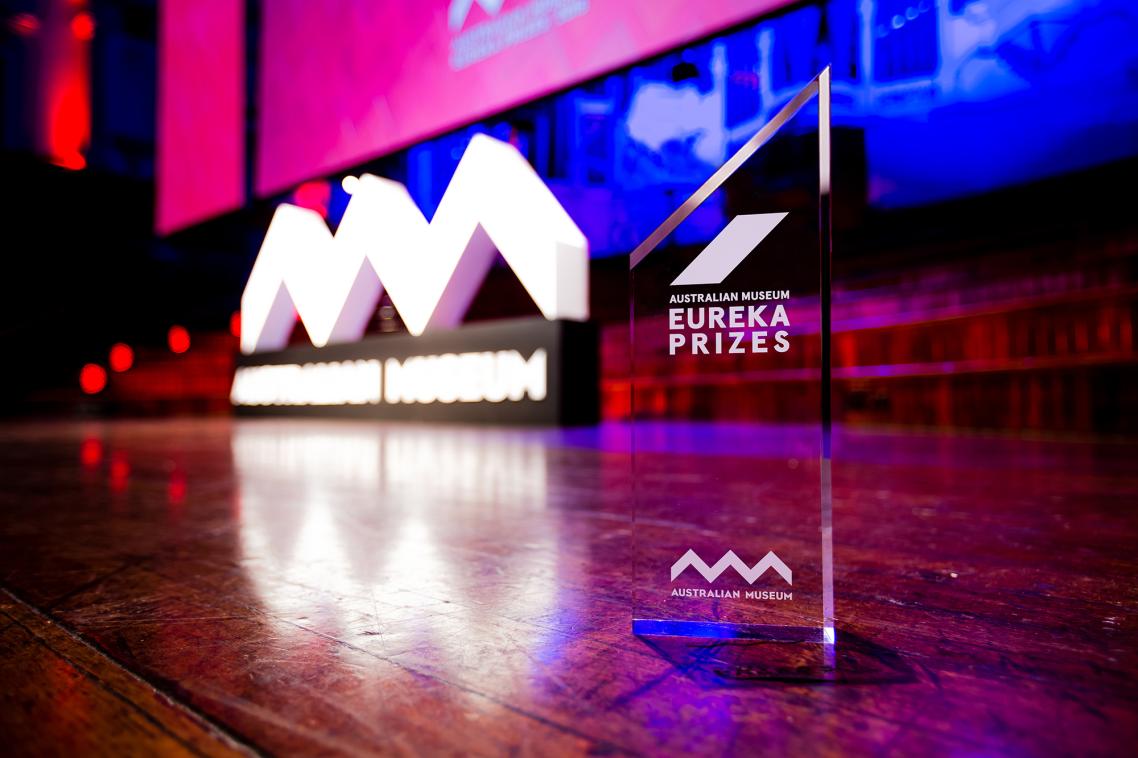
(Photo credit: Australian Museum. )
A program which empowers adolescents to avoid vaping has won the 2026 UNSW Eureka Prize for Societal Impact in Science.
University of Queensland researchers collaborated on the OurFutures Vaping Program, which has reached more than 300,000 students, providing practical health and wellbeing education nationwide.
The annual Australian Museum Eureka Prizes celebrate excellence in research and innovation, leadership, science engagement and school science.
The 2026 winners were announced at an awards ceremony on 3 September.
Explore the work of the UQ researchers recognised at this year's awards below:
Reducing vaping by school students

Professor Leanne Hides from UQ's National Centre for Youth Substance Use Research.
(Photo credit: The University of Queensland.)
Professor Leanne Hides from UQ's National Centre for Youth Substance Use Research led the Queensland arm of the OurFutures Vaping Program, winner of the UNSW Eureka Prize for Societal Impact in Science.
The program is a collaboration with The Matilda Centre for Research in Mental Health and Substance Use, University of Sydney, Curtin University, Monash University, UNSW and the University of Newcastle.
"It is fantastic to see clinical research on substance use being recognised in this way," Professor Hides said.
OurFutures empowers adolescents to avoid vaping through engaging digital lessons co-designed with students and teachers.
The program was evaluated in 40 schools across Queensland, New South Wales and Western Australia.
"OurFutures reduced the odds of vaping by 65 per cent after one year, making it the first evidence-based vaping prevention for adolescents," Professor Hides said.
"We look forward to supporting the implementation of OurFutures in Queensland schools."
A global resource for microbial taxonomy

The UQ Genome Taxonomy Database team (L-R) Aaron Mussig, Pierre-Alain Chaumeil, Maria (Masha) Chuvochina, Chris Rinke, Phil Hugenholtz, Donovan Parks.
(Photo credit: The University of Queensland.)
The Genome Taxonomy Database was a finalist in the Australian Research Data Commons Eureka Prize for Excellence in Data Platforms.
The database was created in 2017 to standardise the classification of bacteria and archaea.
Professor Phil Hugenholtz , Australian Centre for Ecogenomics Director, said the database was a response to frustrations that classifications were not consistent according to evolutionary relationships.
"This led to poor scientific communication and confusion, exacerbated by the widespread recovery of microbial genomes directly from environmental samples," Professor Hugenholtz said.
"With funding from an Australian Research Council Laureate I was able to recruit a talented team to develop a global solution.
"This work matters, because better classification means better biological signals.
"We are now in the process of extending the database to include fungi, which currently lacks a genome-based taxonomy."
With 1,000 new microbial species sequenced and more than 10,000 queries each month, the Genome Taxonomy Database has become a leading global resource for microbial taxonomy.
Pin-pointing gene mutations linked to disease

Dr Michael Healy.
(Photo credit: The University of Queensland.)
Dr Michael Healy , a structural biologist from the Institute for Molecular Bioscience , was a finalist in the Macquarie University Eureka Prize for Outstanding Early Career Researcher category.
Dr Healy uses electron microscopy, crystallography and AI modelling to reveal how proteins move inside cells.
"Every cell runs a logistics network of extraordinary precision - thousands of proteins delivered to the right place at the right moment by machines only nanometres across," Dr Healy said.
"When a structure finally resolves and you're looking at the extraordinary, intricate machinery inside a cell - something no one has seen before - it is amazing."
Dr Healy defined the structure of Commander, a 16-part protein complex that directs cellular traffic, pinpointing disease-linked mutations.
"Now that we have resolved these protein complexes we want to use new computational techniques to design proteins to manipulate these systems," he said.
"The revolution in protein design lets us specify a protein that has never existed and have it fold as intended.
"The gap between 'we understand this' and 'we can make this' has never been narrower."


