
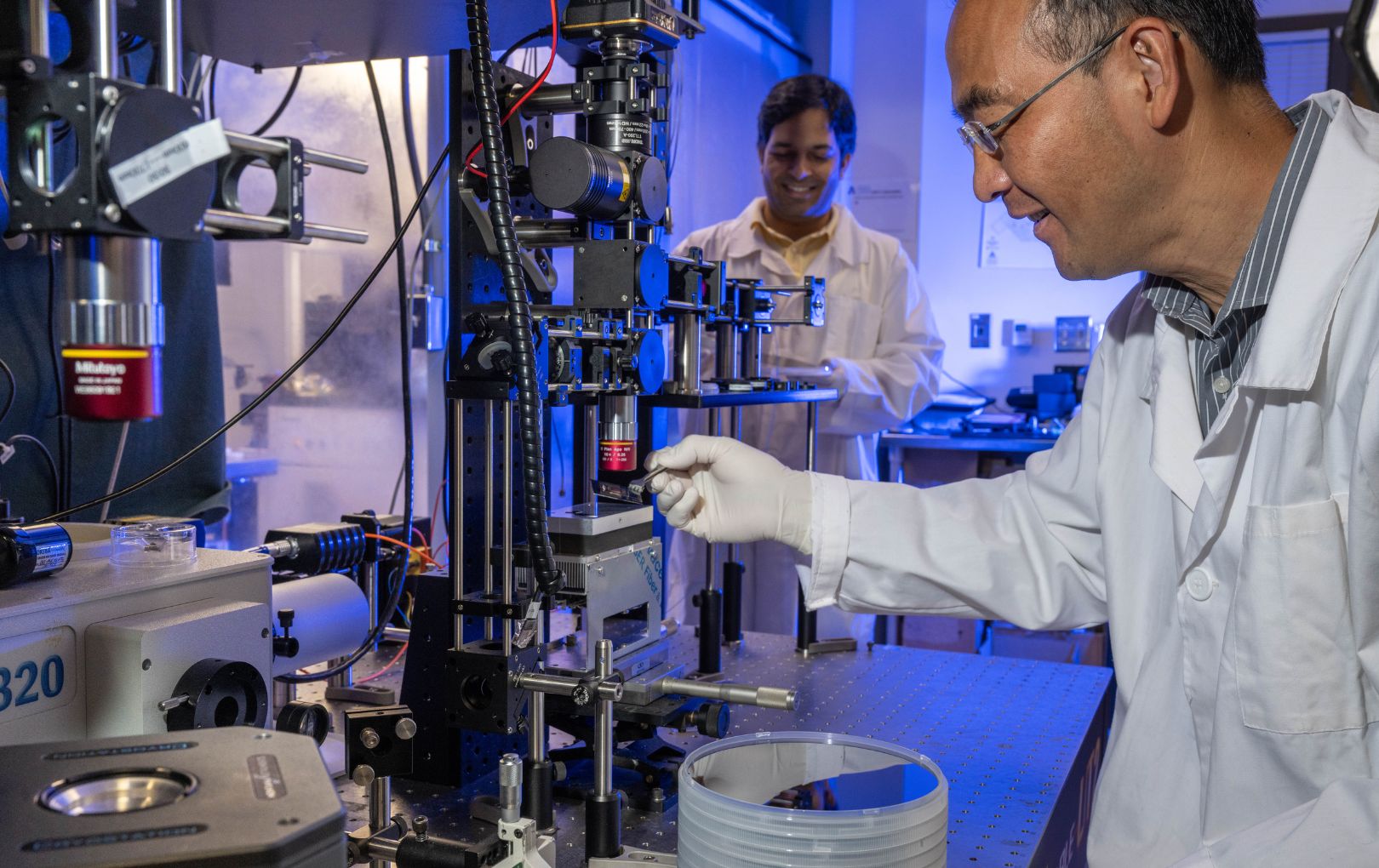
Ten interdisciplinary research teams at The University of Texas at Arlington has received nearly $200,000 in grants designed to bring together researchers from fields that do not typically collaborate. Awarded through the Office of the Vice President for Research and Innovation's Interdisciplinary Research Program (IRP), this year's funding represents a 42% increase over the grants awarded in 2025.
"UT Arlington continues to expand our support for interdisciplinary research, recognizing that many of society's most complex challenges demand creative, collaborative solutions," said Kate Miller, vice president for research and innovation. "These investments empower researchers to pursue transformative discoveries that improve lives, strengthen communities, and reinforce UTA's position as a leader in interdisciplinary innovation."
The 2026 recipients of the IRP grants include:
- Team: Yan Wan, distinguished professor of electrical engineering; Kelsey Hanson, assistant professor of anthropology; Ahmet Taha Koru, assistant research professor, electrical engineering
- Project: A Multi-Drone Swarm-Intelligence Approach for Non-Destructive Cultural Heritage Documentation: An Interdisciplinary Research Initiative
- The Gist: Archaeological sites in caves, cliffs, and other complex environments preserve some of the best records of past societies, but many remain poorly documented because current survey methods are time-consuming, difficult to deploy, and can put both researchers and fragile sites at risk. The IRP project aims to leverage advanced drone swarm intelligence to transform time-intensive archaeological surveys and autonomously generate 3D virtual models of complex, hard-to-access environments. This project will improve archaeological documentation by reducing survey time, cost, and risk while supporting digital preservation and better protection of vulnerable cultural heritage sites.
- Team: Diego Patiño, assistant professor of computer science and engineering; and Yunyao Li, assistant professor of earth and environmental sciences
- Project: Improving the Spatial Resolution of Satellite-based Air Pollutants with Physics-Informed AI Models
- The Gist: Satellites that monitor air pollution measure only the total atmospheric column rather than near-surface concentrations. Hence, observations of variables such as particulate matter (PM2.5) are subject to large biases and lack the resolution detail that health studies depend on. This project aims to produce high-resolution pollution maps from NASA satellite observations and Environmental Protection Agency data by integrating AI-based super-resolution models with the dynamic equations governing atmospheric transport. The goal is to make environmental health information more accurate and more usable for public health research, air quality forecasting, and environmental policy.
- Team: Weidong Zhou, professor electrical engineering; Muhammad Huda, professor of physics; Di Zhang, assistant professor of materials science and engineering; Sally Jia, assistant professor of mechanical and aerospace engineering; Yogesh Fulpagare, assistant professor of mechanical and aerospace engineering; and Dereje Agonafer, presidential distinguished professor of mechanical and aerospace engineering
- Project: Hybrid Semiconductor Junctions for 3D Heterogeneous Integration
- The Gist: Heterojunctions are fundamental building blocks for high-performance semiconductor electronics and optoelectronics. Currently, heterojunctions are limited to materials with similar lattice constants, due to the epitaxial synthesis constrain. We investigate here the fundamental physical properties of the bonded junctions for three-dimensional heterogeneous integration (3DHI), as the basic building blocks for silicon photonics, optoelectronics and co-packaged optics.
- Team: Kathleen Preble, associate professor of social work; Maryam Rafieifar, assistant professor of social work; and Masoud (Max) Rostami, assistant professor of instruction
- Project: Critically Evaluating Machine Learning Models Trained on Federally Prosecuted Human Trafficking Cases
- The Gist: This interdisciplinary pilot project examines what machine learning can responsibly learn from prosecution-based human trafficking data and where institutional blind spots may shape model findings. Using federal trafficking prosecution records maintained by the Human Trafficking Institute, the research team will address two key questions: (1) What patterns do machine learning models identify when trained on federally prosecuted human trafficking cases? and (2) What do those patterns reveal about the structure, limitations and potential biases of prosecution-based trafficking data? The findings will help inform the responsible use of AI in trafficking research and practice.
- Team: Crystal Cooper, assistant professor of psychology; Inderjeet Singh, research scientist II, UTARI; Christos Papadelis, professor of research, biengineering; and Sadra Shahdadian, postdoctoral research associate, bioengineering
- Project: Mapping Somatosensory Neuroplasticity in Adolescents with Hemiplegic Cerebral Palsy using a Soft Robotic Glove and Functional MRI
- The Gist: Adolescents with hemiplegic cerebral palsy often experience impaired hand function and altered brain processing of touch, but researchers lack effective tools for understanding how the brain's sensory networks respond and adapt during rehabilitation. This project will use a novel soft robotic glove together with functional MRI to deliver controlled touch stimulation and map brain activity, enabling researchers to identify how sensory networks function and reorganize in adolescents with cerebral palsy compared with their typically developing peers. The findings will provide critical insights into neuroplasticity and lay the foundation for personalized, brain imaging-guided rehabilitation technologies that could improve hand function and quality of life for individuals with cerebral palsy and other neurological conditions.
- Team: Wei Jiang, assistant professor of mathematics; Jin Liu, associate professor of education; Yutong Chen, assistant professor of economics; Jiandong Wang, lecturer, computer science and engineering
- Project: Reliable and Valid Social Data Science: A Trustworthy Framework for Robust Measurement and Analysis
- The Gist: This project addresses a common problem in social science research: social science researchers often rely on complex real-world data that can be noisy, incomplete and difficult to analyze reliably, which can weaken confidence in the findings that inform education, policy and public decision-making. Our project will create a practical interdisciplinary framework that combines statistics, artificial intelligence, education, economics and computing to help researchers diagnose data quality problems, compare analysis methods and select more trustworthy approaches. By producing open-source tools and clear evidence-based guidance, this work will strengthen the credibility and reproducibility of social data science at UTA and beyond, while laying the groundwork for larger external funding.
- Team: Justyn Jaworski, associate professor of bioengineering; Salman Sohrabi, assistant professor of bioengineering; and Alison Ravenscraft, assistant professor of biology
- Project: An Automated Process for Generating Novel Endosymbiotic Microbial Systems
- The Gist: As opposed to gradual evolutionary changes, large gains in function are found when microorganisms combine forces through symbiosis. Our solution is to create an automated process for generating new endosymbiotic microbial pairs. This will provide a first step toward a tool for directed symbiogenesis through which new novel and emergent biological functions may be screened and selected.
- Team: Bei Shi, associate professor of electrical engineering; Sally Jia, assistant professor of mechanical and aerospace engineering; and Joseph Ngai, professor of physics
- Project: Thermal Management of High-Performance Quantum Dot Lasers on Engineered Substrates for Hyperscale AI Data Centers
- The Gist: Hyperscale AI data centers place an increasing demand on dense optical interconnects, yet localized heating in compact photonic chips can limit the performance and reliability of on-chip laser sources. Our team will develop thermally robust quantum-dot lasers on engineered substrates by combining photonic device fabrication, thermal modeling, and advanced oxide-interface engineering. The anticipated impact is to open up a new pathway toward more reliable, energy-efficient optical links for next-generation AI hardware and co-packaged optics.
About The University of Texas at Arlington (UTA)
The University of Texas at Arlington is a growing public research university in the heart of Dallas-Fort Worth. With a student body of over 42,700, UTA is the second-largest institution in the University of Texas System, offering more than 190 undergraduate and graduate degree programs. Recognized as a Carnegie R-1 university, UTA stands among the nation's top 5% of institutions for research activity. UTA and its 300,000 alumni generate an annual economic impact of $28.8 billion for the state. The University has received the Innovation and Economic Prosperity designation from the Association of Public and Land Grant Universities and has earned recognition for its focus on student access and success, considered key drivers to economic growth and social progress for North Texas and beyond.


