
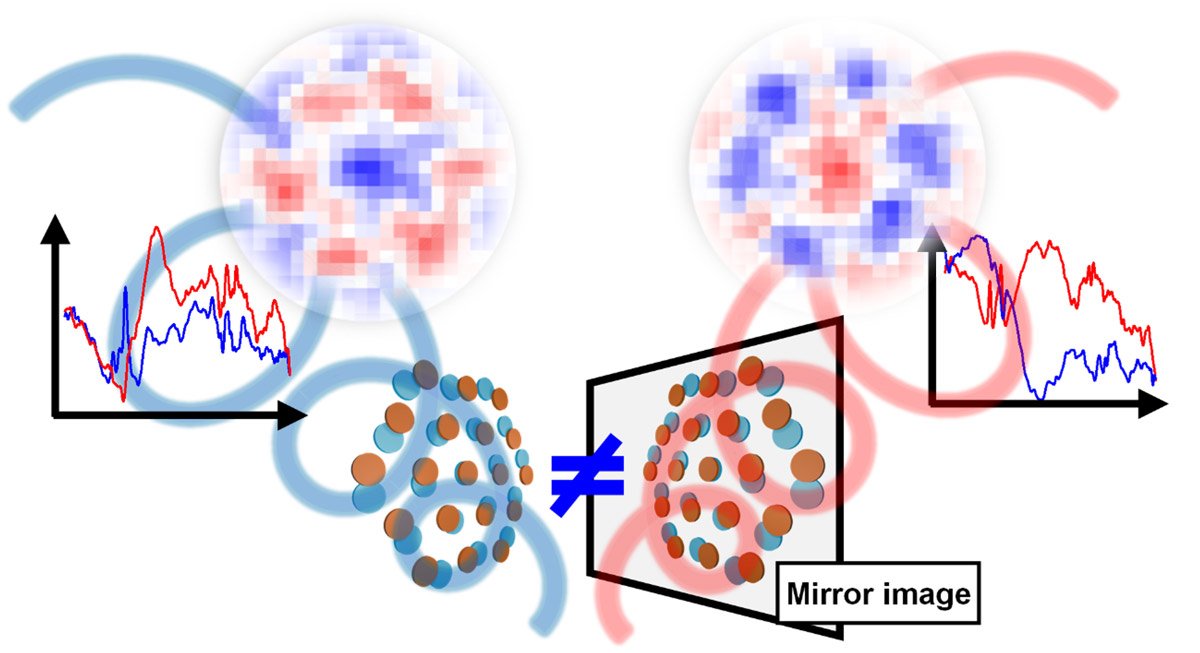
Chiral objects can behave differently depending on their handedness. However, existing methods cannot reveal how chirality varies across a material. A research team from Chiba University and Tohoku University developed a terahertz imaging technique that maps right- and left-handed chirality using spiral-shaped light. The researchers visualized different chiral regions on a moiré-type metasurface with a resolution of about 100 μm, marking the first direct observation of spatial chirality distributions within a material.
In nature, there exist structures that are mirror images of each other but cannot be perfectly superimposed. These are known as chiral objects, derived from the Greek word for "hand," since left and right hands share the same relationship. Although similar in structure, chiral molecules exhibit different behaviors, and chirality is central to life itself. DNA has a twisted chiral structure, and living organisms prefer one handedness over the other. This distinction is equally important in drug design, materials science, and nanotechnology.
One way to distinguish chiral molecules is by measuring their response to circularly polarized light in the terahertz (THz) region. THz waves lie between microwaves and infrared light and are especially sensitive to subtle collective motions and twisting structures in materials. However, conventional THz measurements average the signal across an entire sample, making it impossible to determine how chirality varies across different locations.
Now, researchers in Japan from Chiba University and Tohoku University have shown that this limitation can be overcome, allowing chirality to be visualized as two-dimensional images, much like creating a map of chirality across a material.
The study was published in the journal ACS Photonics on June 2, 2026.
"This work was inspired by a simple question. Conventional measurements only reveal averaged chirality, but what does the actual spatial distribution look like? We wondered whether directly visualizing chirality as an image could provide deeper insights, which motivated us to pursue this research," says Professor Katsuhiko Miyamoto (Chiba University).
To generate regions with different chirality in the same material, the researchers built a moiré-type metasurface by stacking microscopic silver disk patterns with a slight offset or rotation. These structures were fabricated at the micrometer scale so that they could strongly interact with THz light. By carefully designing the overlapping patterns, the researchers created an artificial surface containing both right-handed and left-handed twisting regions, allowing them to create and control different chiral configurations in a designed system.
When circularly polarized THz waves were directed onto the metasurface, different regions responded differently depending on their local chirality. The new approach could spatially resolve chirality distributions with a resolution of approximately 100 μm, roughly the thickness of a human hair.
"We succeeded in visualizing the coexistence of different chirality within a single sheet for the first time in the world. These findings are expected to find applications in the quality evaluation of next-generation materials, the analysis of biomolecular structures, and the development of new THz devices," says Miyamoto.
As advances in nanofabrication make increasingly sophisticated chiral materials possible, the proposed method could provide a reliable way to examine whether these structures function as intended without damaging the material.
Looking ahead, the researchers expect to expand the technology to a broader frequency range from 2 to 15 THz, enabling more detailed structural analyses. The approach could eventually support new diagnostic techniques for visualizing abnormal protein aggregates linked to disease, help inspect advanced signal-control devices for next-generation communication systems such as Beyond 5G and 6G, and detect subtle distortions inside quantum and soft materials.
- Publication Details:
Title: Multiscale chirality in moiré metasurfaces revealed by terahertz circular dichroism spectroscopic imaging
Authors: Uina Chiba, Shota Tsuji, Gaku Oritani, Takumi Yoichi, Rinpei Sasaki, Takeo Minari, Seigo Ohno, and Katsuhiko Miyamoto
Journal: ACS Photonics


