
A solar eclipse reveals one of the most mysterious parts of our Sun, its corona. The same principle inspires Leiden researchers developing coronagraphs. These instruments block light of other stars to uncover what would otherwise remain invisible: planets orbiting distant stars.
During a total solar eclipse, the Moon briefly blocks the bright surface of the Sun, allowing the faint outer atmosphere, the corona, to become visible. Normally, the intense sunlight makes this impossible to observe.
Astronomers use the same idea in a different way. 'Instead of waiting for an eclipse, we build instruments that artificially block the light of a star,' says astronomer Frans Snik. These so-called coronagraphs allow astronomers to search for otherwise hidden planets.
🌘 The upcoming solar eclipse
On 12 August 2026, the Moon will pass in front of the Sun, creating a partial solar eclipse visible from the Netherlands. The eclipse starts around 19:15 and reaches its maximum around 20:10, when about 90 per cent of the Sun's disc will be covered. As it's a partial eclipse the corona will not be visible. The full spectacle of a total solar eclipse will only be visible from parts of Spain and Iceland.
Seeing what is hidden in the glare
Corona graphs make it possible to detect and characterise exoplanets directly by capturing the faint light from the planet itself, rather than indirectly via changes in the starlight. But it is extremely challenging because the difference in brightness is enormous: the star can be billions of times brighter than the planet next to it. Even a small amount of scattered starlight can hide the signal astronomers are looking for.
'The challenge is to block as much starlight as possible while preserving the faint signal coming from a planet, so we can characterise its atmosphere and surface if it has those,' says Snik. 'Even tiny imperfections in the instrument can make the difference between seeing a planet and seeing nothing at all.'
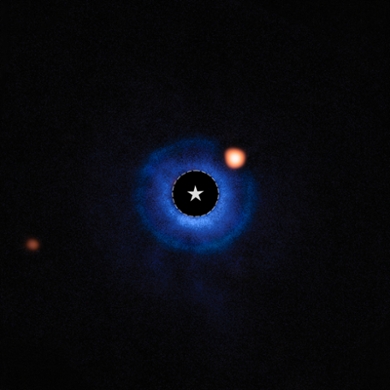
Building better coronagraphs in Leiden
At Leiden Observatory, Snik and several of his colleagues are working on new coronagraph technologies that could help future telescopes both on the ground and in space directly image and study exoplanets.
Leiden researchers are applying advanced liquid-crystal technologies to develop novel coronagraphs: instruments that use specially designed layers of liquid crystals to control light with extreme precision. In recent work, Leiden researchers and collaborators tested improved versions designed to reduce unwanted light leakage. It marks an important step towards the high contrast needed to detect Earth-like planets.
Another approach uses specially designed optical plates that alter the way light is distributed inside the telescope. These so-called vector apodising phase plates are being developed for instruments on the upcoming Extremely Large Telescope.
From distant planets to new discoveries
The better astronomers get at separating a planet's faint light from the glare of its star, the more details they can uncover about distant planets. This could reveal their size, temperature and atmospheric composition. This could provide new insights into how planets form and evolve, and perhaps even help identify worlds with conditions similar to Earth's. In such cases, humanity will be able to probe extraterrestrial worlds for signs of life for the first time.

Tips from Frans Snik: how to watch the eclipse safely 🌞😎
Never look directly at the Sun, even during a partial eclipse. Without proper eye protection, sunlight can permanently damage your eyes. You can buy eclipse glasses at the Old Observatory in Leiden.
If you do not have eclipse glasses, you can safely view the solar eclipse using a 'pinhole camera'. This allows you to project an image of the Sun rather than looking at it directly. You can make your own by piercing a small hole in a piece of card. Alternatively, use everyday objects such as a colander or the canopy of a tree. During the eclipse, the projections change from circles to crescent shapes as the moon moves in front of the sun (see photo).
Because this eclipse occurs in the evening, make sure you find a location with a clear view towards the west.


