
Mechanoluminescent materials convert mechanical energy such as stress, strain, and vibration directly into light, making them attractive as self-powered sensors that require no batteries or wiring. From biomedical sensors to self-powered infrastructure monitoring sensors, mechanoluminescent materials have a wide range of potential applications. However, high-performance mechanoluminescent materials have traditionally relied on expensive, rare-earth materials or complex material compositions.
Now, a research team led by Tohoku University, in collaboration with the University of Tsukuba and Saga University, has developed a zinc oxide (ZnO) material that exhibits strong and highly sensitive mechanoluminescence without using any rare-earth elements.
The newly developed material combines high sensitivity with low cost by using zinc oxide, an earth-abundant material already found in products such as sunscreens, cosmetics, and ointments.
Details of the team's discovery was published in the journal Advanced Science on May 9, 2026.
The researchers achieved this performance by adding a small amount of sodium to zinc oxide and carefully controlling the material's structural defects. According to the team, this is the first demonstration of strong and highly sensitive mechanoluminescence in zinc oxide without the use of any rare-earth elements.
To understand why the material performs so well, the team used advanced electron microscopy and computational modeling. Microscopy revealed that the particles possess a distinctive crater-like surface structure that may efficiently convert external force into internal strain. Meanwhile, first-principles calculations performed using the MASAMUNE-II supercomputer - named after the founder of Sendai, Masamune Date - showed that trace amounts of sodium create stable structural defects capable of temporarily storing electrical charge.
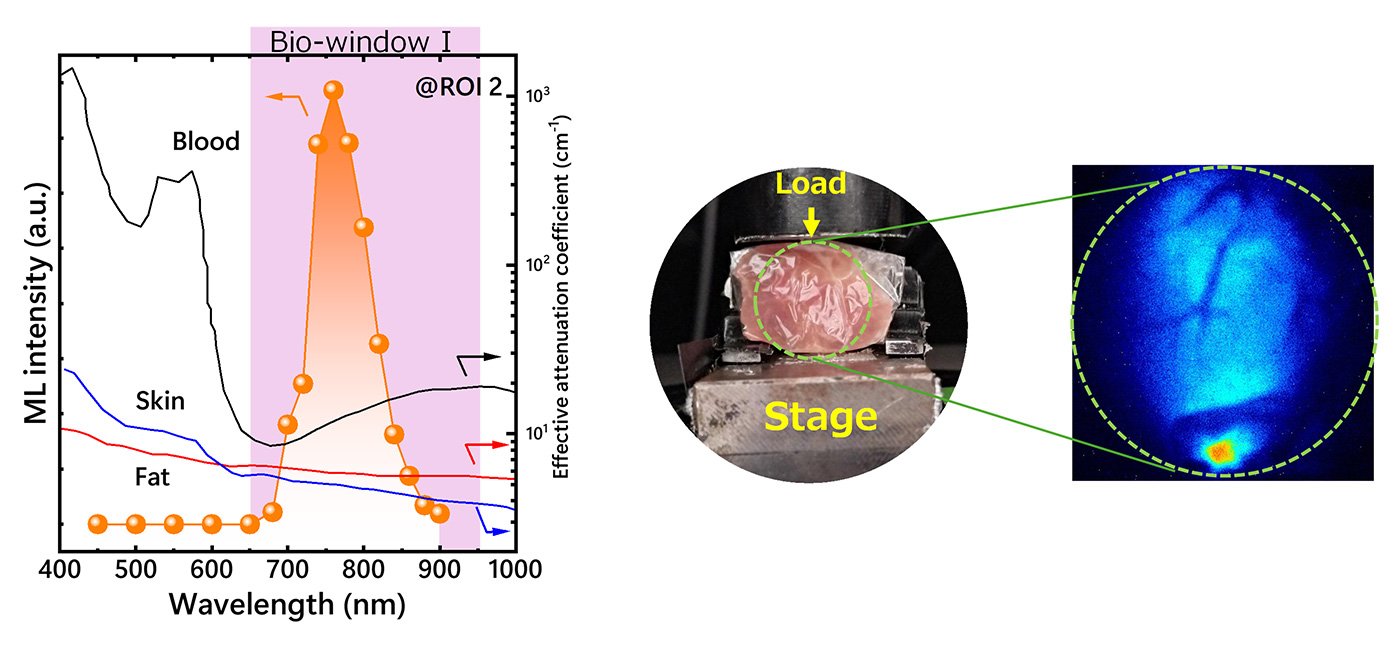
The calculations also revealed that zinc vacancies are responsible for the material's near-infrared emission. Together, these structural defects enable the material to emit bright light under pressure of only a few kilopascals - roughly the pressure produced by a light fingertip touch.
This high sensitivity opens the door to a variety of practical applications. Because the emitted light falls within the near-infrared region, which can penetrate biological tissue relatively well, the material could be used in future medical sensors that operate without internal power sources. Such devices could potentially be activated from outside the body using weak vibrations such as ultrasound.
The material could also support infrastructure monitoring. When applied to bridges, buildings, or wind turbine blades, it may allow small strains and early signs of deterioration to be visualized as light. This could enable remote monitoring systems that operate without wiring or dedicated power supplies.

- Publication Details:
Title: Stress-to-Light Conversion in an Earth-Abundant Oxide Semiconductor
Authors: Tomoki Uchiyama, Koki Otonari (co-1st author), Reona Omori, Guangfa Yang, Eiji Nishibori, Ying Chen, Xu-Guang Zheng, Chao-Nan Xu
Journal: Advanced Science


