The 2025 Nobel Prize in Physics was awarded to three scientists-Dr. John Clarke (Professor Emeritus, University of California, Berkeley, USA), Dr, Michel H. Devoret (Professor Emeritus, Yale University, USA, and Professor, University of California, Santa Barbara, USA), and Dr. John M. Martinis (Professor Emeritus, University of California, Santa Barbara, USA)-for demonstrating that quantum-mechanical phenomena, which occur in the microscopic world, can also be observed in the macroscopic world. Associate Professor Sadashige Matsuo (Department of Physics, School of Science, Institute of Science Tokyo) explains the reasons for the award and the research recognized.
Please tell us the reason for awarding the Nobel Prize in Physics
Matsuo The laureates of this year's Nobel Prize in Physics are Dr. Clarke, Dr. Devoret, and Dr. Martinis. About 40 years ago, Dr. Devoret (as a postdoctoral researcher) and Dr. Martinis (as a graduate student) worked in Dr. Clarke's laboratory. A series of studies published by these three researchers through the mid-1980s was highly evaluated and led to the 2025 award. The reason for the award is the "discovery of macroscopic quantum tunneling and energy quantization in electrical circuits."
In our daily lives, physical phenomena are described by Newtonian mechanics. However, to describe the microscopic world-such as atoms and electrons-Newtonian mechanics is not sufficient; instead, a physical theory called quantum mechanics is required, and it has been nearly 100 years since this was proposed. Why what occurs in the microscopic world does not occur in the macroscopic world has long troubled physicists. The three Nobel laureates achieved a groundbreaking result: they presented concrete examples showing that quantum phenomena-once thought to occur only in the microscopic world-can be "observed" even at the everyday scales in which we live, and they clarified the reasons why. Specifically, they discovered that in ordinary-sized electrical circuits, quantum phenomena such as quantum tunneling and energy quantization-previously believed to occur only in small systems-can in fact occur. This achievement is also connected to the development of today's superconducting quantum computers and has become one of the foundations of the movement known as the "quantum industrial revolution."

Are quantum phenomena not visible in the macroscopic world of everyday life?
Matsuo In everyday macroscopic life, imagine we put a ping-pong ball into a glass. The ball will remain in the glass and will not exit on its own. Or, if we connect a battery and a small light bulb in a circuit, an electric current flows and the bulb lights up. Such phenomena are explained by classical physics-represented by mechanics and electromagnetism-and are basically easy to control and handle.
In contrast, the situation changes in the microscopic world-at the scale of a single atom or a single electron (an atom is about 0.1 nm, roughly one hundred-thousandth the thickness of aluminum foil). What is important is that atoms and electrons possess two properties: those of particles and of waves. This wave nature, which classical physics does not assume, gives rise to phenomena that classical physics cannot fully explain-namely, quantum phenomena that do not appear in everyday life.
Representative examples are quantum tunneling and energy quantization. Tunneling is the phenomenon in which, when an atom moves toward a wall, it sometimes passes through it. By contrast, energy quantization means that energy does not change continuously, but only in discrete steps between certain fixed values. A concrete example is that electrons within an atom can occupy only specific orbitals, such as s orbitals or p orbitals.
Then why are quantum phenomena not visible in the macroscopic world of everyday life? The reason is that in large macroscopic systems, where many particles gather, the waves associated with individual particles overlap with one another, making it difficult to maintain wave-like properties. If wave properties cannot be maintained, quantum phenomena themselves do not appear in an observable way.
Does superconductivity make it possible to see quantum phenomena even in macroscopic systems?
Matsuo Quantum phenomena were actively studied in the first half of the 20th century, leading to the establishment of quantum mechanics. In that process, a fundamental question emerged: "How can we control quantum phenomena?" Research then advanced toward developing techniques for controlling small particles that obey quantum mechanics, such as atoms and electrons, leading to technologies such as ion traps (devices that hold ions suspended in air using electric forces) and atomic cooling (methods that slow atomic motion-i.e., make atoms extremely cold-using laser light).
At the same time, researchers considered whether quantum phenomena could be realized-and perhaps controlled-in a large, everyday-scale world. In practice, this was an extremely difficult challenge, but as research progressed, superconductors attracted attention. A superconductor is a material whose electrical resistance becomes zero, and it was found that in a superconductor, the many particles carrying electricity all share the same wave properties. In response to this discovery, in 1980 Dr. Anthony J. Leggett (a recipient of the 2003 Nobel Prize in Physics) proposed the idea that "if we build electrical circuits out of superconductors, we may be able to observe and control their wave properties." In other words, the idea was that quantum behavior could appear even in macroscopic systems if they were superconducting circuits.
How did it become possible to control quantum phenomena in macroscopic systems?
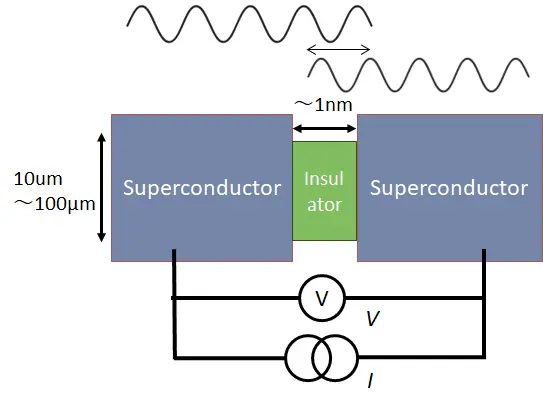
Matsuo The key structure enabling such control is the Josephson junction (a phenomenon proposed by Dr. Josephson and awarded the Nobel Prize in Physics in 1973: Fig. 1). If a thin insulator is placed between two superconductors, an electric current can flow between them with zero resistance, even though the insulator would normally block current. This current reflects the wave properties possessed by the two superconductors. By incorporating this into a circuit, we run a current and measure the voltage.
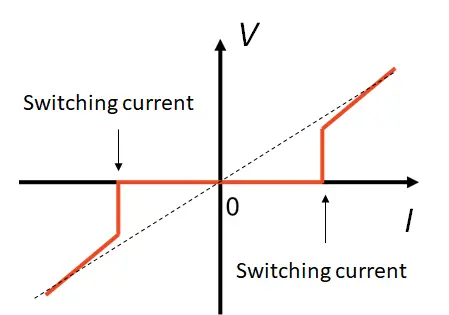
Normally, as the current increases, the voltage increases proportionally. However, with a Josephson junction, a region appears in which current flows with zero resistance. This current is called the superconducting current, and the current at which the resistance changes from zero to a finite value is called the switching current (Fig. 2). This switching current exhibits fluctuations. In the early 1980s, the relationship between these fluctuations and quantum tunneling was pointed out, but it was criticized for lacking decisive proof.
In response, the three laureates carried out experiments based on the idea of "observing energy quantization." The basic experiment involved measuring the distribution of the switching current of a Josephson junction (how much it fluctuates), but they also irradiated the system from outside with high-frequency microwaves and examined how the distribution changed. As a result, they clearly demonstrated that quantum phenomena indeed occur in macroscopic electrical circuits made of superconductors, and that the representative quantum phenomena of quantum tunneling and energy quantization can be observed at macroscopic scales.
In fact, this work also suggested that a circuit could behave like an atom. As a result, interest grew in whether one could realize atoms artificially using circuit-control techniques, and whether the quantum states of such artificial atoms could be controlled using "macroscopic parameters" such as voltage and current.
A well-known achievement in observing and controlling the quantum states of artificial atoms in circuits is the work of Dr. Yasunobu Nakamura (Professor, The University of Tokyo) and Dr. Jaw-Shen Tsai (Professor, Tokyo University of Science). They built an electrical circuit corresponding to an artificial atom using superconductors and showed that by changing the duration of microwave irradiation, they could manipulate the circuit's response (its quantum behavior appearing as a wave). This was the moment when the superconducting qubit was born. From there, by coupling many superconducting circuits (i.e., many artificial atoms) and precisely controlling each one, the field developed toward quantum computers.
This trend also aligns with a statement made in 1981 by Dr. Richard P. Feynman (a recipient of the 1965 Nobel Prize in Physics): "Nature isn't classical, and if you want to make a simulation of nature, you'd better make it quantum mechanical." The progression-from understanding macroscopic quantum phenomena to controlling quantum states of artificial atoms, and onward to the realization of quantum computers-is a clear example of how advances in basic science can ultimately crystallize into new technology.
What does this award tell us?
Matsuo This year's Nobel Prize in Physics can be seen as an achievement that answered, through experiments, a fundamental question in physics: "Do quantum phenomena appear in the large macroscopic world?" It was also important in that it raised the ambition of "realizing and controlling artificial atoms in circuits." Furthermore, this research reminds us that research results do not necessarily lead to applications immediately. The discovery made 40 years ago has only now begun to bear fruit in the form of today's quantum computers. Advancing fundamental science driven by researchers' curiosity deepens our understanding of the world and ultimately leads to technological innovation. I believe this award clearly underscores the importance of that process.
* This article is based on the presentation given at Science Tokyo Nobel Prize Lecture, held online on Wednesday, November 26, 2025.