
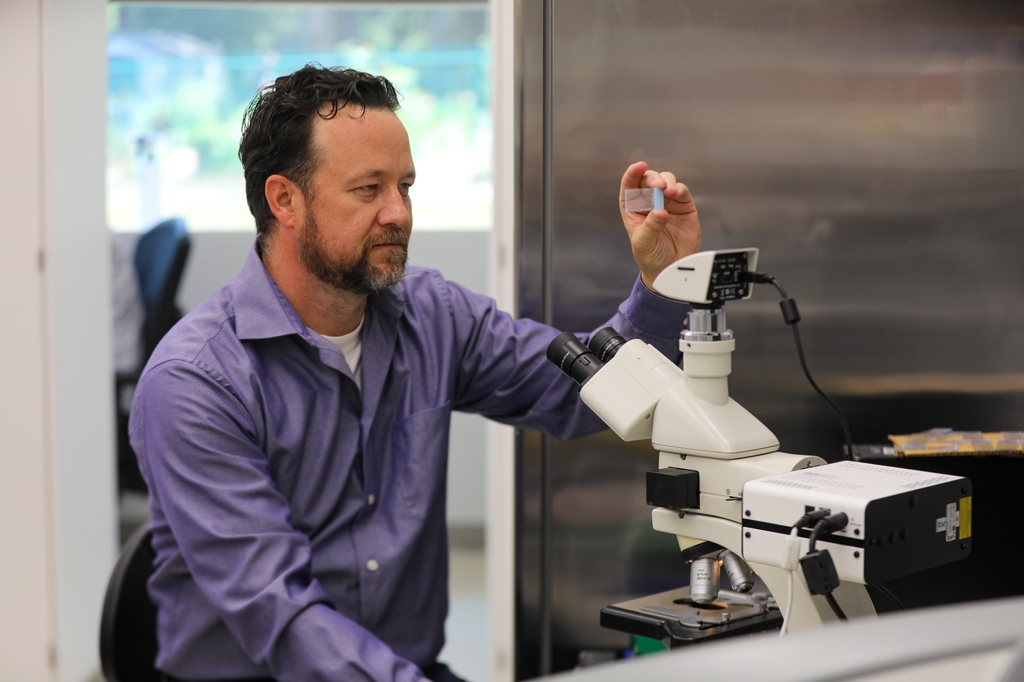
Millions of older adults face vision loss from age-related macular degeneration, or AMD, a leading cause of irreversible blindness. A researcher at Oregon Health & Science University has received a major federal grant to develop a new generation of stem cell therapies that could one day help preserve sight for those with the disease without requiring long-term immune-suppressing drugs.
The National Eye Institute has awarded Trevor McGill, Ph.D., a five-year, nearly $4.2 million grant to advance stem cell-based treatments for dry age-related macular degeneration.
McGill is an associate professor in the Division of Neuroscience at the Oregon National Primate Research Center and a research associate professor in the OHSU Casey Eye Institute.
The project focuses on replacing retinal pigment epithelial, or RPE, cells, which support the light-sensing cells of the retina and gradually die in advanced dry AMD. Loss of these cells can lead to progressive vision loss and blindness. Treatments for advanced dry AMD are limited to dietary and lifestyle changes and no effective drug therapies exist.
"This is really about solving one of the biggest barriers facing regenerative medicine," McGill said. "We know stem cell-derived therapies have enormous potential, but if the immune system rejects those transplanted cells, the benefits are short-lived. Our lab is developing cells that can essentially avoid immune detection while maintaining important safety controls."
Stem cell therapy
For decades, scientists have explored replacing damaged retinal cells with healthy stem cell-derived cells, mostly using rodent models. McGill's laboratory is working to move those therapies closer to clinical use.
Unlike rodents, nonhuman primates develop age-related macular degeneration and have eye biology that more closely resembles humans. In previous research, McGill's team demonstrated that transplanted retinal cells can be rapidly rejected by the immune system, even when donor and recipient are the same species.
Current experimental cell therapies often rely on immune-suppressing medications to prevent rejection, posing challenges for older patients who may already have other health conditions.
"Many patients with AMD are in their late 70s or 80s," McGill said. "The last thing you want is to force someone to choose between protecting their eyesight and dealing with the risks associated with long-term immune suppression."
The new project will build on years of work developing hypoimmune, or universal donor, stem cells. Researchers engineer the cells to hide from the immune system, allowing them to survive after transplantation without provoking a strong immune response. The grant will support studies evaluating the long-term survival, safety and effectiveness of these cells in nonhuman primate models of retinal disease.
The project also incorporates built-in safety mechanisms designed to eliminate transplanted cells if unexpected problems occur.
"We've engineered safety switches that allow us to selectively remove the transplanted cells, if necessary," McGill said. "That provides an additional layer of protection as these technologies move toward clinical applications."
Few treatment options
AMD affects roughly one-third of adults older than 75 and is a leading cause of vision loss among older adults.
While treatments exist for the less common "wet" form of AMD, effective therapies remain limited for the more prevalent dry form, which accounts for 90% of advanced cases.
In dry AMD, cells in the macula — the part of the retina responsible for sharp central vision needed for reading, driving and recognizing faces — gradually degenerate. Once lost, those cells do not naturally regenerate.
"Right now, there is no therapy that can replace those cells," McGill said. "That's why regenerative approaches are so important. The goal is to restore support to the retina before vision is permanently lost."
The work also reflects deep personal motivation: McGill's grandmother lost much of her vision due to AMD.
"I watched the disease affect her independence and quality of life," he said. "Like many scientists, I have a personal connection to the condition I study. That experience has stayed with me throughout my career."
Translational research program
Learn more: OHSU a leader in eye health care and research
The award represents the latest milestone in a translational vision research program built between the Oregon National Primate Research Center and the OHSU Casey Eye Institute.
The partnership brings together expertise in retinal gene therapy, stem cell biology, transplantation immunology, advanced retinal imaging and naturally occurring nonhuman primate disease models. The goal is to move promising therapies through preclinical testing toward human clinical trials.
"We don't do this work in isolation," McGill said. "Our partnership with Casey Eye Institute is essential because we're constantly working with clinicians who care for patients with these diseases. That helps ensure we're developing therapies that can realistically be translated into patient care."
Beyond AMD, McGill believes the technologies developed through the grant could have broader applications across regenerative medicine.
"If we can create stem cell-derived therapies that safely evade immune rejection, that platform could eventually extend far beyond ophthalmology," he said. "The potential impact reaches many diseases that currently have limited treatment options."
This research is supported by the National Eye Institute of the National Institutes of Health under award number R01EY037214. The content is solely the responsibility of the authors and does not necessarily represent the official views of the NIH.
All research involving animal subjects at OHSU must be reviewed and approved by the university's Institutional Animal Care and Use Committee (IACUC). The IACUC's priority is to ensure the health and safety of animal research subjects. The IACUC also reviews procedures to ensure the health and safety of the people who work with the animals. No live animal work may be conducted at OHSU without IACUC approval.


