
The Johnson Investment Institute hosted the first-ever AI Symposium in Finance & Accounting on May 8 at Lindner Hall, welcoming industry leaders from national firms, academics from leading universities and emerging finance and accounting talent.
Organized in coordination with Lindner's accounting department, this new event featured academic and practitioner presentations, a panel discussion and a keynote address on how AI is transforming investment management, financial marketing and accounting - and examining the real-world outcomes and opportunities emerging across the industry.
"We are fortunate to have experts from academia and industry to answer these AI questions for us," said Mehmet Sağlam, PhD, Johnson Investment Institute academic director, in his welcome remarks. "The symposium embodies the mission of the Johnson Investment Institute. We want to connect academics and industry, and to connect theory and practice."
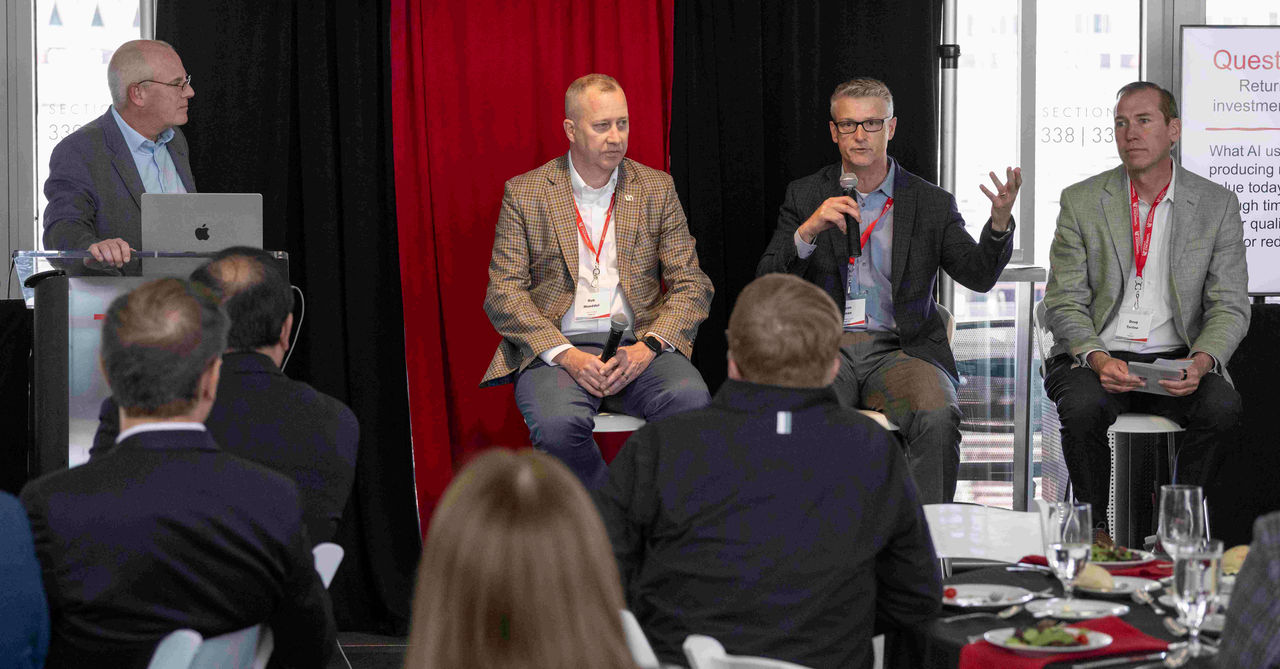
Executive Accounting Adjunct Professor Joe Waller (left) moderated a panel that included (from left) Rob Moeddel (Fifth Third Bank), Ryan Kean (Total Quality Logistics) and Doug Torline (PwC).
Nippert Stadium's West Pavilion set the stage for a luncheon panel discussing how AI is transforming finance and accounting. Lindner dean Marianne Lewis welcomed attendees by highlighting the synergy between the symposium's theme and Lindner's co-op model.
Ryan Kean (Total Quality Logistics), Rob Moeddel (Fifth Third Bank) and Doug Torline (PwC) then joined Executive Accounting Adjunct Professor Joe Waller for a discussion on AI's growing impact. The panel addressed six key questions centered on organizational change, ROI, assurance, governance and risk, operating models and talent development:
- What moved from interesting to operational with AI in the past 12 months - and what surprised you most?
- What AI use cases produce measurable value today - whether through time savings, better quality, lower cost or reduced risk?
- When AI touches finance, audit, tax or reporting, how do you validate that outputs are reliable and supportable?
- Who owns AI risk around privacy, data leakage, bias and hallucinations - and what guardrails actually work?
- How is AI changing your operating model - including team structures, shared services and leverage models?
- What should universities teach now to prepare students for an AI-enabled workplace?
Panelists also fielded questions from students and practitioners on AI regulations within their own companies, advice for students, soft skill development and more.
Above left: Lindner student Harshal Patel, BBA, LBH '29, poses a question during the luncheon panel. Above right: An attendee offers presentation feedback.
The symposium brought together a distinguished mix of academic researchers and industry practitioners to bridge the gap between cutting-edge research and real-world financial practice.
Industry speakers shared real-world applications of AI across trading, investing, market intelligence and risk management, while faculty from leading institutions examined the emerging opportunities and challenges shaping the future of AI in finance.
Featured image (from left): Andrew Robinson (BlackRock), Dacheng Xiu (University of Chicago), Lindner dean Marianne Lewis, Clifton Green (Emory University), Nan Zhou (Lindner accounting department head) and Johnson Investment Institute Academic Director Mehmet Sağlam. Photos/Joe Fuqua II.


