
Around 200 million years ago, long before flowers existed and back when dinosaurs roamed the Earth, some of the first plants used heat to attract their pollinators, according to a new study.
The research, published in the journal Science, sheds light on the early evolution of pollination, a vital plant-animal interaction that now enables the existence of most ecosystems on Earth.
"Generally, when we're thinking about pollination, we're thinking about bees and butterflies, bright flowers, things that we can perceive," explained Neil Rosser, an assistant professor in the Department of Biology at the University of Miami College of Arts and Sciences and one of the study's authors. "If you go back about 200 million years ago, however, there weren't any brightly colored flowers or anything like that, but there were plants with different sexes. So, the question is: How were they being pollinated?"
The research team—which was led by scientists at Harvard University and included scientists at the Montgomery Botanical Center in Coral Gables, Florida, and other institutions—found that an ancient group of plants still in existence called cycads uses infrared radiation to attract pollinators. Instead of flowers, cycads have either male or female reproductive cones that resemble ears of corn. These cones emit infrared radiation that beetles can sense, and by heating up first the male cones and then the female cones, the plants prompt the beetles to carry pollen from the male cones to the female ones.
"It seems clear that heat was the ancestral signal," said Rosser. "It's a very fundamental thing to be able to perceive temperature. It's fundamental to life to be able to avoid hot areas, or if it's cold, to try and find warm areas. So, the beetles would have had this capacity prior to pollination."
"Moreover, we showed exactly what the genes and molecules are that are used by the beetles to detect the heat in the plant and the molecules in the plant that create the heat that the beetles detect," he added.
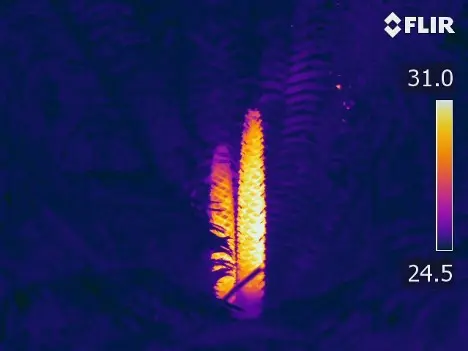
To make these discoveries, the researchers undertook a complex series of experiments. These included using infrared cameras to determine when the male and female cycad cones start to heat up and cool down, as well as tracking the movements of the beetle species Rhopalotria furfuracea in open fields at the Montgomery Botanical Center by marking them with UV-fluorescent dyes.
The researchers also printed 3D models of cycad cones that they heated up to confirm that heat alone—and not chemical signals emitted by the plants—was enough to attract the pollinators. Additionally, the researchers used artificial intelligence to analyze color patterns on different plants to examine the relationship between thermogenesis—the process of producing heat—and plant color diversity.
To investigate how cycads produce heat and how beetles detect it, the scientists employed molecular and electrophysiological analyses. They found that the beetles sense infrared using specialized sensory organs at the ends of their antennae and that the protein TRPA1 appears to play a key role in their heat-sensing abilities.
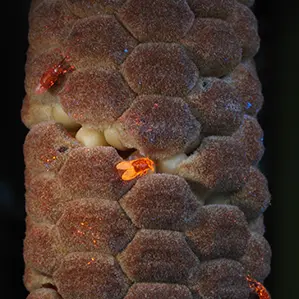
Beetles covered with UV-fluorescent dyes on a female cycad cone. Photo: Michael Calonje
"It's the same protein that rattlesnakes use to detect the heat of a mouse in pitch black," Rosser explained. "It's also used by mosquitoes to detect the heat of a body when they want to bite something."
As for the cycad cones, the researchers learned that the protein AOX1 is involved in the process of producing heat, which the plants accomplish using their mitochondria, specialized structures in cells that generate energy. This is how the cycad cones can reach temperatures of more than 10 degrees Celsius (50 degrees Fahrenheit) above the ambient temperature.
"The metabolic rate is comparable to a hummingbird, so they're really giving off a lot of heat," Rosser said.
Lastly, the research team used fossil data on thermogenic plants and insect pollinators to estimate the origin of thermogenesis. The researchers discovered evidence that infrared signaling began before the advent of colorful flowers. Later, as bees and butterflies evolved and developed sophisticated color vision, plants began to produce brightly colored flowers to attract these pollinators. But cycads, which are the oldest seed plants pollinated by animals that are still in existence, continued to attract their pollinators using heat and other metabolic signals.


