
Biodegradable plastics are usually sought after for their ability to break down quickly. However, this does not tell us how safely a product can be used before it degrades. A research team developed a strong, biodegradable material made from bamboo sheets and a plant-based plastic called PHBH. The material's strength can also be used to predict how it breaks down in seawater, offering a simple way to estimate biodegradation.
Details of the research were published in the journal Polymer Degradation and Stability on March 31, 2026.
"For new materials to enter production, they ultimately need to keep their strength for a certain period of time," said Hiroki Kurita from Tohoku University's Graduate School of Environmental Studies. "Strength is just as important as biodegradability, and hence we addressed the current research with the fundamental question: How long can a biodegradable material remain strong enough during use?"

License. ©L. Rova et al.
Kurita and his team combined bamboo sheets with PHBH to create a layered composite material. Bamboo is known for being flexible, strong, and lightweight. PHBH is a biodegradable polymer designed for marine environments. Together, they form a material that is both durable and environmentally friendly.
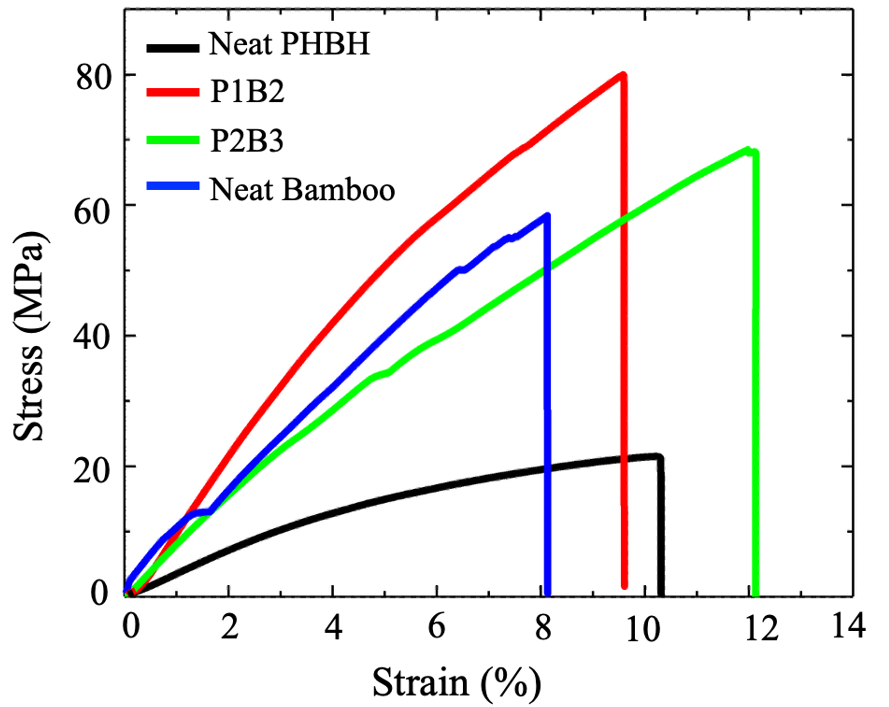
The researchers tested several designs. The best design used two bamboo layers and one PHBH layer. This structure showed higher tensile strength than either bamboo or PHBH alone. It reached a strength of 71.2 MPa.
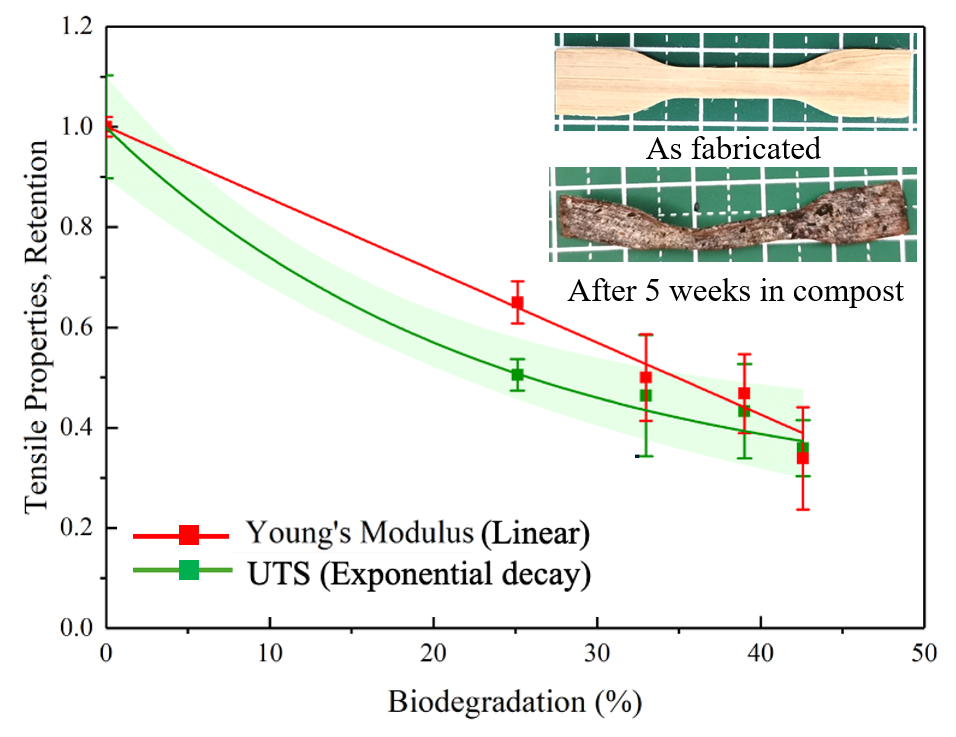
The team then studied how the material degraded over time. They first tested it in compost. After 45 days, the material reached about 45% biodegradation. At the same time, its strength decreased in a clear and steady way.
This pattern was important. It showed that strength loss follows biodegradation in a predictable manner. The researchers used this relationship to estimate degradation in water environments.
The material was also tested in seawater and tap water. In both cases, strength decreased over time. However, the decrease was faster in seawater. After three weeks, the estimated degradation was about 9.0% in seawater and 3.4% in tap water.
This result is important for real-world use, noted Snigdha Das, a master's student at Tohoku University. "Many biodegradable products are used in outdoor or marine settings. Designers need to know how long these materials will last. This study provides a simple way to estimate usable lifetime based on strength."
The work also supports the shift away from fossil-based plastics. It shows how natural materials like bamboo can be combined with biodegradable polymers. It also highlights the need for materials that are both strong and predictable in how they break down.
"By linking strength loss to biodegradation, we can move closer to designing materials with a predictable usable lifetime," said Lovisa Rova, a doctoral student at Tohoku University. "This is important for developing sustainable materials that are reliable in practice."
- Publication Details:
Title: Quantitative Coupling Between Mechanical Deterioration and Biodegradation in Bamboo-Poly(3-hydroxybutyrate-co-3-hydroxyhexanoate) Composites: Toward Predictive Modeling Across Compost and Aquatic Environments
Authors: Snigdha Das, Lovisa Rova, Zhenjin Wang, Hiroki Kurita, Fumio Narita
Journal: Polymer Degradation and Stability


