

<(From Left) Dr. Minju Jeong,(UCSD), Prof. Byung Kook Lim (UCSD), Prof. Se-Bum Paik (KAIST)>
Drug addiction carries an extremely high risk of relapse, as cravings can be reignited by minor stimuli even long after one has stopped using. Previously, this phenomenon was attributed to a decline in the function of the prefrontal cortex (PFC), which regulates impulses. However, a joint international research team has recently revealed that the cause of addiction relapse is not a simple decline in brain function, but rather an imbalance in specific neural circuits.
KAIST announced on March 9th that a research team led by Prof. Se-Bum Paik from the Department of Brain and Cognitive Sciences and Prof. Byung Kook Lim from the University of California, San Diego (UCSD) has identified the core principle by which specific inhibitory neurons in the prefrontal cortex regulate cocaine-seeking behavior.
In particular, the research team focused on parvalbumin-positive (PV) inhibitory neurons, which regulate the balance of neural signals by suppressing the activity of other neurons in the brain. They confirmed that these cells act as a "brake gate" that controls excitatory signals in the brain and serve as a crucial factor in determining drug-seeking behavior that emerges after withdrawal.
The prefrontal cortex (PFC) of our brain can properly perform its "braking" function to suppress impulses when excitatory and inhibitory signals are in balance. To investigate how chronic drug exposure disrupts this balance, the research team conducted cocaine administration experiments on mice. During this process, they tracked when inhibitory neurons in the PFC were activated and how they sent signals to downstream brain regions.
The experimental results showed that parvalbumin (PV) cells, which account for about 60-70% of the inhibitory neurons in the PFC, were highly active when the mice attempted to seek cocaine. However, when "extinction training"—training to stop seeking the drug—was conducted, the activity of these cells significantly decreased. This demonstrates that the activity patterns of PV cells are not permanently fixed by addiction but can be readjusted through the extinction process.
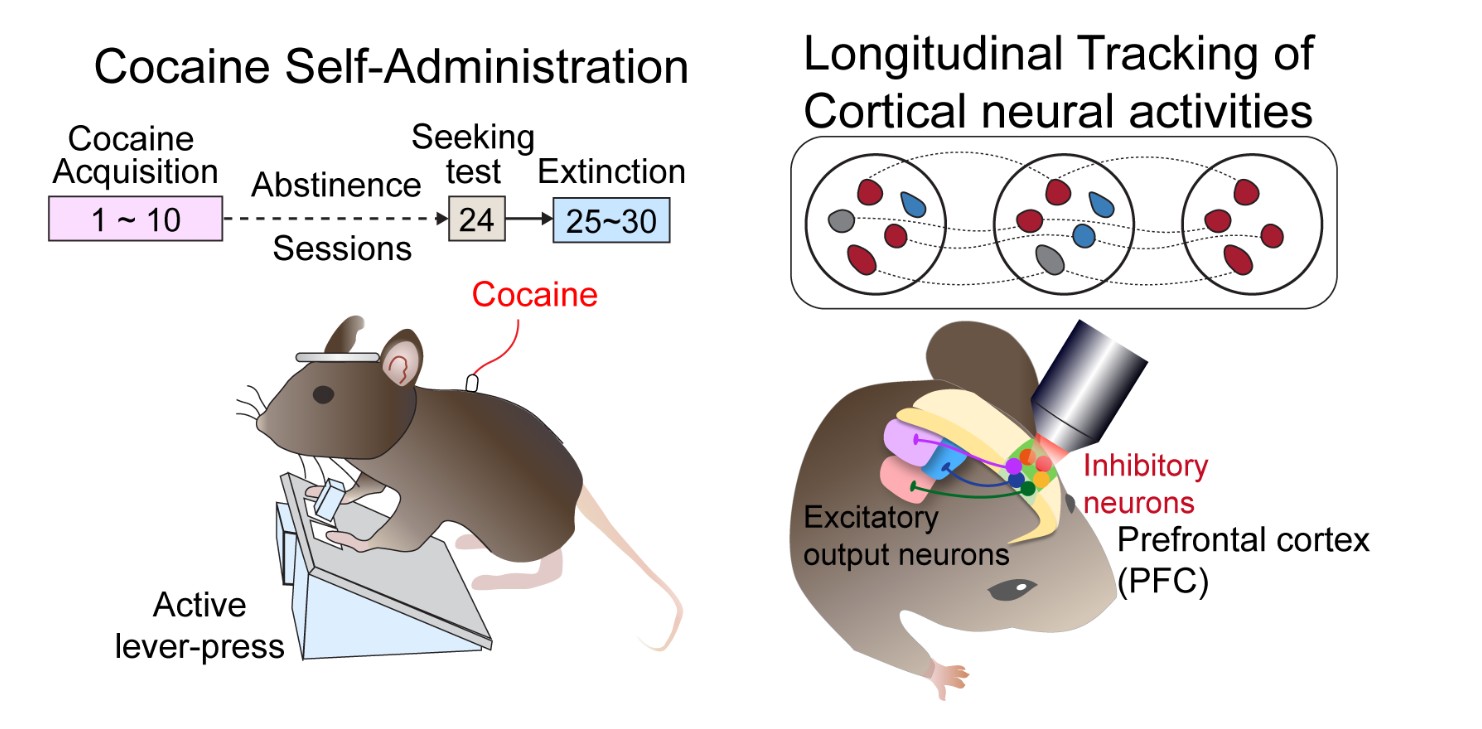
<Figure 1. Experimental design illustrating cocaine self-administration and longitudinal tracking of prefrontal cortical neural activity during cocaine-seeking behavior>
The research team confirmed that artificially suppressing PV cell activity significantly reduced cocaine-seeking behavior in mice. Conversely, activating these cells caused the drug-seeking behavior to persist even after the extinction process. This effect was specifically observed in drug-addiction behavior and did not appear with general rewards like sugar water. Furthermore, this phenomenon was not observed in somatostatin (SOM) cells—another type of inhibitory neuron—indicating that PV cells selectively regulate drug addiction behavior.

The team also identified the specific brain circuit through which these PV cells operate. Signals originating from the prefrontal cortex are transmitted to the reward circuit of the Ventral Tegmental Area (VTA), a key brain region related to reward. This pathway emerged as the central channel for regulating addiction behavior, determining whether or not to seek the drug again. In this process, PV neurons act as a "regulatory switch," controlling the flow of signals to influence dopamine signaling and deciding whether to maintain or suppress addictive behavior.
In short, the study revealed that addiction relapse is not due to an overall functional decline of the prefrontal cortex, but is determined by whether PV neurons regulate the neural pathway connecting the PFC to the reward circuit.

Prof. Se-Bum Paik stated, "This research shows that drug addiction is a circuit-level problem arising from a collapse in the regulatory balance of specific neurons and downstream neural circuits. The discovery that parvalbumin (PV) cells act as a 'gate' for addictive behavior will provide a crucial lead for developing precision-targeted treatment strategies in the future."

This study was led by Dr. Minju Jeong (UCSD) as the first author, with Prof. Byung Kook Lim (UCSD) and Prof. Se-Bum Paik (KAIST) serving as co-corresponding authors. The findings were published online on February 26 in Neuron, a premier journal in the field of neuroscience.
- Paper Title: Distinct Interneuronal Dynamics Selectively Gate Target-Specific Cortical Projections in Drug Seeking
- DOI: 10.1016/j.neuron.2026.01.002
- Full Author List: Minju Jeong, Seungdae Baek, Qingdi Wang, Li Yao, Eun Ji Lee, Arturo Marroquin Rivera, Joann Jocelynn Lee, Hyeonseok Jang, Dhananjay Bambah-Mukku, Christine Hyun-Seung Mun, Tyler Boesen, Sumit Nanda, Cheol Ryong Ku, Hong-wei Dong, Benoit Labonté, Se-Bum Paik, and Byung Kook Lim.
This research was conducted with the support of the Basic Research Program in Science and Engineering of the National Research Foundation of Korea.


