
Key takeaways
- Simulating war and peace. UCLA cognitive scientist Tao Gao created a computer game to test longstanding theories about why conflicts escalate and how adversaries can reach peaceful settlements.
- Misunderstanding fuels conflict. His research indicates that people, like nations, tend to escalate conflicts when they are unsure about an opponent's intentions, often misinterpreting defensive actions as threats; greater transparency about intent can help mitigate conflict.
- Boundaries foster peace. In addition, when opponents have a shared "focal point," or understanding and acceptance of borders, conflicts are less likely to escalate into protracted wars.
- Teaching AI diplomacy. The research also has implications for training AI to negotiate with humans.
What causes adversaries to escalate conflicts into costly, prolonged wars even when neither side wants to fight? And in the fog of war, what might help them break that cycle and find a path to peace?
Those questions are at the heart of new research by UCLA cognitive scientist Tao Gao, who used a two-person territorial-conflict computer game to explore how individuals choose between war and peace by deploying troops across a grid.
Gao, a professor in UCLA's departments of communication and statistics, and his colleagues found that the game's players frequently misinterpreted their opponents' defensive actions as threats, triggering cycles of escalating hostilities. But something as simple as a shared visual boundary, they found, helped players better understand one another's intentions and reach peaceful settlements.
The research, co-authored by Zhen Li of Zhejiang University in Hangzhou, China, was recently published in the Journal of Experimental Psychology: General.
A game of war — and peace
In the game, players compete to maximize their wealth by occupying limited territory on a grid. They expand their territory by dispatching troops from their bases, advancing one square per round, and they collect "tax" from each occupied square, generating wealth that is automatically converted into additional troops.
When opposing troops meet on the same square, a battle occurs, with the larger force having a higher probability of victory. The winning troops secure the square, while the defeated troops retreat. The war is deliberately designed to be mutually destructive, such that even the winner may suffer heavy casualties. Because prolonged fighting can deplete both players' resources, they face a choice: Keep fighting a war of attrition or find a way to coexist.
There's another complication: The players can't communicate with each other. They must determine what their opponent intends simply by observing troop movements. That uncertainty creates a version of what military strategists call the "fog of war" — the difficulty of knowing an adversary's intentions during a conflict.
The researchers found that without any obvious boundaries on the grid-board, players had trouble distinguishing between offensive and defensive moves. They were particularly likely to mistake defense for aggression, creating what is known as a "security dilemma": One player moves troops forward for protection, but the opponent sees the move as a threat and responds with a military buildup of their own. That response, in turn, appears threatening to the first player.
"In the game, and around the globe, without knowing another's intentions, defensive actions are often misinterpreted as threats, which causes escalation of conflicts and costly wars," Gao said. "Conversely, if you are clear on another's intentions, conflicts tend to de-escalate."
The benefit of drawing a line
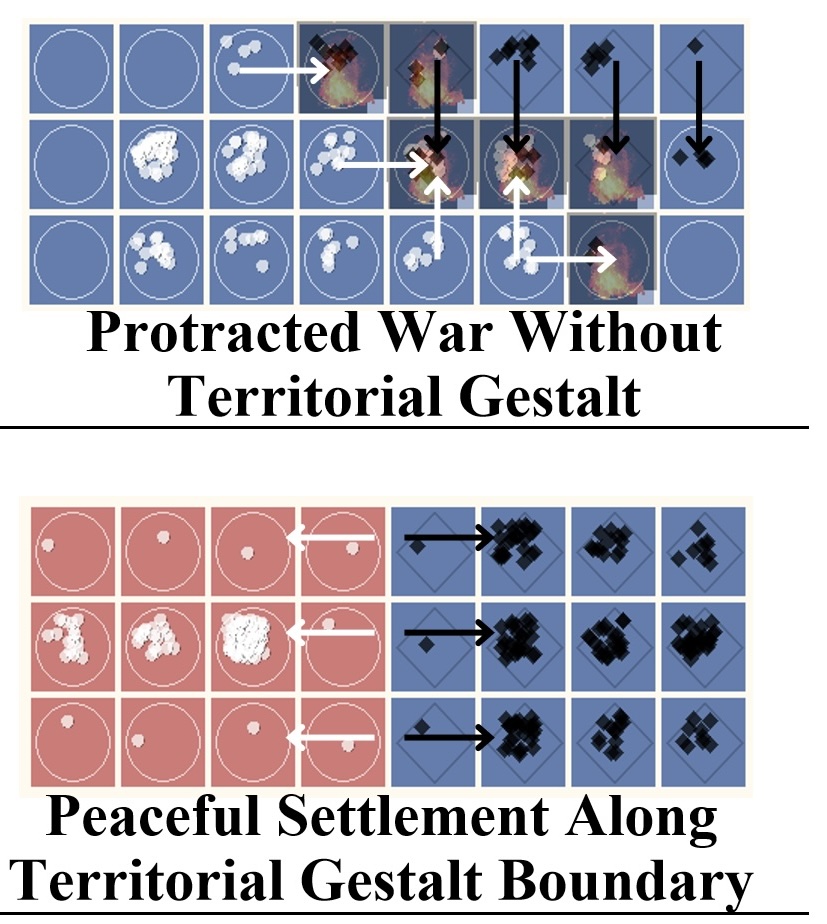
The researchers then introduced a minor change to the game: They divided the grid into two differently colored regions, creating what they call a "territorial Gestalt" — a visual division meant to mimic natural landmarks in the real world.
Even when participants were encouraged to ignore the color groupings — and were told they carried no defensive value and had no effect on game rewards — they still used these visual divisions, or landmarks, as if they were legitimate borders, Gao said.
They were less likely to deploy troops into the other player's perceived territory and more likely to concentrate their defenses along the dividing line. Battles and casualties declined, and periods of peaceful coexistence lasted longer.
The boundaries also gave both players a common reference point for interpreting one another's behavior, making it easier to distinguish defensive actions from aggressive ones. Such shared references, known as "focal points," can help people coordinate their actions even without direct communication, the researchers said, contributing to peace and cooperation.
"This shows that to resolve a conflict, people need something mutually salient and shared — even when what they agree on has no bearing on the conflict itself," Gao said.
From World War I to artificial intelligence
Gao's broader research examines how people intuitively interpret the actions, intentions and motivations of others, often from limited visual information. His work draws on cognitive modeling, artificial intelligence, robotics and computer vision to understand how humans make those judgments.
He began creating this particular game in 2021 after reading about how World War I began due to decisions made by a relatively small number of people and resulted in a long, expensive conflict with millions of casualties. He learned about the security dilemmas Russia, Germany and France were facing at the time and how actions like defensive railway construction could be misinterpreted as a precursor of attack and eventually contribute to all-out war.
He recognized there were many books and large amounts of documentation available on leaders and how they made decisions throughout history but not well-controlled experiments revealing the inner psychology, or "theory of mind," of these individuals and their decisions. He wanted to capture the challenges of conflict mitigation during the fog of war on a more individual level — and was also interested in interventions that reduce the intensity of conflicts that he could simulate with artificial intelligence.
"Ironically, we created this game purely to explore psychological theories when the world was still largely at peace, around 2020. By the time we finished it, wars had flared in Ukraine, Israel and Iran," said Gao, who added that it was disturbing to see how the security dilemma highlighted in the game is now playing out across the globe.
Gao noted that the current research has implications for the increasing use of AI in all sorts of negotiations with humans.
"While a war between humans and AI represents perhaps the most extreme scenario, conflicts of interest between humans and AI will certainly become relevant across a broad spectrum of social scenarios, particularly when AI, acting as an agent of its human master, negotiates with other humans," he said.
"Therefore, understanding the salient mental entities in human conceptual structure becomes crucial. This will enable AI to use 'out of the game' but salient concepts as natural focal points, thereby avoiding crossing a 'line' that humans deeply respect."


