
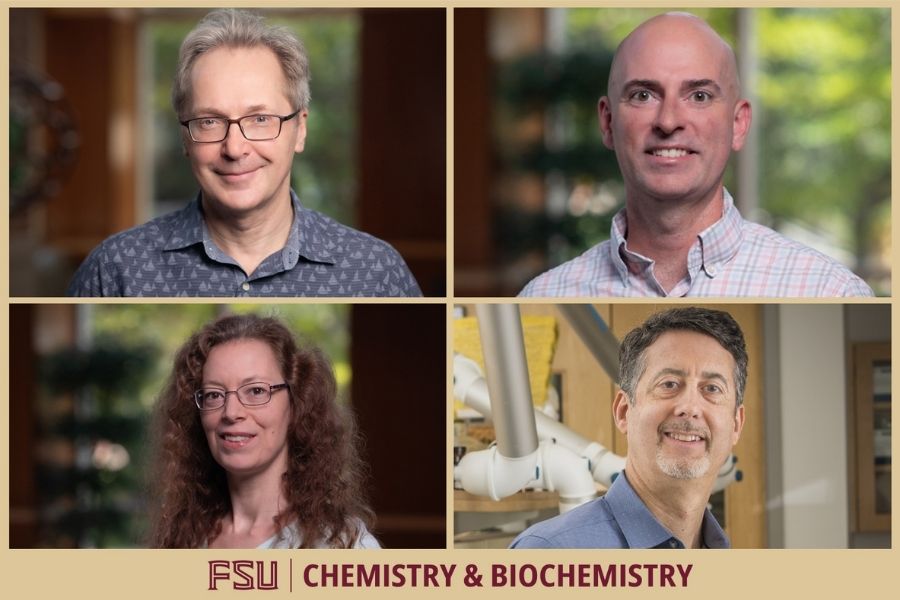
Four Florida State University faculty members from the Department of Chemistry and Biochemistry have received more than $2 million from the National Science Foundation to advance the development of new materials for applications in areas including energy, data storage and technological advances like quantum computing and medical devices.
The three-year grants were awarded this summer to Distinguished Research Professor of Chemistry and Biochemistry Igor Alabugin, Professors of Chemistry and Biochemistry Eugene DePrince and Susan Latturner, and Robert O. Lawton Distinguished Professor Joseph Schlenoff. The funds will also support students' professional and academic growth through graduate research assistantships and hands-on laboratory experiences.
"Materials chemistry has been one of the sustained strengths of FSU Chemistry and Biochemistry," said Wei Yang, Department of Chemistry and Biochemistry chair. "As part of our department's strategic vision, we will continue pushing forward our research of molecules and materials that enable next-generation technologies and chemical discoveries."
Controlling chemistry for new quantum technologies
Alabugin, whose research focuses on developing new chemical reactions and using molecular structure to control chemical and physical properties, received $578,000 for his project, "Design of Functional Graphenic Substructures." His team will develop new synthetic strategies for building small, precisely defined fragments of graphene and systematically investigate how their size, shape and connectivity control the movement of electrons and energy, their interaction with light and their magnetic properties.
By establishing these structure-property relationships, Alabugin and his team aim to develop molecular-level design principles for creating graphene materials with predictable functions. Such materials have potential applications in molecular electronics, energy conversion, sensing, high-density data storage and quantum technologies.
"This research is like using molecular Lego bricks," Alabugin said. "We can connect different pieces of graphene and ask how the way we connect them changes what the resulting molecule can do. Ultimately, we want to understand these rules well enough to say, 'I want a molecule that does this,' and know how to build it."
Expanding the computational chemistry toolkit
DePrince, who develops theories and algorithms for high-accuracy quantum chemical simulations, was awarded $544,501 for the project, "Molecular Response Properties from Ab Initio Quantum Electrodynamics." He will analyze how interactions between light and matter change the molecular properties of a system, which is important in technologies like solar power. DePrince will create new theoretical models and computational tools to understand how molecules behave in optical cavities, or environments with strong interactions between light and matter that alter the properties and underlying chemistry of a molecule.
"We're aiming to expand computational chemists' toolkit and introduce new ways of controlling molecular properties through strong interactions with light," DePrince said. "In the longer term, tools like these could help guide the design of efficient materials for new quantum technologies."
More efficient data storage and energy applications
Latturner investigates novel compounds that can be used in clean energy and received $500,000 for her project, "Directing the Synthesis of Complex Materials from Metal Fluxes," which will grow new intermetallic compounds - substances made from two or more metallic elements like nickel and aluminum - from molten metal to investigate their magnetic, thermoelectric and superconducting properties. These compounds have the potential to facilitate advances in data storage, medicine and energy conversion technology.
"Some compounds we're creating are semiconducting, and they could be used as thermoelectric modules that harness waste heat," Latturner said. "When driving a car, for example, the engine gets hot and most of that heat energy is lost. If we put a thermoelectric module in the car and convert heat back to electricity, the whole system becomes more efficient."
New polymer blends for water purification and more
Schlenoff secured $560,862 for his project, "Extremes of Macromolecular Charge Pairing Motif in Polyelectrolyte Complex Coacervates." His research focuses on understanding and creating new materials from water-soluble polymers, or large spaghetti-like molecules that dissolve, disperse or swell in water. This grant will allow him to create new adhesives, membranes and coatings from charged polymers, which could advance technologies for water purification, fuel cells and batteries.
"We're working to better understand and create new biocompatible polymer blends, including adhesives that can join surfaces underwater for biomedical applications such as wound closure and tissue repair," Schlenoff said. "Almost all scientific breakthroughs are underpinned by this kind of systematic fundamental research, and NSF's support in our pursuit of these discoveries cannot be overstated."
To learn more about research conducted in FSU's Department of Chemistry and Biochemistry, visit chem.fsu.edu.


