
Parent advocate Rose Babic has received Australian Catholic University's highest honour for her work empowering caregivers of children with disabilities.
Key points:
- ACU recognised parent researcher and childhood disabilities advocate Rose Babic with an Honorary Doctorate on 14 May
- Mrs Babic is a founding member of ENVISAGE, an international, evidence-based program supporting and empowering parents and caregivers of children with developmental concerns
- The mother of two's advice to graduating students at ACU was you don't have to have everything figured out
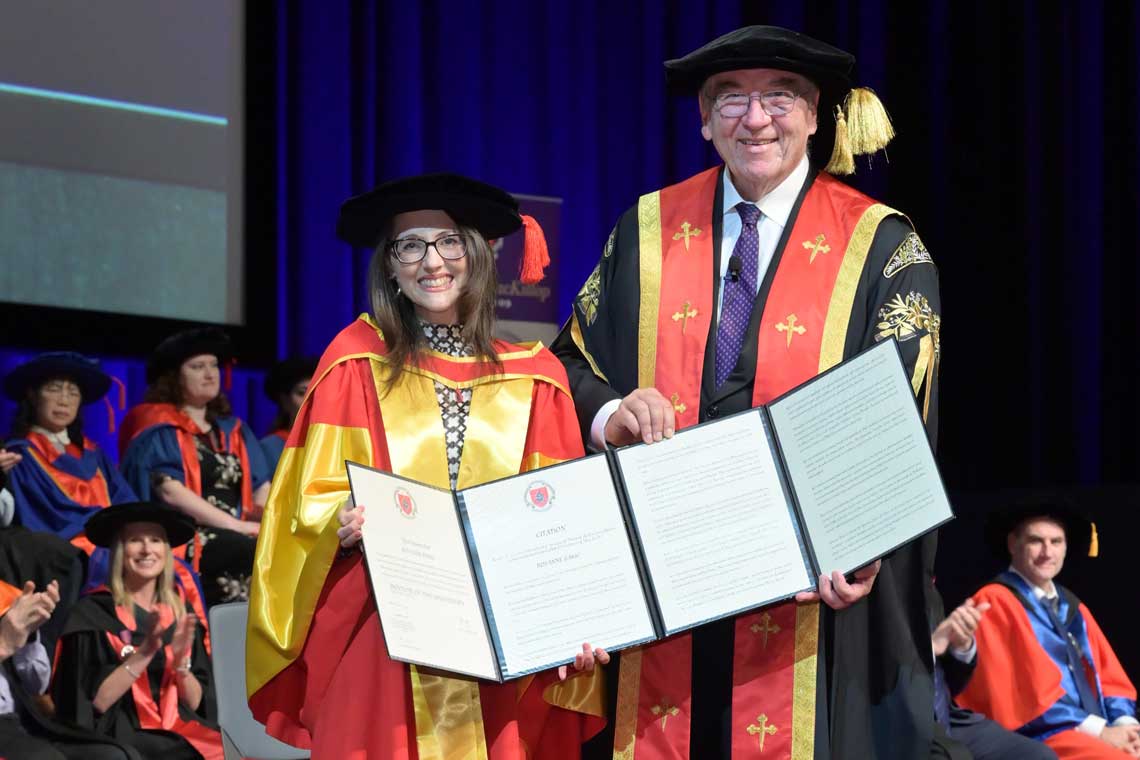
The proud mother of two, including a young adult son with a congenital brain malformation, accepted an Honorary Doctorate (Honoris Causa) in Melbourne on 14 May.
The honorary degree recognises Mrs Babic's work in paediatric disability research and her support of families raising children with developmental concerns through a strengths-based, values-driven approach to caregiving and service delivery.
Originally graduating with a degree in psychology, and later a Graduate Diploma in Education at ACU, Mrs Babic's work in childhood disabilities has been profoundly shaped by her lived experience as a parent of a child with complex disability.
Eric, 21, was diagnosed with polymicrogyria, a brain malformation, at four months old. He lives with cerebral palsy and uncontrolled epilepsy, requiring one-to-one care at all times.
"Eric is very much at the centre of my world, and today our life is both ordinary and extraordinary in ways that many families raising a child with disability will recognise," Mrs Babic said.
"Because Eric has high medical needs, much of each day is focused on keeping him comfortable, feeling loved and safe, and quite simply, keeping him alive.
"The reality of our days includes tube feeding, airway and continence management, alongside plenty of kisses and cuddles.
"It also means coordinating support workers, therapy and medical appointments, navigating funding, and constantly balancing all of this alongside the routines and needs of our wider family."
Mrs Babic said like many caregivers, after Eric's diagnosis she had uncertainties and fears about the future.
"What he has taught me since is that parenting is not defined by milestones or limitations, but by love, connection and learning to see and accept life on Eric's terms," Mrs Babic said.
"The challenges are real and often very hard. Caring is physically and emotionally demanding, the uncertainty can be exhausting, and there are times of immense grief and frustration along the way.
"But alongside that, the family life I hoped for is exactly what we have – it just doesn't look the way I once imagined, and in many ways, it is richer, deeper and more connected because of Eric."
In 2017 Mrs Babic became a founding member of ENVISAGE, an international, evidence-based program supporting and empowering parents and caregivers of children with developmental concerns.
Led by acclaimed occupational therapist Professor Laura Miller from ACU's School of Allied Health in collaboration with McMaster University, Murdoch Children's Research Institute and The University of Melbourne, ENVISAGE supports parents and caregivers to feel confident and competent in caring for a child with a disability.
"In early childhood services, the emphasis is understandably on the child's development but ENVISAGE intentionally shifts some of that focus to parents and caregivers, recognising that their wellbeing, confidence and sense of capability matter deeply," Mrs Babic said.
Through her nearly two decades as a primary caregiver, Mrs Babic said her biggest lesson has been practicing self-compassion.
"For many carers, the idea of self-care can feel unrealistic or even burdensome — another thing to fail at when time, energy and support are already stretched thin," she said.
"Self-compassion, for me, has meant being kinder to myself about the limits of what's possible.
"It's recognising that exhaustion is not a personal failing, that needing rest doesn't mean you're not coping, and that some days simply getting through is enough."
Mrs Babic said she was "genuinely surprised" to receive the Honorary Doctorate from ACU for sharing her lived experience as evidence-based research and advocacy.
"I've always felt incredibly fortunate to encounter opportunities where I've been able to turn my lived experience into something meaningful for others, and that in itself has been deeply rewarding," she said.
"I see this honour as recognising not only my individual contribution, but also the voices, experiences and resilience of the families and communities I represent."
The inspiring mother and advocate's advice to graduating students at ACU was to "learn imperfectly along the way".
"Despite what the social media world tells you, you don't need to have everything figured out," she said.
"Life is made up of experiences that shape you as you move through them, and clarity often only comes in hindsight.
"It's a cliché, but it's true — you don't learn how to navigate uncertainty until you're actually in it, and you're allowed to learn imperfectly along the way."


