
Lithium-sulfur (Li-S) batteries combine the abundance and affordability of sulfur with an energy-storage capability far beyond that of current lithium-ion technologies. Practical deployment, however, has been slowed by a long-standing challenge known as polysulfide shuttling, whereby dissolved sulfur intermediates migrate within the battery, leading to active-material loss and premature performance decay.
Now, researchers from Tohoku University and collaborating institutions have tackled this problem by developing a molecularly designed covalent organic framework (COF)-graphene interlayer. This lightweight interface mitigates polysulfide shuttling by combining chemical trapping, rapid charge transport, and sulfur-conversion promotion.
The work was published in the journal Small on June 16, 2026.
Li-S batteries generate electricity through a remarkable sequence of chemical transformations. During discharge, solid sulfur is converted into soluble lithium polysulfides and then into lithium sulfides. During charging, the process is reversed. This multielectron reaction network enables sulfur to store far more energy than the cathode materials used in today's lithium-ion batteries, making Li-S technology an attractive candidate for next-generation energy storage.
Yet the very chemistry that gives Li-S batteries their enormous energy-storage potential also creates their greatest weakness. The intermediate lithium polysulfides formed during cycling behave much like wandering travellers: once dissolved in the electrolyte, they can escape from the sulfur cathode, drift across the separator, and reach the lithium-metal anode. This uncontrolled migration initiates a cascade of detrimental processes, including parasitic side reactions, depletion of active sulfur, growth of unstable interfacial layers, self-discharge, and a steady erosion of battery capacity with repeated use.
Prevention, however, does not lie in erecting a physical barrier. Instead, the separator interface must function more like an intelligent checkpoint. It should be capable of selectively recognizing polysulfide species, capturing them through strong chemical interactions, rapidly shuttling electrons to sustain electrochemical activity, and actively guiding sulfur intermediates through their successive reduction and oxidation steps. Combining these diverse functions within a single material platform has remained one of the central challenges in advancing practical Li-S batteries.
To solve this issue, the team created a new tetrathiafulvalene-crown ether COF, named TUS-44, and integrated it with conductive graphene to form a TUS-44@G functional layer for Li-S batteries. The framework contained imine nitrogen, crown-ether oxygen, and sulfur-rich tetrathiafulvalene sites, which together provide a hierarchy of interaction sites for lithium polysulfides while the graphene component supplies an efficient electron-transport pathway.
In battery tests, cells equipped with the TUS-44@G layer delivered a high reversible capacity of 1455.7 mA h g⁻¹ at 0.2 A g⁻¹, retained excellent rate capability with 773 mA h g⁻¹ at 10 A g⁻¹, and showed long-term durability with only 0.034% capacity fading per cycle over 1000 cycles at 5 A g⁻¹. A Li-S pouch cell incorporating the same interlayer achieved an initial energy density of approximately 674 Wh kg⁻¹ at 0.05 A g⁻¹, demonstrating the promise of this molecularly engineered interface for practical high-energy batteries.
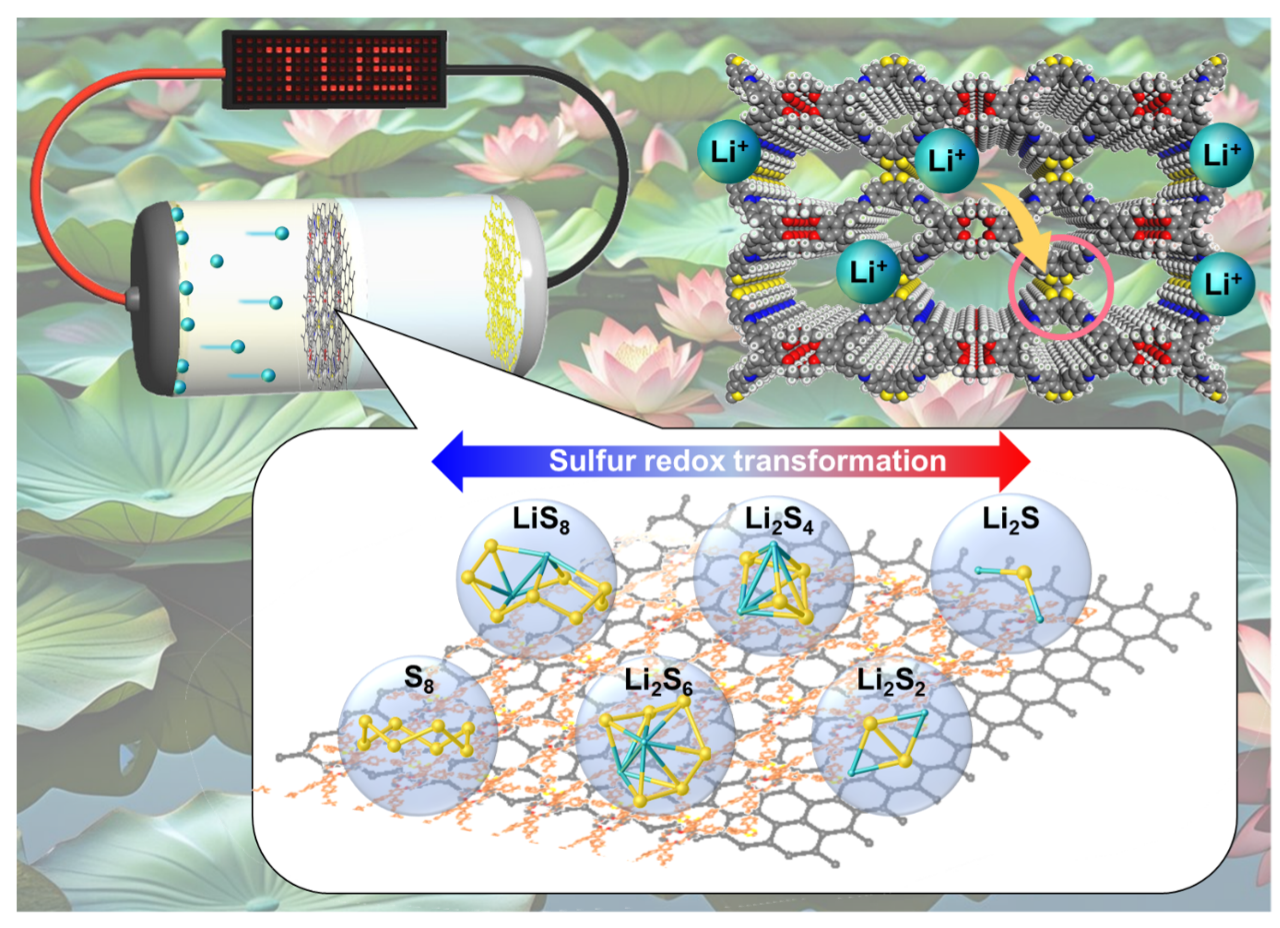
"Our goal was to design an interlayer that does not simply block polysulfides, but actively manages their reaction pathway," explains Saikat Das, Junior Associate Professor at the Institute of Multidisciplinary Research for Advanced Materials, Tohoku University. "By integrating crown ether and tetrathiafulvalene chemistry into an ordered COF and coupling it with graphene, we created a cooperative interface that can anchor, redistribute, and convert sulfur species more efficiently."
COFs offer an appealing solution because they can be constructed with molecular-level precision. Unlike conventional porous carbons, which interact only weakly with polysulfides, COFs possess periodically arranged pores whose dimensions, chemical environments, and electronic characteristics can be programmed by design. In essence, COFs provide a molecularly engineered platform that simultaneously captures, conducts, and catalyzes, offering a powerful strategy to transform the long-standing polysulfide shuttle problem from a major obstacle into a controllable aspect of sulfur electrochemistry.
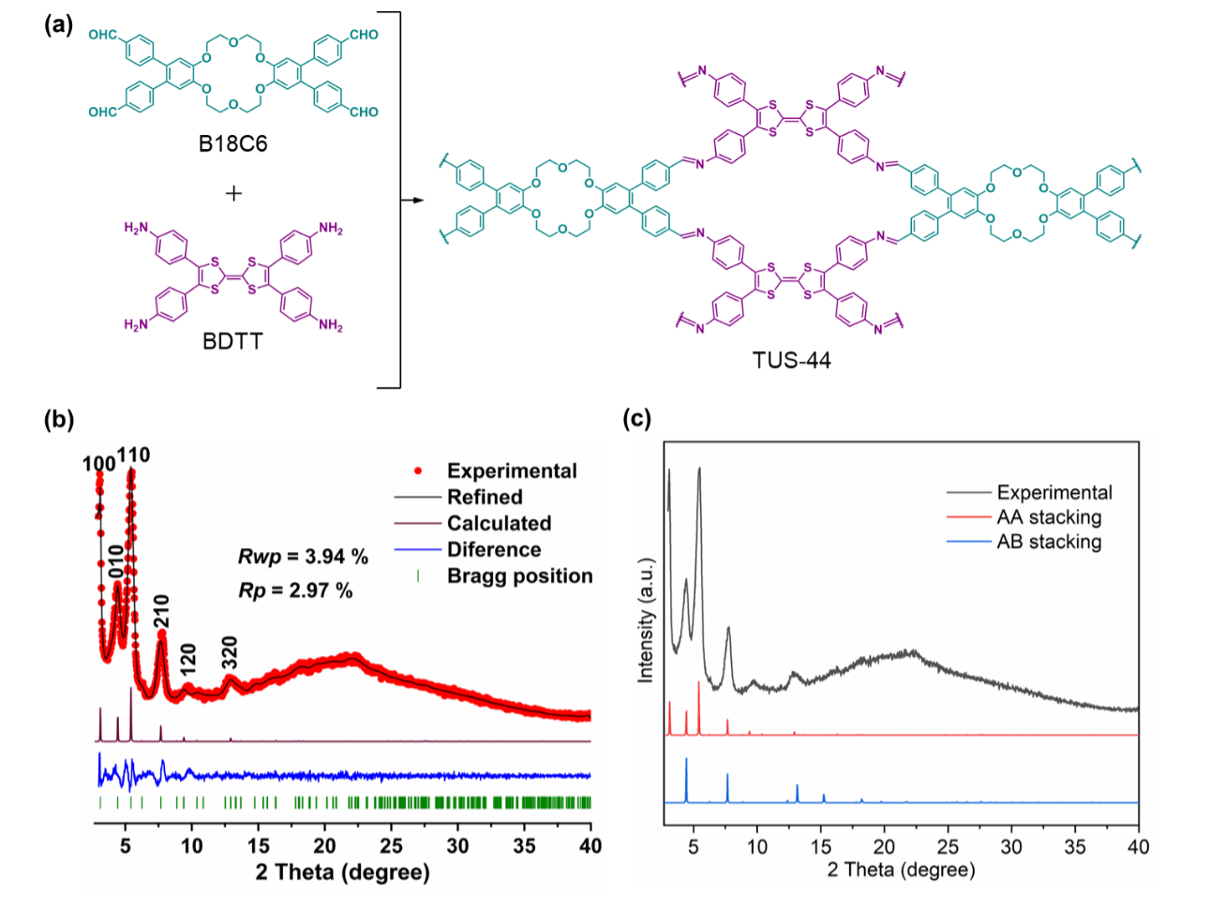
The team synthesized TUS-44 through Schiff-base condensation between a benzo[18]crown-6 tetrabenzaldehyde linker and a tetrathiafulvalene-based tetraaniline building block. Structural analysis confirmed an imine-linked, π-conjugated, two-dimensional bex-topology framework with uniform micropores of approximately 0.9 and 1.2 nm and a BET surface area of about 516 m² g⁻¹.
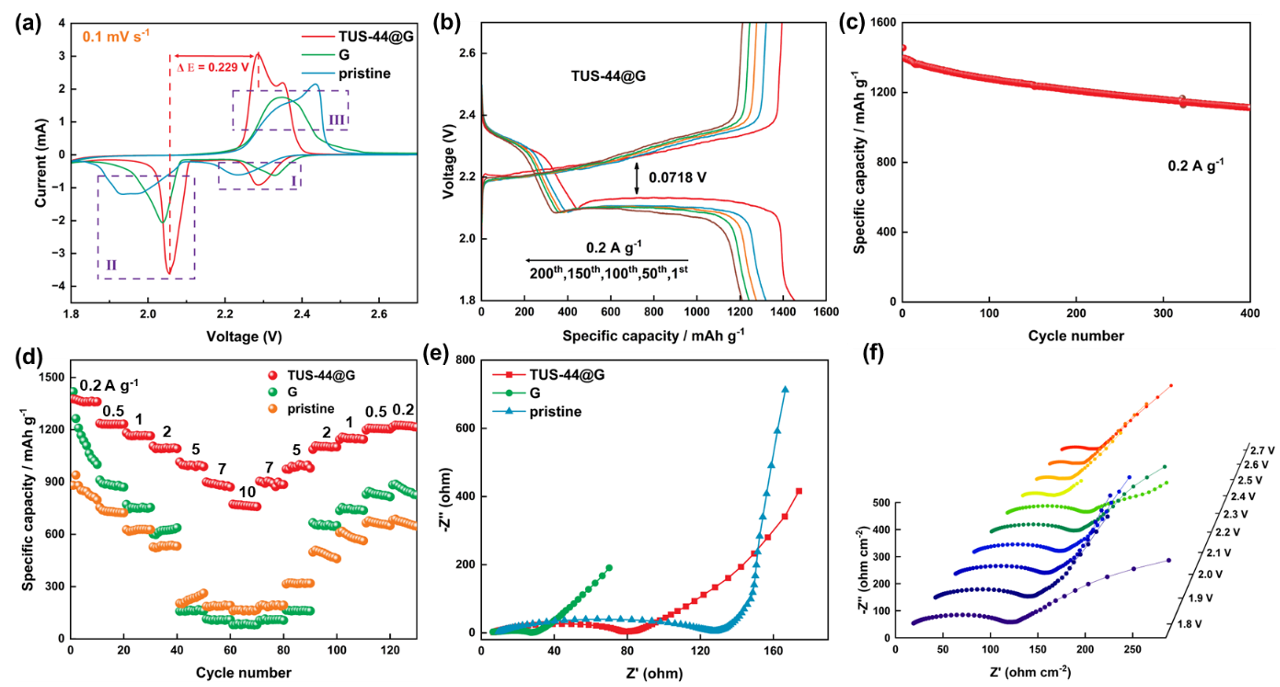
The team also discovered that TUS-44 is not merely a porous scaffold but a molecularly programmed interface in which distinct functional sites perform complementary tasks. Imine nitrogen atoms serve as preferential docking sites for lithium ions, crown-ether oxygen atoms facilitate additional ion coordination and transport, while electron-rich tetrathiafulvalene moieties promote charge delocalization and mediate sulfur redox reactions. Integrating TUS-44 with graphene onto a polypropylene separator produced a thin, homogeneous interfacial coating that readily absorbs electrolyte and effectively blocks the migration of soluble polysulfides.
"This study shows that reticular chemistry can be used to program battery interfaces at the molecular level," remarks Professor Yuichi Negishi of Tohoku University. "The TUS-44@G design offers a route toward lightweight, durable, and high-rate Li-S batteries by unifying polysulfide immobilization with catalytic sulfur conversion."
- Publication Details:
Title: Polysulfide Immobilization and Sulfur Conversion Kinetics Promotion via a Tetrathiafulvalene-Crown Ether COF@Graphene Layer for High-Rate Lithium-Sulfur Batteries
Authors: Kai Sun, Tsukasa Irie, Samim Reza, Kohki Sasaki, Mika Nozaki, Tokuhisa Kawawaki, Yujun Fu, Dequan Liu, Ranjit Thapa, Saikat Das, Deyan He and Yuichi Negishi
Journal: Small
DOI: 10.1002/smll.74240


