
The Dark Energy Spectroscopic Instrument (DESI) has successfully completed the largest high-resolution 3D map of the universe ever made, a major milestone in understanding the force driving cosmic expansion.
Many institutions globally are involved in the project, including the University of Portsmouth, University College London and Durham University along with Berkeley Lab and the Science and Technology Facilities Council.
The milestone was reached when DESI's 5,000 fibre-optic sensors captured their final scheduled observations, targeting a region of sky near the Little Dipper.
The survey was completed ahead of schedule and has delivered significantly more data than originally projected.
Chasing dark energy
Researchers are using the dataset to investigate dark energy, the mysterious force that makes up roughly 70 per cent of the universe and drives its accelerating expansion.
By comparing how galaxies clustered billions of years ago with their distribution today, the DESI collaboration has traced dark energy's influence across 11 billion years of cosmic history.
Early results from the first three years of DESI data hinted that dark energy, long thought to be a 'cosmological constant', might be evolving over time.
With the full five-year dataset now complete, researchers now have significantly more data to test whether this suggestion persists.
If confirmed, it would mark a major shift in our understanding of the universe and its ultimate fate, which hinges on the balance between matter and dark energy.
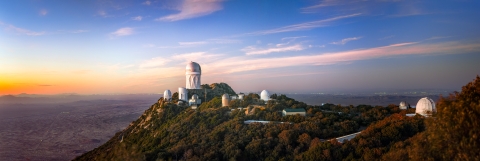
The Mayall Telescope at Kitt Peak National Observatory houses the Dark Energy Spectroscopic Instrument.
Credit: KPNO/NOIRLab/NSF/AURA/P. Horálek (Institute of Physics in Opava)
A new era in cosmology
Dr Seshadri Nadathur , Associate Professor at the University of Portsmouth's Institute of Cosmology and Gravitation , co-chaired DESI's galaxy and quasar clustering working group, leading the effort to extract dark energy measurements from DESI's map. He said: "It is hard to overstate how important this DESI map of galaxies will be for cosmology.
"The possibility of dark energy evolving with time would be revolutionary on its own, and there are still many other things we can do with the data, including weighing neutrinos, the lightest known fundamental particles.
"We've barely scratched the surface so far, and I'm excited to see what else we can learn."
A global collaboration
DESI's quest to understand dark energy is a global endeavour, with more than 900 researchers (including 300 PhD students) from over 70 institutions around the world, including the UK.
Mounted at the Kitt Peak National Observatory (NSF NOIRLab) in Arizona, it is managed by the US Department of Energy's Lawrence Berkeley National Laboratory ( Berkeley Lab ).
The Science and Technology Facilities Council supports the UK component of the study.
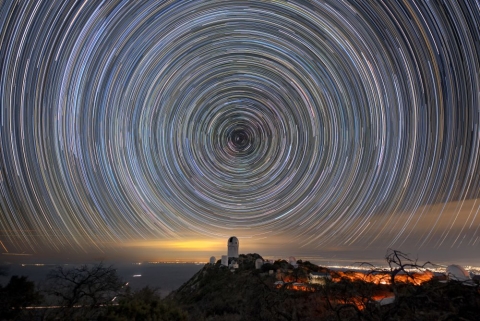
Star trails over the Mayall Telescope that houses DESI.
Credit: Luke Tyas/Berkeley Lab and KPNO/NOIRLab/NSF/AUR
Promising discoveries ahead
Dr Michael Levi, DESI director and a scientist at Berkeley Lab, said: "DESI's five-year survey has been spectacularly successful. The instrument performed better than anticipated.
"The results have been incredibly exciting. And the size and scope of the map and how quickly we've been able to execute is phenomenal.
"We're going to celebrate completion of the original survey and then get started on the work of churning through the data, because we're all curious about what new surprises are waiting for us."
A dataset on an unprecedented scale
DESI has now collected cosmological data from six times as many galaxies and quasars as all previous surveys combined.
The collaboration will now begin processing the full dataset, with the first dark energy results from DESI's full five-year survey expected in 2027.
Meanwhile, scientists continue to analyse the survey's first three years of data, refining dark energy measurements and producing additional results on the structure and evolution of the universe. Several new studies based on these data are expected later this year.
An observing machine
DESI began collecting data in May 2021 and has far surpassed its original goals. The plan was to capture light from 34 million galaxies and quasars, extremely distant, bright objects powered by supermassive black holes, but the instrument instead observed more than 47 million galaxies and quasars, plus 20 million stars.
DESI is now pushing beyond its original mission, expanding its map of the universe into new and more challenging regions of the sky.
Through 2028, the survey will grow by about 20%, from 14,000 to 17,000 square degrees. For comparison, the Moon covers just 0.2 square degrees, while the full sky spans more than 41,000.
This expansion will take DESI closer to the crowded plane of the Milky Way, where bright nearby stars can obscure distant galaxies, and further to the south, where observations must peer through more of Earth's atmosphere.
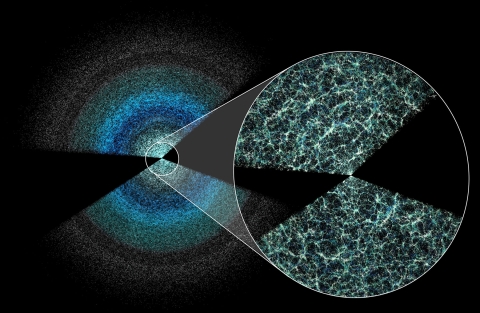
A thin slice of the map produced by the DESI five-year survey shows galaxies and quasars above and below the plane of the Milky Way. The universe's large-scale structure is visible in the magnified inset. Earth lies at the center of the wedges, and the black gap marks where our own galaxy obscures distant objects. Light from the furthest galaxies shown is 11 billion years old by the time it reaches Earth.
Credit: Claire Lamman/DESI collaboration
The sky's the limit
The survey will also revisit previously mapped areas to observe a new class of galaxies, fainter, more distant 'luminous red galaxies.'
These additional measurements will create a denser, more detailed map, sharpening our view of how the universe has evolved over time.
The extended survey is already underway. By integrating the new observations with the ongoing programme, researchers are making efficient use of telescope time and ensuring continuous data collection.
Institute of Cosmology and Gravitation
As a recognised international centre of research excellence, the University of Portsmouth's Institute of Cosmology and Gravitation (ICG) brings together more than 70 researchers - faculty, postdoctoral fellows and PhD students - tackling some of the Universe's most profound mysteries, from the earliest moments after the Big Bang to the large-scale structure of galaxies, dark energy and gravitational waves.
The institute's contributions include roles in major international projects such as the Dark Energy Spectroscopic Instrument (DESI) , Euclid , LISA (Laser Interferometer Space Antenna) , and the LIGO gravitational wave detectors .
Please click the link to read the press release issued by DESI: DESI Completes Planned 3D Map of the Universe - Berkeley Lab News Center


