Researchers
研究者名
Kimura, Satoko Soen
研究者名
Mayu Ogawa
Overview
Kyoto, Japan -- When locals of two coastal communities along the Sea of Japan reported observations of dolphins in nearby waters, it caught the attention of some scientists. The marine environment has been changing rapidly in the Sea of Japan, which is partially enclosed by the Japanese archipelago and the Eurasian continent and connected to the ocean through shallow straits. Though sightings and bycatch records of dolphins have been reported along the coast, basic ecological information on small odontocetes, such as dolphins and porpoises, has remained limited.
Once they heard about dolphin sightings in both Obama City on Wakasa Bay and Tsushima City on Aso Bay, a team of researchers at Kyoto University headed there to investigate. They wanted to know how these upper-level predators use areas like Wakasa Bay and Aso Bay, and what kinds of sounds they produce.
"This study began through local connections: we heard from acquaintances and local fishers that dolphins might be visiting nearby waters," says first author Satoko S Kimura.
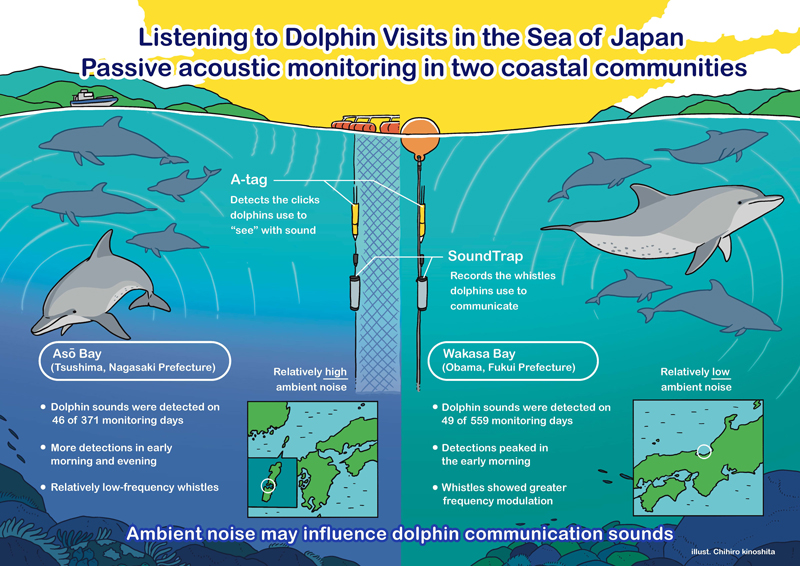
The team conducted passive acoustic monitoring from January 2022 until November 2024 in Wakasa Bay, and from March 2023 through October 2024 in Aso Bay, recording echolocation clicks, whistles, and ambient sounds produced by small odontocetes, as well as sighting information from local fishers. Locals helped the scientists deploy and retrieve recording devices and took photographs when possible.
The recordings revealed dolphin sounds coming from both Wakasa Bay and Aso Bay. However, the detection rate was low in both, occurring only about once every ten days. The whistle characteristics in Aso Bay, where background noise levels were higher, differed from those in the quieter Wakasa Bay. The team could not determine whether these differences came from sound environments or the animals themselves, but based on the acoustic characteristics, sightings, and photographic evidence, the visiting odontocetes are most likely Indo-Pacific bottlenose dolphins.
These findings provide baseline information on the spatiotemporal occurrence and acoustic characteristics of small odontocetes along the Sea of Japan coast. This study also demonstrates that passive acoustic monitoring is an effective method for studying animals in coastal areas where infrequent sightings make them difficult to observe directly.
These methods may also help detect future changes in marine environments and identify the species visiting these coastal waters more accurately. By further developing long-term monitoring, the researchers aim to provide scientific evidence that helps support both marine conservation and the sustainable use of coastal waters by local communities.
"With the help of local fishing communities, we were able to listen to the sea over long periods and begin revealing the lives of dolphins in familiar coastal waters," says Kimura. "We hope to continue working with local communities to better understand and conserve the marine life that shares the sea with us."