
The human brain contains more connections between neurons than there are stars in the Milky Way. Decoding the electrical activity behind all those cells is the massive task that excites neural engineers like Felix Deku, who are working to build better tools for recording brain activity.
"We're at the intersection of engineering and neuroscience," says Deku, the Betsy and Greg Hatton Assistant Professor in Neuroengineering at the Phil and Penny Knight Campus for Accelerating Scientific Impact. "The brain is incredibly complex, and our ability to understand it has been limited by the tools we have available."
New research from Deku's lab, published in the Journal of Neural Engineering, introduces a new tool for recording brain activity known as a neural interface that can record the activity of hundreds of neurons simultaneously.
"If we can build better recording devices," Deku says, "(Devices) that are more precise, more accessible, and more versatile-we can unlock insights into how neural circuits function and what goes wrong in disease."
Developing electrodes that can record activity from hundreds of neurons simultaneously while remaining small enough to place on the brain's surface is no small feat. This challenge drives Deku's lab, a team of materials scientists and engineers united by a common goal of better understanding the human brain.
The work was led by Emma Jacobs, a bioengineering PhD candidate, alongside Manuel Monge, an engineer and CEO of OpenIC, an organization focused on research and development of integrated circuits. It was initially motivated by her own scientific questions. Jacobs wants to map neural circuits, understanding how different regions of the brain connect and how they respond to stimuli ranging from stress to psychedelics. To do this, she needed a neural interface capable of recording and stimulating large numbers of cells, but the only options were high-cost commercial tools with limited adaptability.
Under the mentorship of Monge, Jacobs jumped in headfirst and learned printed circuit board design, which enabled her to custom-build the neural interfaces she needed.
"I came into this project without a background in circuit design, but I was excited to learn by doing," Jacobs says. "It was challenging at first, but being able to build something from scratch was fun."
The new neural interface is called Iris128, named for its 128 recording channels, making it capable of capturing activity from hundreds of neurons at once.
Working alongside Monge, Jacobs designed and manufactured Iris 128, starting with a thin-film array made of platinum electrode sites. This array rests on the brain's surface to record electrical activity, which is then transmitted through an adapter cable to a circuit board with integrated chips.
The Deku lab builds aspects of these sophisticated tools at the Knight Campus Cleanroom, a dust-free facility that allows researchers to create structures compatible with delicate brain tissue.
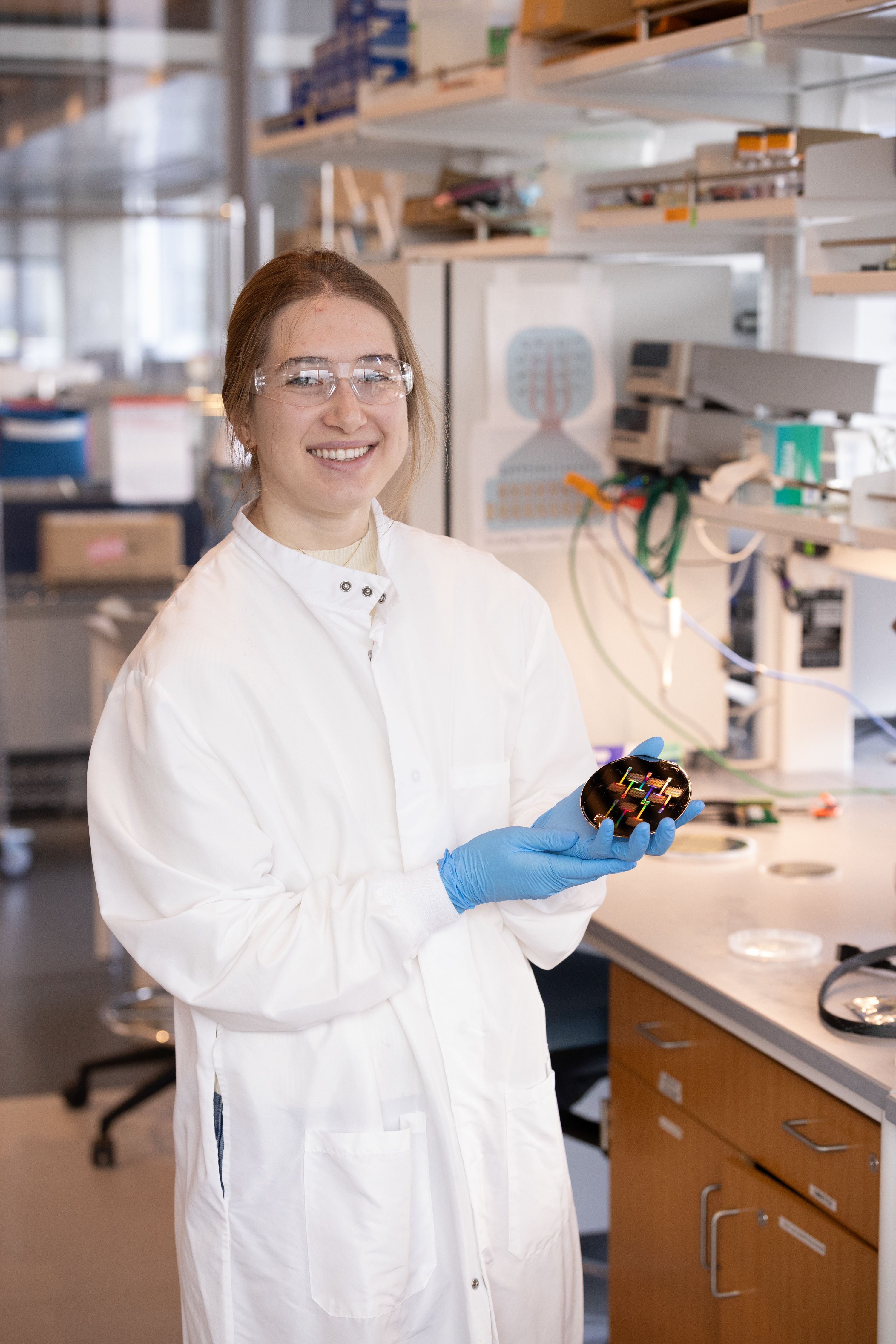
First, the Deku lab fabricates thin-film arrays designed to be lightweight, flexible, and compatible with the brain. These structures are manufactured in the Knight Campus Cleanroom, beginning with a thin, high-performance plastic layer called polyimide. The material then undergoes a series of technical manufacturing processes to create the thin-films and the connections to platinum electrodes. Several of these thin-film arrays are shown on the left.
After manufacturing, individual thin-film arrays are removed and attached to an electrical connector that is attached to a printed circuit board. This printed circuit board will amplify and digitize the electric neural signals. On the left, a thin-film array is shown attached to a electrical connector device.
Through a series of cables, the connector device is attached to an adapter board, a small circuit board designed to interface with different electronic systems. A blue adapter board shown on the left.
Finally, the adapter board is attached to a controller that will communicate with the computer. This is shown on the left.
Jacobs and Monge meticulously documented their entire process and published all instructions and design files online for anyone to access. The goal is to enable neuroscience labs around the world to use these high-density electrodes without prohibitive costs or proprietary barriers.
"It was really interesting designing something from the beginning to be open source," Jacobs says. "We really focused on the user and talked a lot during the design about how we can make this usable. I think we did our best to make it accessible."
Going forward, Jacobs plans to help other neuroscience researchers implement these interfaces in labs across the world. And soon, she is hopeful to use them to listen in on the brain's electrical conversations.
This work was supported by the National Institutes of Health (NIH), National Science Foundation (NSF) and OpenIC.


