
A stepwise assembly framework enables the synthesis of π-extended carbo[17]helicene, a giant chiral nanocarbon featuring a helical backbone of 17 benzene rings and additional lateral π-extension, as revealed by scientists from Science Tokyo. By catalyzing the cycloaddition reactions using nickel, the team overcame steric congestion to achieve the synthesis with an enantiomeric ratio of 98:2. The resulting molecule exhibited pronounced circularly polarized luminescence, highlighting a new approach to designing 3D chiral molecules and nanocarbon materials.
Enantioselective Synthetic Strategy for a Giant Chiral Carbohelicene
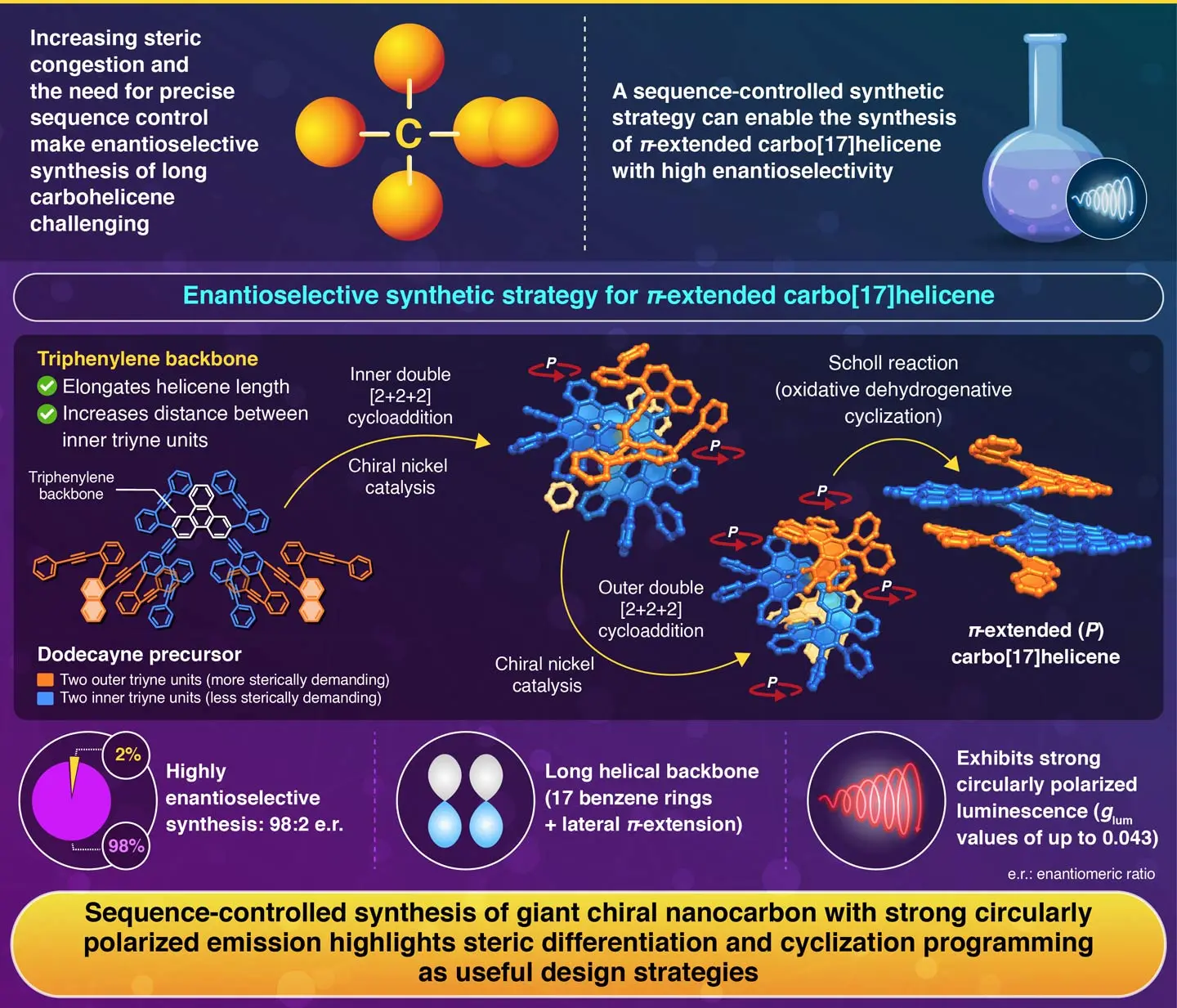
Helicenes are a class of organic molecules consisting of benzene rings arranged in a spiral-like shape. These molecules exhibit significant circularly polarized luminescence-emission of light in left or right handedness-and are expected to be utilized in 3D displays and anti-counterfeiting inks. Carbohelicenes, a sub group of helicenes are composed entirely of carbon and hydrogen.
The rigid and stable helical structures of carbohelicenes, along with their inherent chirality and distinctive optical properties, make them promising candidates for chiral optoelectronic materials, including systems that generate or manipulate circularly polarized luminescence. However, extending the helical backbone while maintaining precise control over its handedness presents a major synthetic challenge.
Increasing the number of fused rings in carbohelicenes intensifies steric congestion-where atoms in a molecule are highly crowded-and molecular strain, while lateral extension of the π-conjugated framework introduces additional structural complexity. Developing a strategy that enables the synthesis of long, laterally extended helicenes with high enantiomeric purity remains a significant challenge.
To overcome this challenge, researchers at Institute of Science Tokyo (Science Tokyo), Japan, and Kyoto University, Japan, have now developed a stepwise assembly framework. The research team was led by Professor Ken Tanaka and Assistant Professor Juntaro Nogami from the Department of Chemical Science and Engineering at Science Tokyo, in collaboration with Professor Hidehiro Uekusa from the Department of Chemistry at Science Tokyo. The team also included graduate student Takeshi Ichimura from Science Tokyo and Dr. Futo Morita, formerly at Science Tokyo and currently at Kyoto University, Japan. They have successfully synthesized π-extended carbo[17]helicene with controlled helical handedness following this strategy. Their study was published online in the journal Nature Synthesis on October 14, 2026.
"Our team designed a precursor containing four triyne units connected through a central triphenylene framework. The two inner triyne units were configured to form less sterically congested helicene structures, whereas the two outer units generated more sterically demanding helicene structures," explains Nogami.
This differentiation was intended to control the order of cyclization and reduce interference between the developing helical structures. Using an asymmetric nickel catalyst, the team carried out four successive [2+2+2] cycloaddition reactions to construct the helical framework, while controlling its handedness.
Subsequent oxidative cyclization reactions, known as Scholl reactions, formed additional carbon-carbon bonds to complete the [17]helicene backbone and extend the π-conjugated framework laterally. The resulting π-extended carbo[17]helicene was obtained with an enantiomeric ratio of 98:2, demonstrating effective control over the molecule's handedness. The researchers conducted single-crystal X-ray structural analysis and confirmed the presence of one of the world's longest helical backbones, consisting of 17 consecutive benzene rings, with additional lateral π-extension.
To investigate the mechanism underlying this reaction sequence, the researchers compared the reactivities of individual triyne units. The triphenylene-bridged inner triyne exhibited approximately four times higher reactivity than the corresponding outer triyne in model reactions. These results support the proposed mechanism in which the inner regions cyclize preferentially before the more sterically demanding outer regions. Computational calculations further indicated that differences in the stability of reaction intermediates help favor the desired pathway and suppress the formation of unproductive intermediates.
The researchers next evaluated the optical properties of the synthesized helicene. The laterally π-extended carbo[17]helicene exhibited red emission with a fluorescence quantum yield of 14%. Its circularly polarized luminescence had a luminescence dissymmetry factor of |glum| = 0.038, indicating a pronounced difference between the emission intensities of left- and right-circularly polarized light.
Together, the findings establish a design principle for synthesizing complex chiral nanocarbons. "Our study highlights steric differentiation and cyclization programming as useful design strategies for enantioselective synthesis of large helical nanocarbons. This strategy of incorporating reaction sequence into a molecular structure could facilitate the future development of 3D chiral molecules for applications in display technologies and anti-counterfeiting inks," concludes Tanaka.
Reference
- Authors:
- Futo Morita1,3,4, Takeshi Ichimura1,4, Juntaro Nogami1, Yuko Kishida2, Kanato Takahashi1, Ryota Shimizu1, Hidehiro Uekusa2, and Ken Tanaka1*
- Title:
- Enantioselective synthesis of π-extended carbo[17]helicene via sequence-controlled quadruple [2+2+2] cycloadditions
- Journal:
- Nature Synthesis
- Affiliations:
- 1Department of Chemical Science and Engineering, Institute of Science Tokyo, Japan
2Department of Chemistry, Institute of Science Tokyo, Japan
3Department of Chemical Science and Engineering, Graduate School of Engineering Kyoto University, Japan


