
Our cells are a hotbed of activity, with reactions churning away to keep us alive. But the cytoplasm, where many metabolic reactions take place, is not uniform. Instead, proteins and other molecules cluster together into membrane-less compartments, creating distinct, crowded microenvironments for reactions. But how the physical properties of these environments affect enzymes, and how enzymes might change these environments in turn, remains underexplored.
Now, researchers from the Okinawa Institute of Science and Technology (OIST), in collaboration with the Max Planck Institute for Dynamics and Self-Organization (MPI-DS) and RIKEN, have studied model protein-rich droplets to explore how enzymes interact with these crowded environments, revealing how protein crowding increases enzymatic activity, while increased enzymatic activity can, in turn, increase the liquid's flow.
"What's fascinating is that we can connect interactions between individual atoms to the movement of molecules across an entire droplet. Events at the smallest scales can shape, and be shaped by, the physical behavior of a much larger system," says senior author Professor Paola Laurino, who leads the Protein Engineering and Evolution Unit at OIST.
Crowding in droplets can speed up reactions
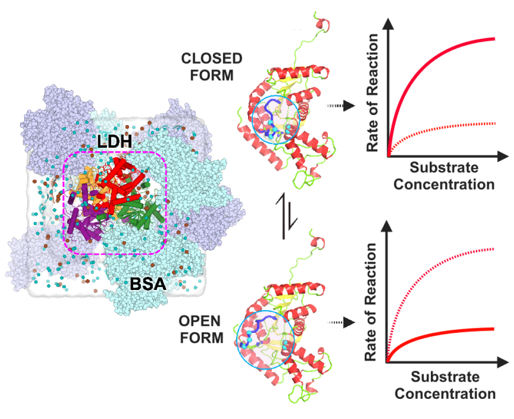
In the first part of the study, OIST researchers created tiny droplets containing a protein called BSA at varying concentrations, ranging from dilute droplets to ones heavily packed with BSA. They then added enzymes - lactate dehydrogenase (LDH) in one set of experiments and alcohol dehydrogenase (ADH) in another - and their substrates to these model droplets to study how crowding affected the enzyme's catalytic activity.
The researchers found that, up to a point, increasing BSA concentration boosted enzyme activity. Only at very high levels of BSA did the increased crowding have a detrimental impact, causing enzymatic activity to decrease.
"This initial increase in enzymatic activity seemed counter-intuitive, as you'd typically expect any level of crowding to impair movement of the enzymes and substrates and increase the liquid's viscosity, therefore slowing down the reaction from the start," explains Laurino.
To dig into why crowding initially increased rather than decreased enzyme activity, researchers at RIKEN used computer simulations to examine how the structure of the enzymes changed as the environment became more crowded. They found that in a dilute environment, the enzyme's active site (the part of the enzyme where the substrates bind and react) was open. But as the environment became crowded with BSA, the enzyme's active site closed.
"When closed, the energy barrier required was much lower, allowing the reaction to happen more readily," explains Laurino. "To detect such a change in these simulations was really surprising to us."
Enzymes get things moving
Next, Laurino and her team examined how enzyme activity affected the fluid dynamics of the droplets. In fluorescent tracer experiments, the researchers found that active enzymes made both BSA proteins and fluorescent nanoparticles move more freely through the crowded droplets. In contrast, droplets that contained altered inactive enzymes were more viscous, and the molecules within moved slower.
"Similarly, we found that higher concentrations of the enzymes or their substrates in the droplets also increased mobility," says Professor Ramin Golestanian, director of the department Living Matter Physics at MPI-DS.
In a theoretical model, MPI-DS researchers proposed that enzyme activity created chemical gradients within the droplets, inducing tiny flows.
"These flows allow the molecules to move more freely and mix within the droplet, highlighting how enzyme activity can potentially lead to physical effects across larger scales," says Ramin.
In future studies, Laurino plans to examine if these two-way interactions between enzymes and their crowded environment hold true for multi-enzymes complexes too, where multiple enzymes are in close proximity. Her team also plans to conduct experiments in vivo in bacterial cells, to determine if their findings hold up under more complicated biological conditions.


