
9 December 2025
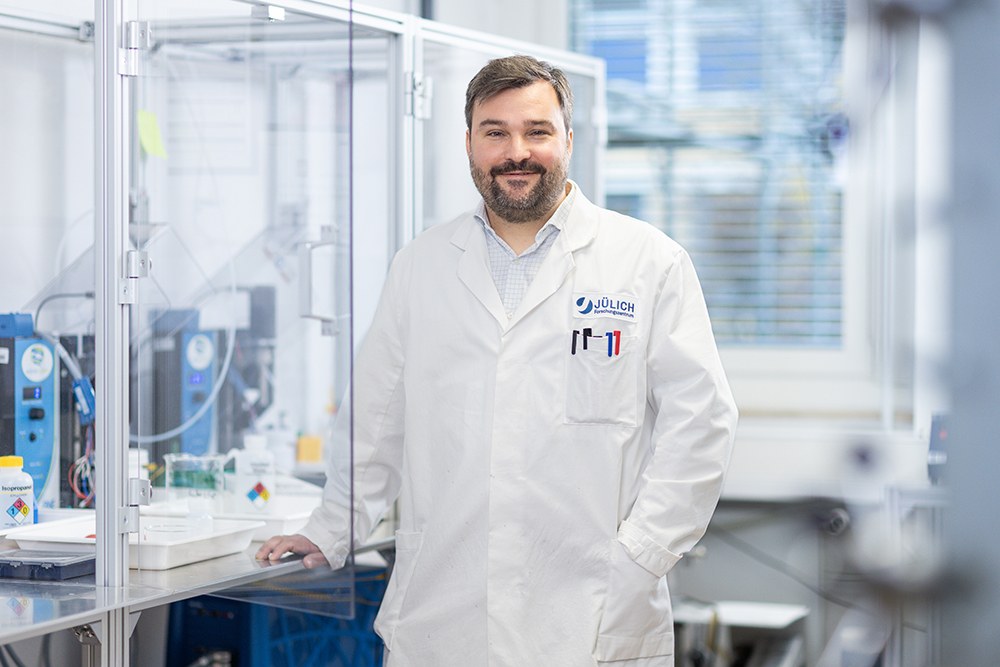
Dr. Felix Gunkel from the Electronic Materials Division at the Peter Grünberg Institute (PGI-7) at Forschungszentrum Jülich has been awarded a Consolidator Grant by the European Research Council (ERC). Over the next five years, his project "Scrambled Oxs" will receive two million Euros in funding. It aims to use a new material design to develop particularly stable and efficient materials for water electrolysis - a key process for the environmentally friendly production of hydrogen.
Hydrogen is considered a versatile energy storage medium with the potential to replace fossil fuels. It is particularly sustainable when produced by electrolysis, a process where water is broken down into its components using electricity.
For this process to work, catalysts are needed - materials that accelerate reactions and, ideally, are not consumed. The oxygen evolution reaction (OER), where water molecules are broken down to release oxygen, is a particularly challenging step in the process, requiring a lot of excess energy. The amount of energy required and the duration a material remains stable, and therefore effective, depends largely on the composition and structure of the catalyst.
"I come from the field of nanoelectronics research, where we have learned to tailor-make such materials with a high degree of precision. I now want to apply this methodology to energy-related issues," says Dr. Felix Gunkel. "For the energy transition especially, we need to develop new and powerful materials and reach beyond the boundaries of specialist disciplines. In Scrambled Oxs, we are using our expertise to develop new catalyst materials for electrolysis."
This highlights one of Forschungszentrum Jülich's particular strengths: expertise from fields such as nanoelectronics, materials research, and energy technology is concentrated in one place. Scrambled Oxs is an example of how this proximity promotes interdisciplinary research and, in turn, pioneering innovations.
A new approach: atomically precise oxides
Dr. Gunkel is focusing on certain oxides in Scrambled Oxs - in this case, compounds of metals with oxygen. Many of these complex metal oxides, such as perovskites and spinels, are promising candidates and can be very active when it comes to releasing oxygen during electrolysis. However, they age too quickly and rapidly lose their stability in their conventional form. This is precisely where the project comes in.
"In order to increase the stability of the catalysts, we need to gain a deeper understanding of the processes that are crucial for ageing and counteract them with targeted material design," says Gunkel.
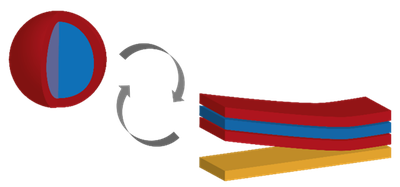
Gunkel's team is developing tailor-made oxide layer systems in which the active oxide layer is enclosed between two stabilizing materials. The layers are stacked on top of each other like atomic Lego bricks, and can be peeled off like a film using a novel process. This new concept is derived from core-shell structures, a versatile design from the field of nanotechnology that effectively protects particularly sensitive materials.
From model material to real electrode
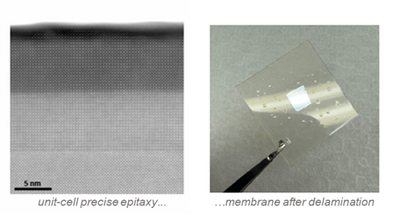
The resulting oxide membranes are crushed into nanometre-sized flakes and incorporated into a liquid to create a kind of catalyst ink - a liquid mixture that can be used to coat electrodes. This targeted "scrambling" creates a new composite material and gave the Scrambled Oxs project its name.
The composite produced in this way makes it possible for the first time to transfer the material properties of the layered oxides to real electrode structures and examine them there under realistic conditions - in other words, exactly as they will be used later in electrolyzers. Only if a material remains stable and active not only in the laboratory model but also in a real electrode can energy consumption be reduced and operating time extended - both key prerequisites for more efficient and economical production of green hydrogen.
Scrambled Oxs thus closes a gap that had previously persisted: for the first time, the model materials can also be examined under real reaction conditions in order to derive concrete guidelines for the development of future catalysts.
ERC Consolidator Grants
With the Consolidator Grants, the European Research Council funds excellent researchers between seven and twelve years after completing their doctoral degree. The grant is considered one of the most prestigious awards in the European scientific landscape.
Funding of up to two million Euros is awarded over five years; additional funding is possible if there is a justified need.


