Scientists from the consortium behind the Euclid space telescope, including researchers at Leiden University, have created the largest and most detailed visible-light image ever taken of the centre of the Milky Way. The image shows more than 60 million stars.
The Milky Way is thought to contain several hundred billion stars, with the highest concentration located in its central region. In this part of the galaxy - about 26,000 light-years away in the constellation Sagittarius - stars are so densely packed that telescopes struggle to distinguish them individually.
On 23 March 2025, the Euclid space telescope was pointed at the centre of the Milky Way. The European Space Agency (ESA) telescope captured the region at a resolution of 60 gigapixels, more than a thousand times the number of pixels in a typical modern smartphone photo. The final image is actually a mosaic made up of nine separate exposures, each covering an area of sky larger than the full Moon. It contains over 60 million stars, as well as clouds of gas and clusters of stars in the galactic centre.

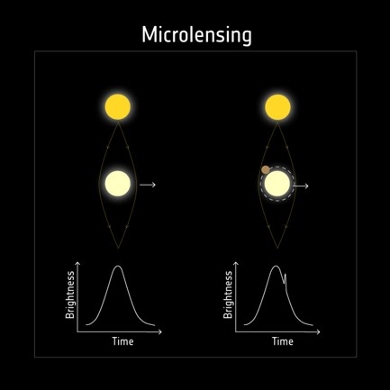
This crowded region is an ideal place for astronomers to search for exoplanets using a technique known as microlensing. This method relies on a chance 'alignment' of two stars, when they appear to line up perfectly as seen from Earth. The closer star bends the light from the more distant one, acting like a cosmic magnifying glass and briefly making the background star appear brighter. If the nearer star has a planet orbiting it, this can be detected as subtle changes in the bent light.
Natural lenses in space
The Euclid mission is primarily designed to map the distribution of galaxies in the (early) universe, using a phenomenon known as gravitational lensing. In this process, nearby galaxies or clusters of galaxies bend the light from much more distant galaxies, effectively acting as natural lenses. However, gravitational lensing also occurs on smaller scales, including around individual stars.
Because there are so many stars in the centre of the Milky Way, the chances of two stars aligning with Earth are relatively high. In this region, the probability that stars overlap in this way is roughly one in a million.
Euclid is particularly well suited to this kind of research. It combines the sharp vision of a space telescope like Hubble with the ability to image large areas of the sky at once. Its field of view is around 270 times larger than Hubble's. Euclid is also faster and can detect the faint details of stars that ground-based telescopes often miss.
Measuring planet masses
Microlensing events can last from a few weeks to several years. In longer events, uneven changes in the bent light can sometimes be seen, caused by a planet orbiting the foreground star. In effect, the planet becomes part of the gravitational lens. Because the Euclid observations took only 26 hours to complete, they did not reveal any new microlensing events. However, the images are still extremely valuable for both future observations of this region and for past data. Researchers expect that these measurements will help determine the masses of around 60 exoplanets previously discovered in this area using gravitational lensing.
'This allows us to measure how fast these objects move.'
Later this summer, NASA is expected to launch the Roman Space Telescope, which will study the centre of the Milky Way in detail and search for exoplanets. 'Euclid has captured all the stars that will be involved in lensing events seen by Roman, but before the stars and planets line up,' says Natalia Reftsini of the Institut d'Astrophysique de Paris, who led the study of the Euclid data. 'This allows us to measure how fast these objects move. That information can be used to confirm the existence of a planet and determine its mass.'
'Microlensing is unbiased - we detect whatever is there.'
One of the strengths of the microlensing technique is that it can reveal relatively small planets far from their host star. Most of the more than 6,000 known exoplanets have been discovered using the transit method, where a planet passes in front of its star. This mainly detects large, hot planets. 'Microlensing is unbiased - we detect whatever is there,' says Reftsini.
Koen Kuijken and a member of the Euclid consortium, is enthusiastic about the new results. 'Euclid combines the sharpness of a large space telescope with the power of wide-field imaging,' he says. 'That allowed us to map this region of the Milky Way in a way we have never seen before. It is a fantastic dataset for astronomers, with many applications, from studying planets to charting the motions and origins of stars in this part of the galaxy.'
About NOVA
The Netherlands Research School for Astronomy (NOVA) is a partnership between the astronomy institutes of the universities of Amsterdam, Groningen, Leiden and Nijmegen. NOVA's mission is to carry out leading astronomical research, train young astronomers at the highest international level, and share new discoveries with society. NOVA laboratories specialise in building advanced optical, infrared and submillimetre instruments for the world's largest telescopes.
This press release originally appeared on astronomie.nl.