
Scientists have long known that diet shapes the immune system. Now, a UC San Francisco team has found that even a brief dietary change can substantially change how the body responds to skin irritation, at least in mice.
When scientists fed mice a high-fat diet for just a few days, the mice had a much worse reaction to an irritating cream. And the skin stayed on alert even after the mice returned to a low-fat diet and inflammation cleared, responding more strongly the next time it was exposed to the cream.
The findings suggest that short-term diet may have just as much effect as body weight when it comes to inflammation.
"Long-term dietary habits absolutely matter for health, but our study unearthed a much more real-time influence of diet," said Sagar Bapat , MD, PhD, professor of pathology at UCSF and corresponding author of the paper, which appears in Nature on Oct. 28. "Breakfast, lunch, dinner - they all can have a tremendous and rapid impact on the immune system."
The discovery grew from laboratory experiments on obesity, led by Zewen "Owen" Jiang, PhD, co-first author of the paper, carried out when he was a graduate student at UCSF.
Jiang and his colleagues first raised mice on either low-fat or high-fat food pellets. Then, the scientists applied imiquimod, a cream that triggers skin inflammation, to one ear of each mouse and compared what happened between the low- or high-fat diet groups.
Obese mice habitually fed high-fat pellets had severe reactions to imiquimod, while mice fed with low-fat pellets had mild reactions.
"For many years, we've known that obesity is tied to more severe inflammation. But we wanted to know whether it was the extra weight or simply the bad diet that was driving the stronger response," Jiang said.
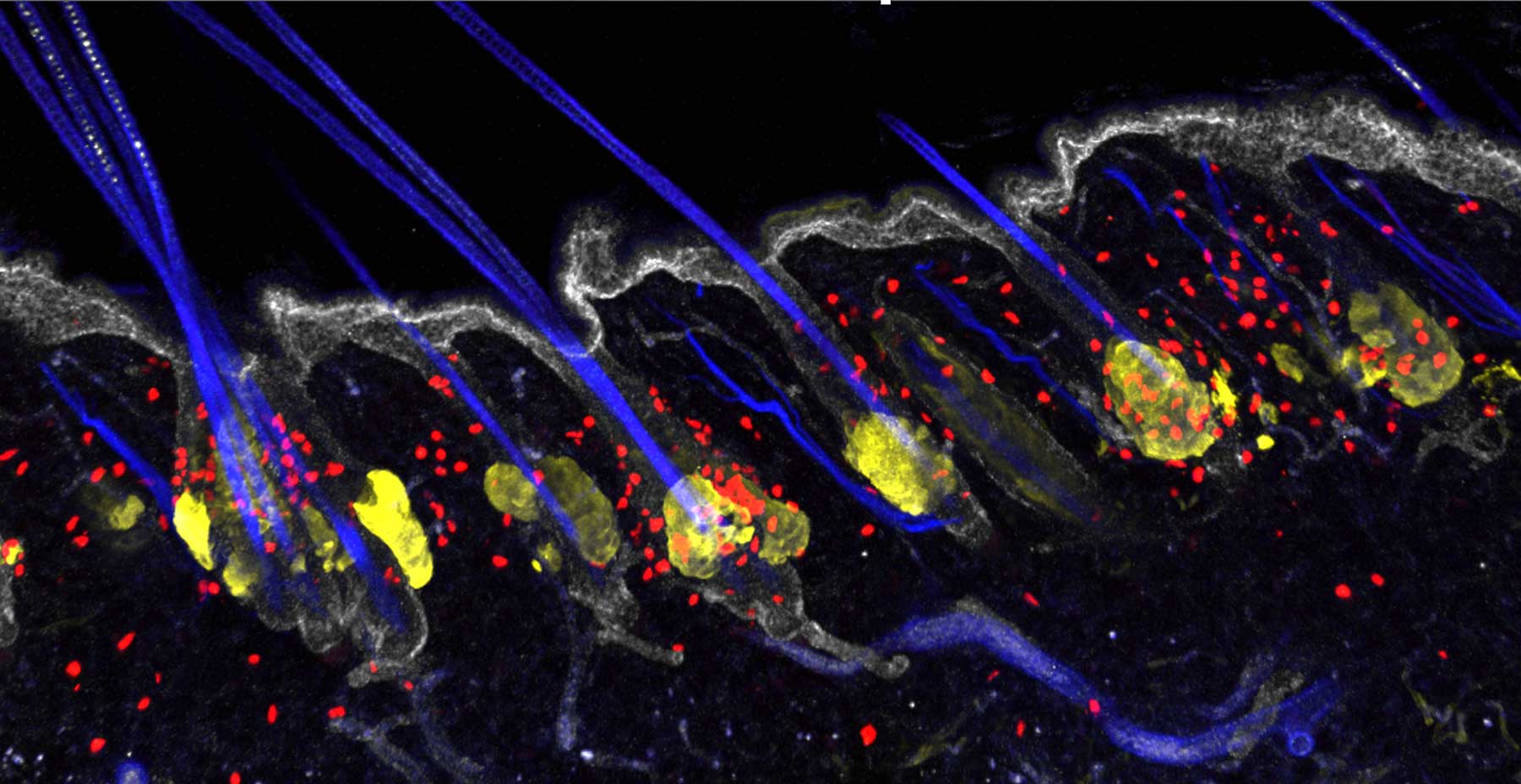
Mice were briefly fed high-fat food for three days before receiving an irritating cream on one ear, leading to severe inflammation. The mice were returned to a low-fat diet. Weeks later, after the inflammation subsided, many memory T-cells (red) remained in the ear, priming it to overreact in the future. Below: Blue, hair cells; yellow, oil (sebaceous) glands; grey, skin.
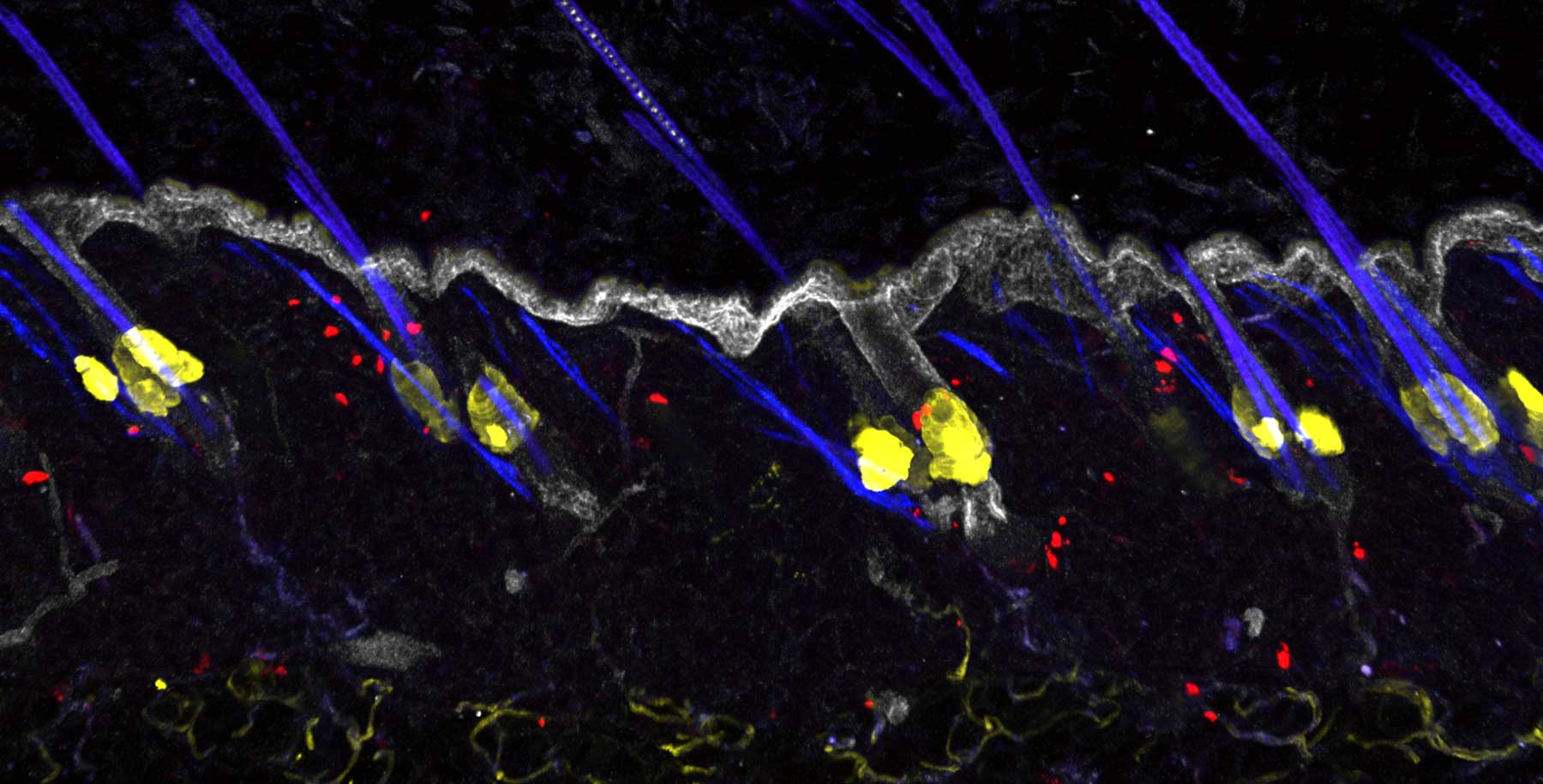
Mice on a low-fat diet received an irritating cream on one ear, prompting a mild inflammatory response. Weeks later, few memory T-cells remained.
So, the team tested whether just four days on high-fat food was enough to trigger an over-active immune response. They switched mice that had been raised on low-fat food to high-fat food, and dabbed one ear with imiquimod three days later. The normal-weight mice developed severe ear inflammation just like the obese mice.
Likewise, obese mice that had been switched to normal food for four days experienced much milder inflammation.
Weeks later, after the normal-weight mice had returned to a low-fat diet and their inflammation had subsided, they got a second dose of imiquimod in the same ear that had flared before - and it triggered an outsized response.
Jiang and Bapat found that high-fat food drew rapid-response immune cells into the skin, where they amplified the reaction to imiquimod. As the inflammation subsided, other immune cells, called memory T cells remained in the affected ear. Together, these changes left the tissue primed for the next time.
The team found a similar kind of heightened inflammation in response to irritation in the lungs after just a few days of eating a high-fat diet.
"The diet of a laboratory mouse doesn't map neatly onto what we eat, but it's striking how quickly the immune system responds to what's happening in the body right now," said Jiang. "Diet, exercise, sleep - they could all shape immune health in ways we don't yet appreciate."
Authors: Other UCSF authors are John M. Tayeri; Im-Hong Sun, PhD; Joy Li, PhD; E. Dean Merrill, MD; Longhui Qiu; Dongliang Zhang, MD; Vrinda Johri; Megan E. Dobson, PhD; Ruriko Watanabe, PhD; Mazharul Maishan; Margaret M. Lowe, PharmD, PhD; Chihiro Tabuchi, PhD; Sarah G. Gayer; Arum Yoo; Nandini Borkar; Jiaxi Wang; Han Yin; Shin Shyan Chuah; Preetal Deshpande; Brittany Davidson; Jessica Tsui; Nicholas F. Kuhn, PhD; Tristan Courau, PhD; Vinh Q. Nguyen; Raymond J. Cho, MD, PhD; Jeffrey B. Cheng, MD; Michael D. Rosenblum, MD, PhD; Mark R. Looney, MD; Alexis J. Combes, PhD; Ari B. Molofsky, MD, PhD; Michael A. Matthay, MD; and James M. Gardner, MD, PhD. For all authors, see the paper.
Funding: This work was supported in part by the National Institutes of Health (R01DK125260, P30DK116074, R35HL161241, R38HL143581, K38HL154202). For all funding and disclosures, see the paper.


