
"Cotton-Inspired Phase Change Fiber Aerogels with Dual-functional Thermal Protection for Personal Thermal Management" ACS Energy Letters
Once cotton gets wet, it pulls heat from your body. This is helpful when you're exercising or outside on a hot day but dangerous in the bitter cold. Now, researchers reporting in ACS Energy Letters have created an ultralight synthetic fiber material with a cotton-like fluffiness that also repels water. The prototype fabric outperformed regular cotton in both retaining heat in the cold and releasing heat at room temperature.
Inspired by the fluffy structure of cotton, we created a new material that is ultralight and flexible." - Quan Shi
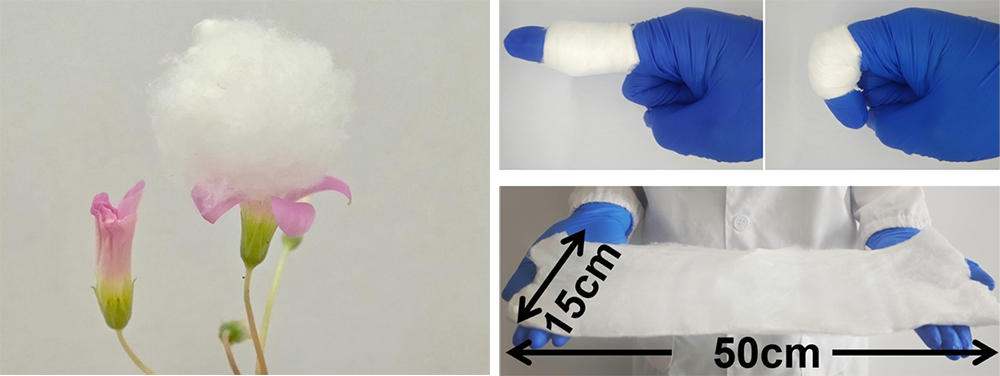
Adapted from ACS Energy Letters 2026, DOI: 10.1021/acsenergylett.6c00363
"Inspired by the fluffy structure of cotton, we created a new material that is ultralight and flexible. It keeps you warm in the cold better than cotton or commercial synthetic insulations, while also prevents you from getting too hot at room temperature," says Quan Shi, a corresponding author of the study.
To improve natural fibers' ability to regulate heat in extreme cold, researchers have proposed coating the fibers with phase-change substances. These substances harden and melt as the air temperature changes and then trap or release heat, respectively. But current phase-change coatings stiffen fabrics and sometimes leak onto the wearer. So, Shihui Zhang, Zhihua Zhang, Quan Shi and colleagues integrated a phase-change material into synthetic fibers that the team designed to mimic the soft structure of cotton.
The researchers created a network of polymer fibers dotted with microscopic capsules of a phase-change hydrocarbon. Their lightweight material could be formed into cotton-like balls or flat fabric.
Then, the team produced swatches about 6 by 20 inches (15 by 50 centimeters) for experiments. Initial tests showed that the swatches didn't absorb water vapor in a humid environment or water droplets, whereas cotton fabric absorbed both forms of moisture. Additionally, the material stayed flexible and strong after repeated bending and movement.
Play Video
Seek to live, currently behind live
Playback Rate
- Chapters
- descriptions off, selected
- captions settings, opens captions settings dialog
- captions off, selected
- en (Main), selected
Fullscreen
This is a modal window.
The video is bad or in a format that cannot be played on your browser
Close Modal Dialog
The swatches automatically switched between releasing or trapping heat, depending on air temperature. And in tests, the new fabric kept a hand wrapped in it significantly warmer than a hand wrapped in cotton fabric of the same thickness at minus 13 degrees Fahrenheit (minus 25 degrees Celsius), and it let heat through slightly better than traditional cotton at room temperature. Finally, after 20 washes, the prototype swatches didn't shed fibers, bounced back to their original fluffiness, and kept 97% of their heat-trapping ability. The researchers say that these results indicate this new cotton-inspired material is promising for use in clothing, especially items designed for extreme cold.
The authors acknowledge funding from the National Natural Science Foundation of China, Dalian Institute of Chemical Physics, and Dalian Science and Technology Innovation Fund.


