
The UC Davis Center for Mind and Brain is set up for a unique experiment with laminated images on the walls at each blue X taped to the floor: a banana across from an extended tape measure, scissors facing blueberries, an orange facing a hammer.
Experiment participant Travis Rouse would have eight minutes to find and remember each pair. Then all the images would be taken down, and he would have to stand at those same spots to try to remember exactly what he had seen there.
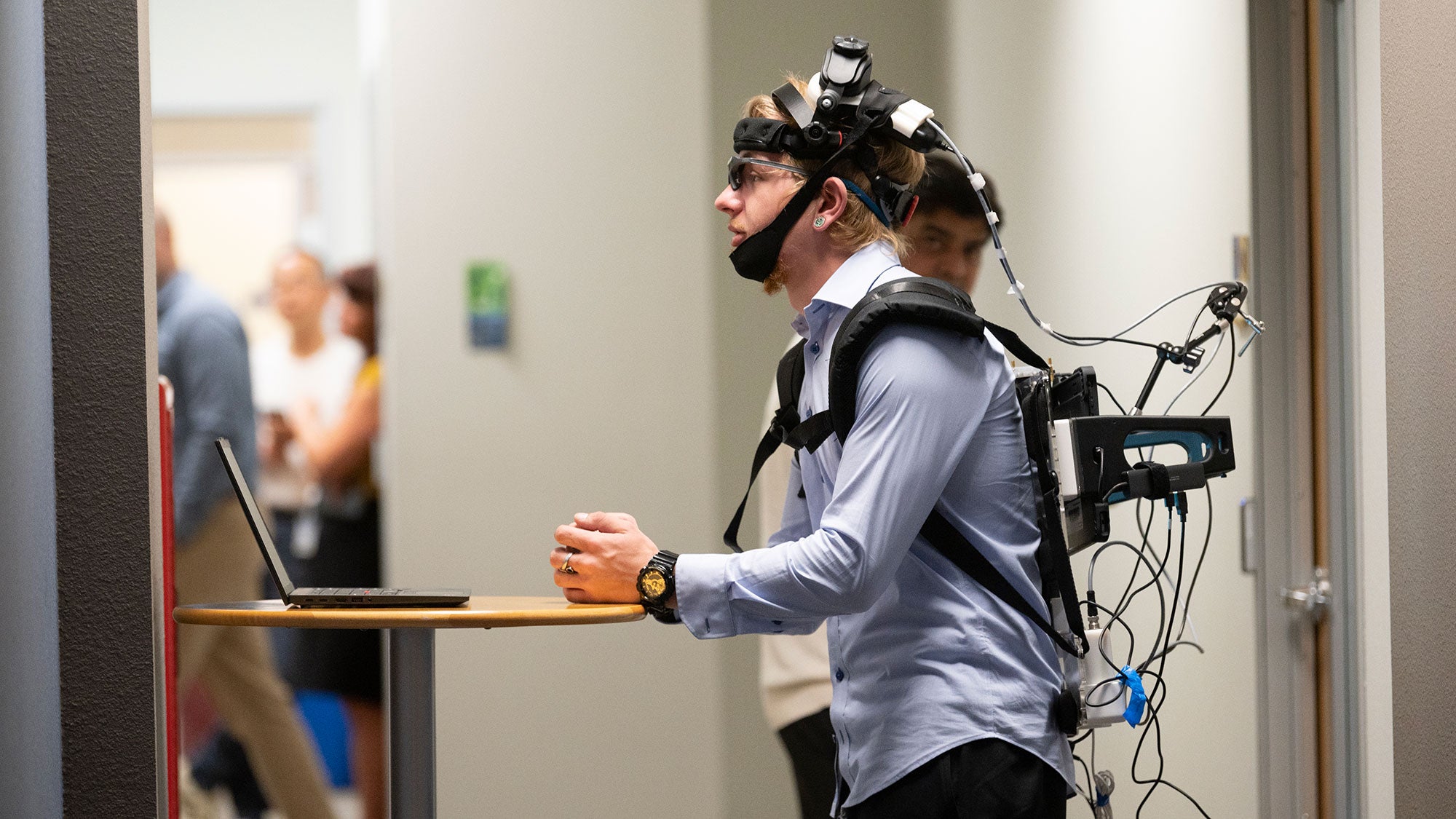
But before going off to find the fruits and tools, postdoctoral scholar Anand Shankar was equipping Rouse with a backpack and headgear carrying a GPS device, Wi-Fi router, tablet, eye tracker and a scanning wand to gather data from the device implanted in Rouse's brain that helps manage his epileptic seizures.
While Shankar fidgeted with the headgear, Rouse joked, "There's so much going on here. Where's the flux capacitor?"
It was late March, and 22-year-old Rouse and his stepmother Renay Huntsinger had driven more than two hours from their home near Redding, California, to take part in this experiment led by Dr. Jack Lin, director of the UC Davis Comprehensive Epilepsy Program and a core member of the Center for Mind and Brain, a research center in the College of Letters and Science that studies how the human mind works. This kind of research is rare and will take a leap forward in understanding how the brain navigates us through the world from the neurons up.
"How we go from one place to another is critical for our everyday living, yet we actually don't know a lot about it at the very elemental level," said Lin.
What causes an epileptic seizure
Everything we do starts with electrical activity in the brain. Seeing an apple, moving across the room or reading an article like this one all happen via tiny jolts of electricity pulsing through a network of neurons. However, sometimes those networks break down.
Epilepsy is a condition in which those breakdowns cause seizures. The seizures can range in severity from focal seizures, which can leave a person momentarily confused, to a tonic-clonic seizure, previously called grand mal seizures, which can cause convulsions and a loss of consciousness. Medications can help control epileptic seizures, but not always.
Rouse was diagnosed with epilepsy when he was 12, but the seizures might have begun as early as 6 years old.
"We started noticing that the seizures were getting more and more frequent and more and more violent," said Huntsinger. "There were times when he'd fight us coming out of it. He would try and climb the walls. His arms would swing. His legs would swing."
Since his diagnosis, Rouse experienced a roller coaster of ups and downs. Medication had not worked and neither had any of the treatments recommended by his pediatric doctors.
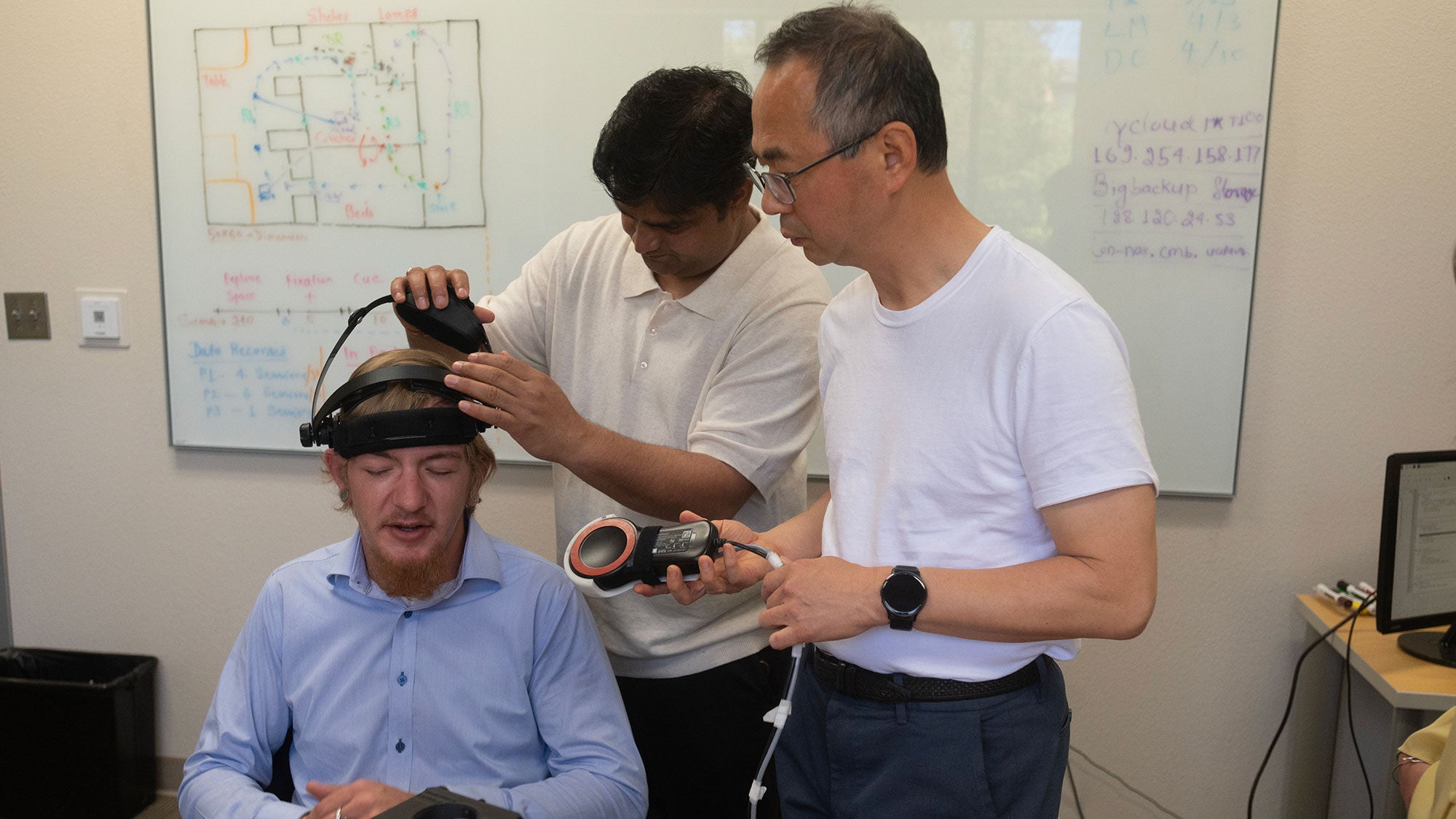
When Rouse first met Lin, he was scared to have surgery but trusted Lin's knowledge and team. In the Comprehensive Epilepsy Program clinic, 13 electrical leads implanted into Rouse's brain showed that the seizures were emanating from the hippocampus, a deep structure that is critical to everyday life.
The hippocampus has been described as the brain's storyteller for how it stitches together separate events into a narrative. It's also where navigational memory is encoded, giving us snapshots of where we have been so we can get where we are going.
What happens in the hippocampus is hard to study in high detail. It has been possible to capture activity when a person is lying down inside the giant magnet of a fMRI machine. In the Comprehensive Epilepsy Program, implanted electrical leads capture brain activity at even greater resolution - down to small groups of neurons - and with much more freedom.
This combination of high-resolution observations and relative freedom to move around opens up an incredible potential for studying the brain. However, the experiment with Rouse may not have happened without a completely separate line of research at much lower resolution.


