
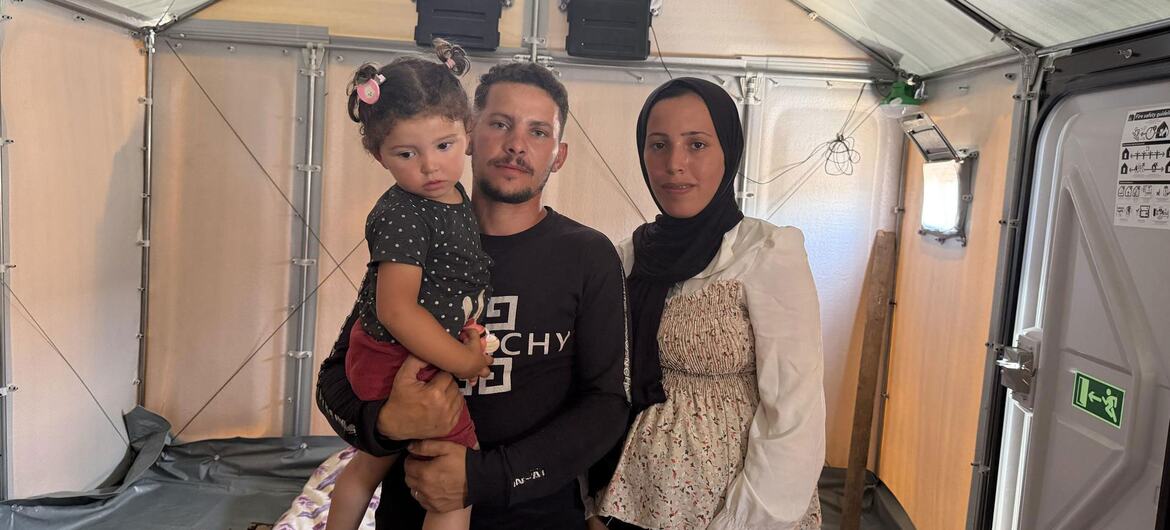
Displacement has drastically reshaped every aspect of daily life in war-ravaged Gaza for 24-year-old Mayyada, who is seven months pregnant with twins and caring for her two-year-old daughter, but now she and her family are getting settled into a temporary home of their own.
"I hope my children's future will be brighter than our present," said Mayyada, who is originally from Jabalia refugee camp in Gaza and has lost count of the number of times her family has been forced to move during the Israel-Hamas war that started in October 2023.
Forced to flee their homes multiple times, families have sought refuge wherever they could, moving between schools, temporary shelters and makeshift tents while facing overcrowding, insecurity and the loss of privacy.
"From our home to another home, from school to school, from tent to tent," she says. "We move from one place to another. Every time we faced many struggles."
Now, she tends to a garden and prepares for the birth of her twins.
Rebuilding neighbourhoods
As early recovery efforts expand across Gaza, restoring neighbourhoods means more than providing temporary shelter because it requires rebuilding the conditions that allow communities to function again.
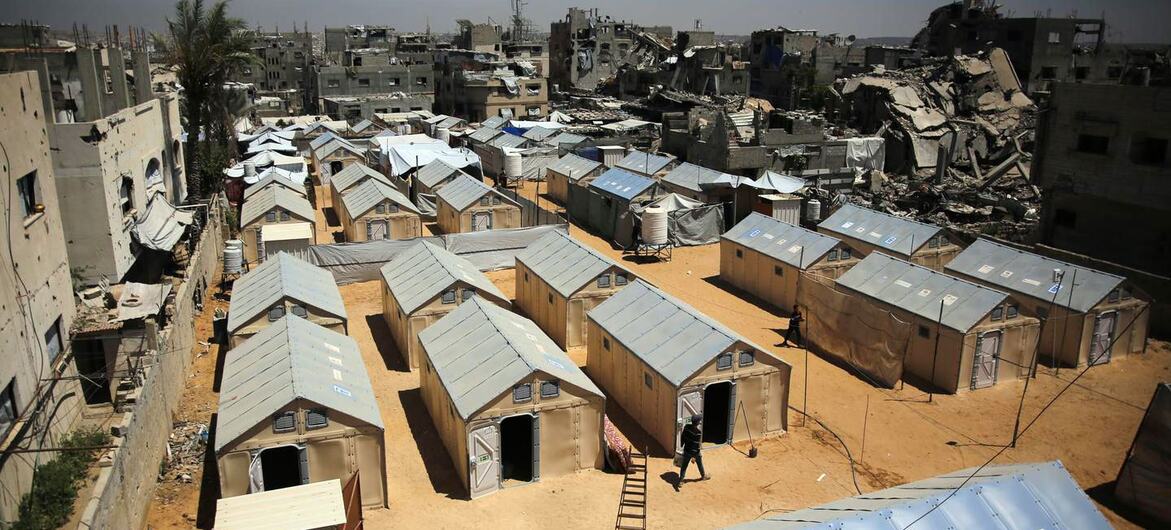
Families like Mayyada's are being supported to return closer to their areas of origin through the Gaza Neighbourhood Approach project implemented by the UN Development Programme ( UNDP ) in coordination with the Palestinian Authority, UN sister agencies and other partners.
The new housing units also come with debris removal, rehabilitation of essential services, emergency employment opportunities and the restoration of basic infrastructure, as part of UNDP's Relief, Employment and Vital Infrastructure for the Vulnerable in Emergencies ( REVIVE ) initiative that is supporting communities across six countries.
A war-changed future
Before the war, Mayyada worked as a portrait artist, painting and selling her artwork.
"Painting was always the first thing I wanted to do wherever I lived," she says. "But, since the war started, I haven't touched my art."
The war also changed the future she and her husband, Ahmed, had envisioned together, planning their marriage and looking forward to building a life of their own.
"I hoped that we would have everything," she said. "I never expected that I would be living in tents for so long."
Starting from scratch
Each displacement meant starting over from scratch, Mayyada said. Every new shelter brought new hardships, while the simple comforts of privacy, stability and routine became increasingly difficult to find.
"There were times when we lived in tents with my uncles and aunts," she recalls. "It was very difficult. There was no privacy at all."
Displacement also meant leaving behind more than a home. Across Gaza, countless people have lost not only their livelihoods, but also the routines and passions that once defined their daily lives.
"All of these tents are close together and men and women must stay separately, making family life even more challenging," she said.
'We had to stay in other people's tents'
During the ceasefire in March 2025, the family briefly moved into Ahmed's family home, which had remained standing. But, the relief was temporary. As displacement continued, they were once again forced to seek shelter wherever space was available, often sharing tents with other families.
"When we were displaced again, we had no chance to live by ourselves," Mayyada explains. "We had to stay in other people's tents."
In the rubble of their home
Eventually, they returned to the place where their home once stood and built their own makeshift shelter using whatever materials they could find, including old clothes, pieces of wood and nylon sheets.
"We built it from whatever we had," she says. "But, these materials wear out very quickly."
Like thousands of displaced families across Gaza, they faced constant exposure to the elements, deteriorating shelter materials and lack of protection from insects and pests.
'We were waiting for that moment'
When Mayyada recently learned that her family would receive a relief housing unit, she began counting the days until they could move in.
"We were waiting for that moment," she said. "Just having a small, private place meant so much."
Today, these units provide the family with a safer and more dignified place to live. More than shelter, it has restored a measure of privacy and stability while allowing them to begin rebuilding a sense of home.
"I am trying to create a sense of stability for myself and for my family," she said. "As an artist, I want to make it beautiful."
Yearning for 'my own home'
The family now carries out daily chores outside the unit, while Mayyada has planted greenery around it and started decorating the space.
While the housing unit has improved the family's living conditions and restored some privacy, Mayyada's hopes remain focused on the future where, like many displaced families in Gaza, she dreams of something more permanent, a place to call her own.
"More than anything," she says, "I still wish to have my own home to have peace in my mind and to have peace around me."
Watch how relief housing is already changing lives across Gaza:
Key takeaways
Here's what you need to know:
The structures: UNDP is offering transitional weather-protected lockable shelters that can be assembled in several hours
Neighborhood approach: The units are part of a broader recovery strategy and are erected along with restored water wells, solid waste management, health centres and educational services
International support: Funding and resources are coming from Germany, Republic of Korea and Sweden
Housing rehabilitation: UNDP is also working to repair partially damaged homes
Challenges: Despite the installation of these units, the need remains overwhelmingly high, with widespread infrastructural damage, meaning these temporary shelters are an interim step prior to long-term reconstruction


