
A new global review shows countries taking very different approaches to regulating polygenic embryo testing
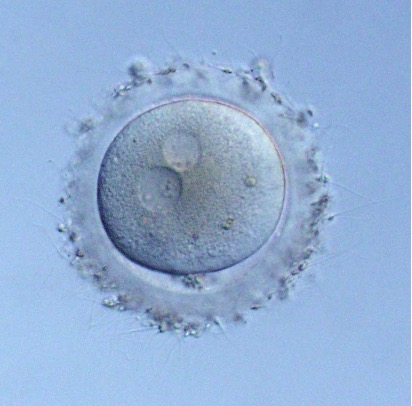
For more than four decades, in vitro fertilization (IVF) has helped families have children. Scientists estimate that more than 10 million people worldwide have been born through IVF and related assisted reproductive technologies, according to the International Committee for Monitoring Assisted Reproductive Technologies.
As part of these procedures, prospective parents may choose to genetically test embryos before implantation in the uterus. This process, known as preimplantation genetic testing (PGT), was originally developed to identify serious inherited diseases caused by single errors in the DNA or gene mutations, such as cystic fibrosis or haemophilia, and prevent them from being passed on to the next generation. However, advances in technology have significantly expanded the potential scope of preimplantation genetic testing.
In a new article published in Frontiers in Reproductive Health, Professor Tetsuya Ishii of Hokkaido University examines the emerging use of genomic testing to predict complex traits in embryos, such as intelligence or the risk of developing conditions like diabetes, heart disease, or Alzheimer's disease later in life. As embryo testing moves beyond disease prevention toward the prediction of complex human social characteristics, Ishii argues that stronger oversight and clearer regulations are needed.
Many traits, such as intelligence and physical appearance, as well as the likelihood of developing common diseases like schizophrenia and cancer, are shaped by both our genes and our environment. Unlike monogenic diseases, which result from a mutation in a single gene, polygenic diseases and traits arise from the combined effects of many genes, each contributing subtly alongside lifestyle and environmental factors.
In recent years, scientists have identified numerous genetic variants linked to these complex traits and can combine them into a single polygenic score, a statistical estimate of an individual's genetic tendency to a particular trait or condition. With this advancement, preimplantation genetic testing has expanded from screening for monogenic diseases (PGT-M) to assessing polygenic conditions (PGT-PS), which often emerge later in life.
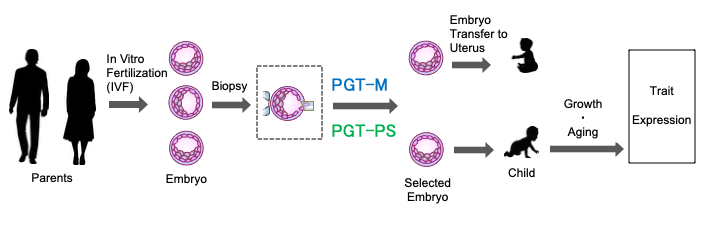
"However, predicting complex traits remains highly uncertain. Polygenic scores attempt to predict complex traits using only an embryo's genetic variants and data from large genetic studies, without accounting for environmental influences," explains Ishii.
Countries around the world regulate polygenic embryo testing in very different ways. In the United States, polygenic embryo screening has been commercially available since 2019, and some fertility clinics routinely offer it to prospective parents who wish to select embryos. Surveys suggest that many Americans support using polygenic scores to reduce disease risk, and some are also open to using them for non-medical traits.
In contrast, several European countries have adopted stricter limits. Germany and Italy allow embryo testing only to prevent serious genetic diseases, while the United Kingdom currently does not permit the use of polygenic scores for embryo selection.
In many other countries, however, clear regulations have yet to be established. Without explicit rules, the use of polygenic scores in embryo selection could expand even as scientists continue to debate their clinical value.
The technology has also raised several ethical concerns. Prospective parents could develop unrealistic expectations about their future children based on genetic predictions that remain uncertain. "Because of environmental influences, parental behavior, the child's autonomy, and many other factors, the use of polygenic scores cannot guarantee that a child will develop the predicted trait," says Ishii.
Then there are broader societal concerns, including the potential stigmatization of certain traits, the risk of viewing children as products designed to meet parental expectations, and fears that the technology could revive ideas associated with eugenics.
The underlying challenge is the growing gap between expert opinion and public attitude. While many physicians and geneticists remain cautious about using polygenic scores for embryo selection, surveys suggest that some prospective parents are more receptive to the technology.
Because polygenic embryo testing remains a rapidly developing field, Ishii argues that policymakers should adopt precautionary regulations while improving public understanding of what genetic predictions can and cannot reliably reveal. Clear guidelines, he suggests, will be essential as reproductive technologies continue to advance.
Original article:
Tetsuya Ishii., Precautions for polygenic embryo selection: prohibition or cautious use. Frontiers in Reproductive Health. February 26, 2026. DOI: 10.3389/frph.2026.1771127.
Funding:
This work was supported by JSPS Grant-in-Aid for Transformative Research Areas (A) 23H04857.


