
'If we can tell before they are trained if they [will be successful], that saves a lot of time and a lot of money, and it will also increase the number of guide dogs out there to help people'
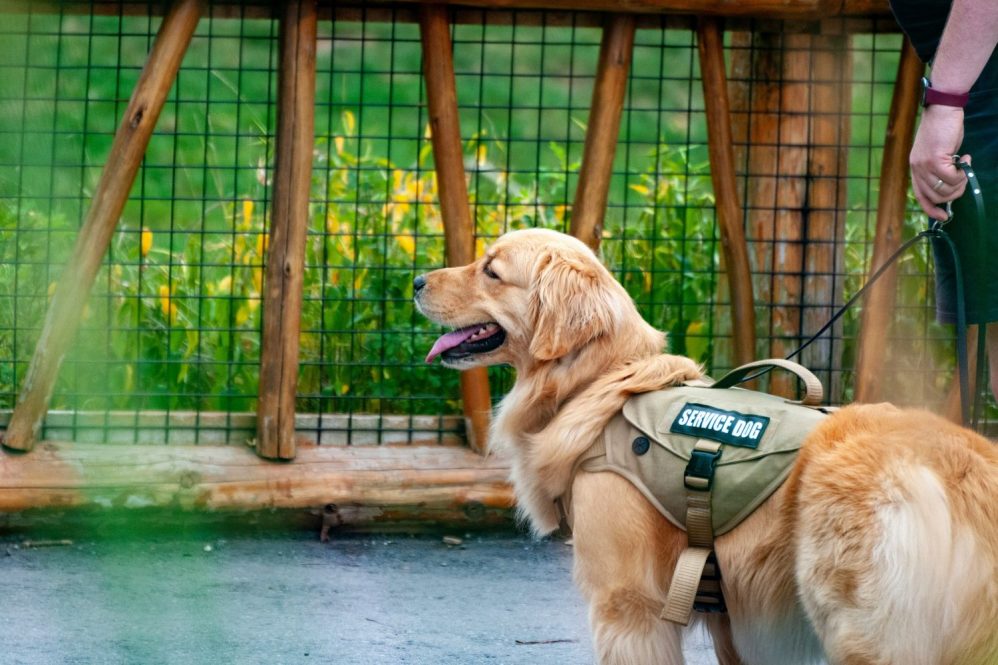
Photo by Andy Luo on Unsplash
Guide dogs help thousands of people with visual disabilities navigate daily life.
While guide dogs provide tremendous benefits, the current training program faces serious inefficiencies, since a large percentage never actually assist an owner. Only 60% of dogs evaluated for assistance work graduate from their training programs. This means a loss of more than $12,000 per dog unable to complete training. A dog that has completed the program costs up to $50,000, and people can wait years for a trained animal.
Most dogs that fail to complete guide dog training do so because of behavioral issues. This led Breno Fragomeni, associate professor of animal science in the College of Agriculture, Health and Natural Resources (CAHNR), to conduct an analysis of dogs' genetics to see if there was a way to better predict which animals would be successful guide dogs.
"If we can tell before they are trained if they [will be successful], that saves a lot of time and a lot of money, and it will also increase the number of guide dogs out there to help people," Fragomeni says.
This work was published in Genetics Selection Evolution.
Fragomeni looked at 17 traits taken from the International Working Dog Registry's (IWDR) Behavior Checklist. Trainers working for organizations around the world use this checklist to quantify dogs' fitness to work as guide dogs.
Fragomeni focused on the traits that are most associated with failure to graduate including jumping on people, biting, and reactivity to strangers or loud noises.
Fragomeni had access to IWDR's pedigree information, which includes at least three generations, as well as complete genomic sequences for 1,100 Labrador retrievers, the most common breed of guide dog.
Using equations, he correlated this genetic information with the dogs' performance according to their Behavior Checklist evaluations.
"If I have one dog with many puppies, and I look at the performance of those puppies, that performance would be a good indicator of the genetics of the father," Fragomeni says.
With genomic data, Fragomeni was able to not only tell if certain parental genetics gave rise to puppies that were more likely to become guide dogs, but if individual animals are more likely to be successful. Fragomeni found that genomic data was a better predictor of a dog's success for at least 11 of the 17 traits he studied when compared to traditional evaluations.
"If I have genomic data, I don't need to wait for animals to have progeny to tell if they are going to be good [guide dogs]," Fragomeni says. "Just using genomic data, I can predict how well all those animals will perform."
This information can inform "breeding values," numbers IWDR assigns to give breeders a sense of the likelihood that a given dog's offspring can be successfully trained as guide dogs.
"If we keep selecting them, we're going to improve that population consistently over time," Fragomeni says.
One major limitation of this study was the lack of animals with complete genomic data available. While people, including Fragomeni, have been using genomic information to help selectively breed livestock for decades, this was one of the first attempts to use it for guide dogs.
"The paper is very important for that reason, because now we have a working example in that specific population," Fragomeni says. "It shows the potential of those tools, and we expect those numbers to increase much, much faster."
While this study was confined to Labrador retrievers, Fragomeni says he plans to expand the work to other common guide dog breeds including German shepherds and golden retrievers. He is also working on a paper evaluating how selecting for one trait, like fear of strangers, could impact others, like harness sensitivity.
Fragomeni is also interested in using this work to predict common health issues within a breed. This could have applications beyond service animals.
"Eventually we want to come up with a way that people can genotype their pets and learn if they're at a higher or lower risk of developing cancer," Fragomeni says. "That will change how you treat them throughout their life and if you allow them to breed or not."
This work relates to CAHNR's Strategic Vision area focused on Enhancing Health and Well-Being Locally, Nationally, and Globally.


