
The biggest bat genome and fossil study ever undertaken has busted myths about their origin and revealed echolocation and flight evolved near the dawn of bat evolution.
Published in the prestigious international journal Nature, the study lays new foundations for research into the genetic basis of bats' exceptional longevity and disease resistance, with potential relevance to human health.
The study brought together 137 researchers from 64 countries, working as the Bat1K consortium, generating and analysing 103 genomes and 44 fossils.
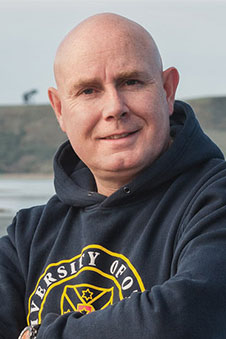
Professor Neil Gemmell
Among them was co-author Professor Neil Gemmell, of the University of Otago – Ōtākou Whakaihu Waka Department of Anatomy.
Using state-of-the-art DNA sequencing and computational methods, the team assembled the largest collection of high-quality bat genomes to date, representing every one of the currently recognised 21 bat families, including Aotearoa New Zealand's native short-tailed bat (pekapeka), combining them with fossils to reconstruct the species' evolutionary history.
"Bats are fascinating creatures. They are the only mammals capable of true powered flight, they use sonar – echolocation – to 'see' in the dark, and they live surprisingly long lives while resisting many deadly diseases.
"Despite these superpowers, scientists have long argued over exactly how bats evolved and where they came from," Professor Gemmell says.
The findings show bats most likely originated in Europe about 65 million years ago and that two defining characteristics of bat biology – echolocation and powered flight – were established near the origin of the group itself.
"These findings overturn previous assumptions which were that bats originated in Asia, Africa or North America. Instead, we found they dispersed from Europe, into Africa, then Asia, the Americas and Australia.
"There has also been a lot of debate about bat evolution – how are the different families related, when did flight and echolocation emerge, and how did they evolve their unusual traits?"
Senior author and Co-founding Director of Bat1K Professor Emma Teeling, of University College Dublin, says the study has provided answers to many of these long-standing questions.
"We've essentially redrawn the bat family tree, resolving debates which have puzzled scientists for decades," she says.
The study also reconstructed the genome of the ancestor of all living bats.
This now gives scientists a genomic map for how one lineage of mammals evolved powered flight, advanced biosonar, exceptional longevity and unusual disease resistance.
"It is extraordinary, after decades of research and conflicting findings, we finally have a framework to properly understand how bats' unique traits evolved. We also have the genomes to uncover the molecular basis of these spectacular adaptations and know where the fossil bats fall in this tree," Professor Teeling says.
Professor Gemmell notes bats seem to be particularly unaffected by viruses, and suggests this new framework may eventually inform human research into ageing, immunity and disease resistance.
"This includes some that have been devastating to human health in recent years, like Covid-19. Cancer also seems less frequent in bats. Perhaps bats will provide some clues to how we might be able to protect ourselves from those diseases in the future."
Senior author and Bat1K Co-founding Director Professor Sonja Vernes, of the University of St Andrews, says bats are among the most extraordinary mammals on Earth.
With more than 1,500 species distributed across the globe, bats account for one fifth of all living mammals and play vital roles in maintaining healthy ecosystems by pollinating plants, dispersing seeds and consuming vast numbers of insect pests.
"Bats constantly surprise us. They are one of evolution's greatest experiments. This extraordinary genomic resource, the culmination of years of international cooperation of Bat1K, is finally allowing us to understand how their remarkable biology evolved," she adds.
From bumblebee to sucker-footed bats to bats that like to crawl instead of fly
The work represents the largest combined bat genome and fossil study ever undertaken. Building this dataset required samples collected over decades from bats across the world, including representatives of some of the rarest and most unusual bat families, found in the most remote locations.
Among them are the tiny bumblebee bats of Thailand and Myanmar, widely considered the Earth's smallest mammal, the remarkable sucker-footed bats of Madagascar, which have suction cups on their wrists and ankles that they use to cling to smooth leaves, and one from Aotearoa New Zealand's only native mammals, the lesser short-tailed bat (pekapeka), which "walks" along the forest floor using its folded wings as forelegs.
Professor Gemmell says the lesser short tail bat genomic sequencing was only possible with the support of Ngāti Rangi iwi, which gave permission to sequence a bat found dead on their rohe more than 25 years ago, which had been stored in a lab freezer.
"I was delighted we could use that old sample, to produce an extraordinarily high-quality chromosome level sequence with the support of Genomics Aotearoa, and colleagues from The Bioeconomy Science Institute, The Bragato Research Institute and the University of Auckland."
While the pekapeka from Aotearoa was a small part of study, with the greatest focus being on Northern Hemisphere bats, the species filled in a crucial part of the bat family tree.
"The genetic blueprint, now established through this study should empower further studies of this species that would aid its future conservation," Professor Gemmell says.
About Bat1K:
The Bat1K consortium is an international initiative working to generate and analyse reference-quality genome assemblies for all living bat species. This study represents Phase 1 of the project. See more at www.bat1k.com
Publication:
Reference genomes and fossils revise bat family phylogeny and biogeography
Ariadna E. Morales, Yan Liang (梁妍), William R. Thomas, Evgeny V. Leushkin, Francisco X. Castellanos, Denis M. Larkin, Tom Brown, Bastian Fromm, Suzanne J. Hand, Zixia Huang, Graham M. Hughes, Matthew F. Jones, Burton K. Lim, Meike Mai, Eugene W. Myers, Martin Pippel, Sebastien J. Puechmaille, Nancy B. Simmons, Linelle Ann L. Abueg, Nadav Ahituv, Zahran A. AlAbdulsalam, Ine Alvarez van Tussenbroek, Dineilys V. Aparicio, Lina M. Arcila Hernández, Alexander Ben Hamadou, Petr Benda, Mark Blaxter, Alex V. Borisenko, Jorge Brocca, Nair Cabezón, Lucia Carbone, Jose I. Carvajal, Wharton O. Y. Chan, Paul Davis, Dina K. N. Dechmann, Annette Denzinger, Judith L. Eger, Seth J. Eiseb, David Enard, Mark D. Engstrom, Nicole M. Foley, Giulio Formenti, Jackson Fuller, Ismael Galván, Akshamal M. Gamage, Neil J. Gemmell, Joanne E. Gillum, Alejandro Gonzales-Irribarren, Mailyn A. Gonzalez, Steven M. Goodman, Jonathan Gray, Carola Greve, Michael W. Guernsey, Edgar G. Gutiérrez, Yelena Guttman, Michael Hackenberg, Elena Hilario, Leon Hilgers, Thomas W. Horsley, Melissa R. de Waal, Deirdre M. Jafferally, Erich D. Jarvis, Sahieda A. Joemratie, Mirjam Knörnschild, Jenna E. Kohles, Dimitrios-Georgios Kontopoulos, Bonhwang Koo, M. Elise Lauterbur, Michael Letko, Harris A. Lewin, Shenglin Liu, Darrell K. Lizamore, Brian D. Lloyd, Livia Loureiro, M. Cristina MacSwiney G., Yury V. Malovichko, Kirsty McCaffrey, Dominik W. Melville, Magdalena Meyer, William O. Mgoola, Matthieu Muffato, Vincent J. Munster, William J. Murphy, Martina Nagy, Nicolas Nesi, Kimberly A. Nevonen, Haris Nicolaou, Evans E. Nkrumah, Zacharias Norman, Brian P. O'Toole, Sarah H. Olson, Alain Ondzie, Bismark A. Opoku, Jorge Ortega, William S. Pearman, Francy J. Perez-Llanos, Kendra L. Phelps, Myrtani Pieri, Sarahjane Power, Maksym Prylutskyi, Paola Pulido-Santacruz, Guoying Qi, Bernal Rodríguez-Herrera, Danny Rojas, Indranee Roopsind, Stephen J. Rossiter, Constance Scharff, Tilman Schell, Stephanie N. Seifert, Fernando Simal, Pipat Soisook, Simone Sommer, Andrew Spalton, Emma L. Stone, Peter H. Sudmant, Sam Talbot, Robert M. Timm, Laura Uelze, Nathan S. Upham, Marek Uvizl, Peter Vallo, Juan M. Vazquez, Lin-Fa Wang, Linet C. Watson, Daniel Whitby, Sylke Winkler, York Winter, Laurel R. Yohe, Monika Zavodna, Ning Zhang, Huabin Zhao, David A. Ray, Sonja C. Vernes, Liliana M. Dávalos, Michael Hiller, Emma C. Teeling
Nature
DOI: 10.1038/s41586-026-11007-3


