
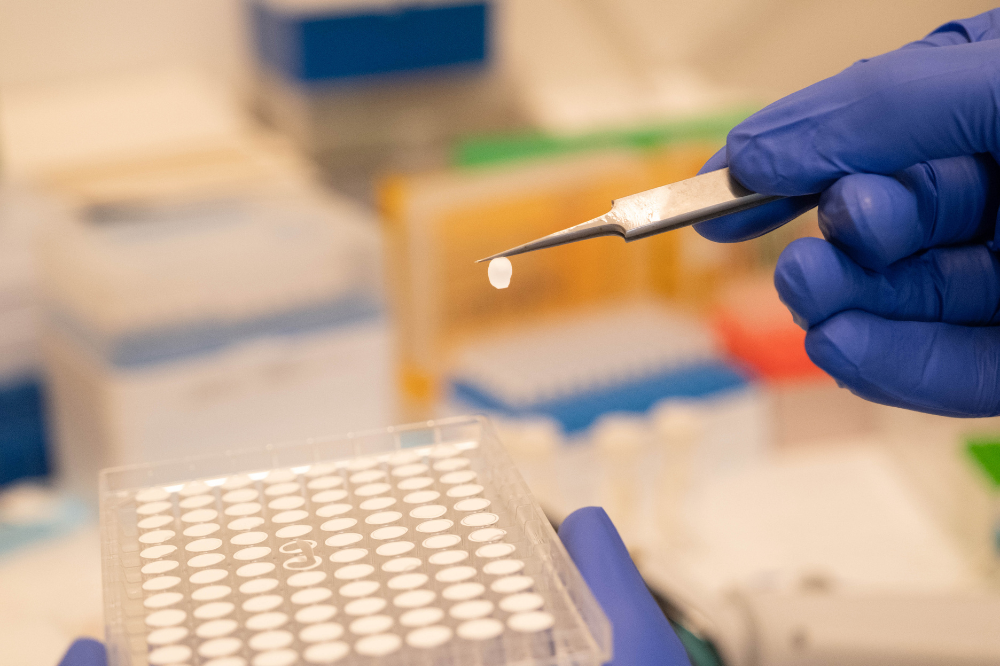
Shanshan Liu and Mark Gad developed a liposome-based transport assay to characterize SLC33A1 transport activity. (Credit: Lori Chertoff)
In the past several years, Rockefeller University's Kivanç Birsoy and his team in the Laboratory of Metabolic Regulation and Genetics have revealed remarkable details about the antioxidant glutathione, which plays many essential roles in the body, from clearing free radicals to repairing cellular damage. Among other things, they've discovered the transporter that shuttles glutathione to where it's needed, how glutathione keeps iron levels in check, and the metabolite's complicated relationship with mitochondria, the energy center of the cell, where it both keeps the lights on yet can drive the metastasis of breast cancer.
Now they've discovered glutathione's key part in maintaining the smooth operations of a protein-producing hub in the cell called the endoplasmic reticulum (ER). They shared their results in a paper published in Nature Cell Biology.
"Rockefeller has an incredibly rich history of research on the endoplasmic reticulum, so we know that when things go wrong in this organelle, many diseases ranging from neurodegeneration to cancer can result," says Birsoy. "We discovered a glutathione regulator in the ER that likely plays a key role in these conditions."
That regulator, they learned, acts as a crucial proofreader, ensuring proteins in the ER are folded correctly.
Striking the right balance
Birsoy's team discovered a few years ago that if glutathione levels aren't precisely maintained in mitochondria, all systems fail. Among those team members were co-first authors Shanshan Liu, a postdoc in the lab who has long researched mitochondrial metabolism, and Mark Gad, a Ph.D student jointly supervised by Birsoy and Richard Hite, of Memorial Sloan Kettering Cancer Center. On the heels of their initial findings, the group began to wonder about glutathione's impact in the ER, which works with the mitochondria to keep the cell in a state of homeostasis.
Based on previous work, the team knew that glutathione contributes to maintaining the tightly regulated, Goldilocks-like environment of the ER, where secretory and membrane proteins manufactured by ribosomes are folded for export. These proteins are then exported into the cytosol (the jelly-like fluid that fills the cell) and then move further afield to complete their assigned tasks. Unlike in the mitochondria-where the ratio between different forms of glutathione favors the unoxidized version-the ER prefers an oxidized environment. So, working with Hite's lab, the team set out to discover not just why that is, but also what mechanisms calibrate the optimal ratio.
Quality control
After developing a new method to rapidly profile the chemical landscape within the ER, Liu began to directly observe functions within the organelle. She discovered that the ER maintains its oxidized equilibrium by importing from the cytosol an oxidized form of glutathione called GSSG and exporting a reduced form called GSH. The ER maintains its balance by keeping a high ratio of GSSG to GSH. A genetic screening revealed that a transporter called SLC33A1 oversees this process. Structural studies performed by Gad in collaboration with the Hite lab further confirmed that SLC33A1 protein indeed transports GSSG and revealed biochemical details of this process.
"Before this work, we knew the ER needed to stay oxidized to fold proteins correctly, but the machinery responsible for maintaining that balance was essentially a black box," says Gad.
"We discovered that the correct glutathione ratio is essential to a proofreading step in protein folding. It may even be its primary job," Liu says. "So if something goes wrong and the GSSG accumulates, it inhibits an enzyme that relies on the correct oxidation of the ER environment to operate a protein quality control system."
Moreover, they discovered, when misfolded proteins don't pass quality control, they won't get exported, so they too pile up in the ER. Eventually this excess debris can lead to cell death.
"Identifying SLC33A1 as the key exporter-and being able to visualize exactly how it binds its cargo-gives us a handle on a process that, when it goes wrong, is linked to neurodegeneration and cancer," says Gad.
Neurodevelopmental disorders and cancer
To that point, the researchers also identified glutathione-linked molecular mechanisms that may contribute to very different diseases. The first is Huppke-Brendel Syndrome, a severe neurodevelopmental disorder characterized by severe intellectual disability, motor deficits, and progressive neurodegeneration. Until now, researchers knew it was linked to mutations in the gene that produces the SLC33A1 transporter but little else.
"Our findings raise the possibility that the dysfunction of this gene alters the delicate glutathione balance in the ER and leads to protein misfolding during brain development," Liu says. "We think this could lead to new interventions, such as reducing the glutathione overload through synthesis inhibitors or compounds that can dissipate it."
The findings also have implications for potential therapies for lung cancers related to mutations in the KEAP1 gene. "These cancer cells rely on a high level of glutathione synthesis," she adds. "So if we were to inhibit the SLC33A1 transporter, the GSSG would accumulate, and the cancer cells would die."
"Our work demonstrates that defining how nutrients and metabolites are transported across cellular and organelle membranes reveals fundamental principles of cell biology while uncovering a major class of disease-relevant and therapeutically tractable proteins," Birsoy says. "We will continue to illuminate this largely uncharted area in future work."


