
A study in the Antarctic proves this: If a group of people is isolated for months in a hostile environment, this promotes mistrust, conflict and group formation.
By orbiting the moon at the beginning of April 2026, humanity has taken another step towards long-term space missions. While technical hurdles are increasingly being overcome, another challenge is emerging: the long-term coexistence of people under extreme conditions.
Although healthy interpersonal relationships and team cohesion are crucial for mission success, long-term data on the development of social interactions and the functioning of teams in prolonged isolation has been lacking until now.
This is now changing: Professor Sebastian Walther, Director of the Department of Psychiatry, Psychosomatics and Psychotherapy at the University Hospital of Würzburg (UKW), and a team from the Universities of Bern, Zurich, Turin, Lisbon, Madrid and Melbourne have analysed how isolation and confinement affect a crew. The results have been published in the journal PNAS.
Cut off from the outside world for months
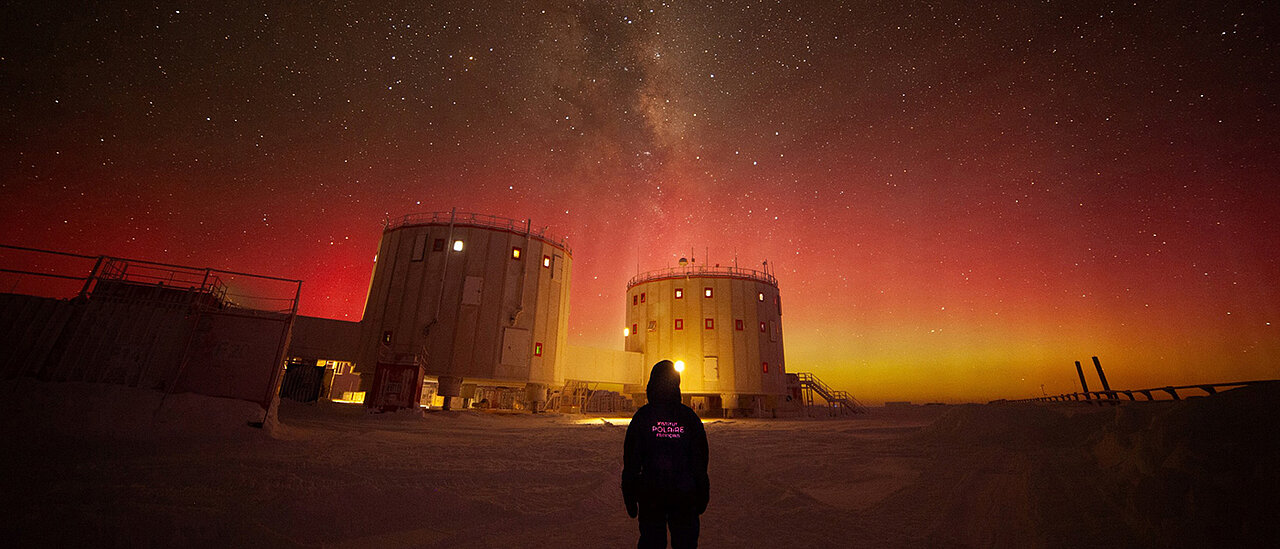
For ten months, the researchers followed twelve members of the wintering team at the Concordia research station in Antarctica - using wearable proximity sensors and repeated interviews.
During the Antarctic winter, which lasts from mid-February to mid-November, the research station is completely cut off from the outside world. "Its extreme remoteness is even greater than that of the International Space Station (ISS)," explains Sebastian Walther. "This requires exceptional preparation for self-sufficiency in emergencies and places a considerable burden on the teams working there."
For outdoor activities, the crew members have to wear heavy protective suits and brave the extreme conditions - down to minus 80 degrees at an altitude of 3,200 metres. "The hostile external conditions, dependence on technology for life support, limited rescue options and communication delays, as well as the confined space and working in small, isolated multicultural teams are key characteristics that a Concordia Station hibernation team shares with a long-term space mission," says Walther.
Distrust, loneliness and team dynamics
Previous studies on wintering teams in the Antarctic have focussed on individual factors such as mood and sleep. This revealed a consistent deterioration in these values over the course of the missions.
Walther and his team now focussed on social interactions, mistrust, loneliness and team dynamics. As extreme isolation can distort the perception of the frequency and quality of social interactions and team processes, wearable proximity sensors were used. They were used to reliably record all close interactions between team members: Who meets whom, how often and for how long? This created a picture of the network of social contacts within the team.
Paranoid tendencies recognised
In addition, self-reporting by the team members provided insights into subjective experiences. For example, the participants reported increased mistrust as early as the middle of the mission, even though they had previously undergone strict selection procedures. After a few months, they believed that others were talking about them or watching them.
"These paranoid tendencies and mistrust illustrate that even psychologically robust people can develop distorted social perceptions under extreme conditions," comments Sebastian Walther. These psychological dynamics, which can influence the ability of teams to function in long-term missions, have received little attention to date.
"We know from studies with people with manifest paranoid experiences that proximity is perceived as particularly stressful," says Walther, referring to two studies he has published on the subject. Until now, it was assumed that sleep disorders and a negative self-concept were particularly dangerous for the development of paranoid experiences. However, according to Walther, the current study shows that isolation under extreme conditions can also lead to clear paranoid symptoms.
Human proximity becomes a burden
In addition to an increase in paranoid thoughts, the results also show greater loneliness and an increase in conflicts, while team cohesion and individually perceived performance decreased.
Interestingly, the interpersonal interactions recorded by the sensors increased over time without, however, being accompanied by improved well-being or increased team dynamics. On the contrary: more frequent contact sometimes even led to more conflicts and greater psychological stress.
The study therefore indicates that not only isolation, but also close spatial boundaries or long-term spatial proximity can represent a key stress factor and trigger interpersonal tensions.
Group formation in multicultural teams
In addition, the Concordia team, which consisted of people of Italian and French nationality and one person from another member state of the European Space Agency (ESA), formed subgroups based on language and nationality.
This pattern corresponds to the principle of homophily: "Birds of a feather flock together". It shows that people tend to identify more strongly with similar groups when they are insecure. The authors of the study assume that group boundaries have become more pronounced with increasing exhaustion and point to the risk of social fragmentation and polarisation in international missions.
For future long-term missions, for example to Mars, such dynamics could be of crucial importance: "Success in space depends not only on technology, but also on how well people work together under extreme conditions," says Sebastian Walther.
Wearable sensors have proven their worth
At the same time, the study shows that wearable sensors - SocioPatterns sensors were used in the study - are a promising tool for continuously and unobtrusively recording team interactions in so-called ICE environments (ICE is derived from the English term "isolated, confined, extreme") and recognising potential problems at an early stage.
The findings are not only relevant for space travel: They could also help to make teams more stable and resilient in other extreme working environments such as in submarines, on offshore platforms or in remote research and military stations.
Information about the Concordia station
The research station is located on an East Antarctic plateau and is operated jointly by the French polar institute IPEV and the Italian Antarctic programme PNRA. It was founded in 2004 as a research centre for various disciplines such as glaciology, atmospheric sciences, astronomy, astrophysics, geosciences and technology. It is located at an altitude of 3,200 metres and the oxygen content of the air is reduced. The environmental conditions are among the most extreme on earth: the average winter temperature is minus 51 degrees Celsius, with extreme values reaching minus 80 degrees. Concordia is 950 kilometres from the nearest coast, 1,670 kilometres from the South Pole and 560 kilometres from the nearest station.
Publication
Social interactions in isolated, confined, and extreme environments: A study of Antarctic winter teams using wearable sensors. PNAS, 26 May 2026, https://doi.org/10.1073/pnas.2533420123


