Scientists have found a planet that challenges the long-held assumption that lava planets are too hot to sustain an atmosphere. Waterloo Scientist Dr. Lisa Dang, physics and astronomy professor, and her collaborators made this discovery when they found a thick atmosphere around the rocky exoplanet TOI-561 b after flagging it as a planet of interest.
TOI-561b is a rocky planet orbiting so close to its parent star, and theory predicts it should have had its atmosphere blown away by the intense stellar radiation. Using data from the James Webb Space Telescope (JWST) that covered 37 hours and almost four orbits of the planet, they found that the temperature on the day side of TOI-561 b wasn't as hot as they thought it should have been. To get the temperature of a planet that far away, scientists look to measure the light emitted by the planet.
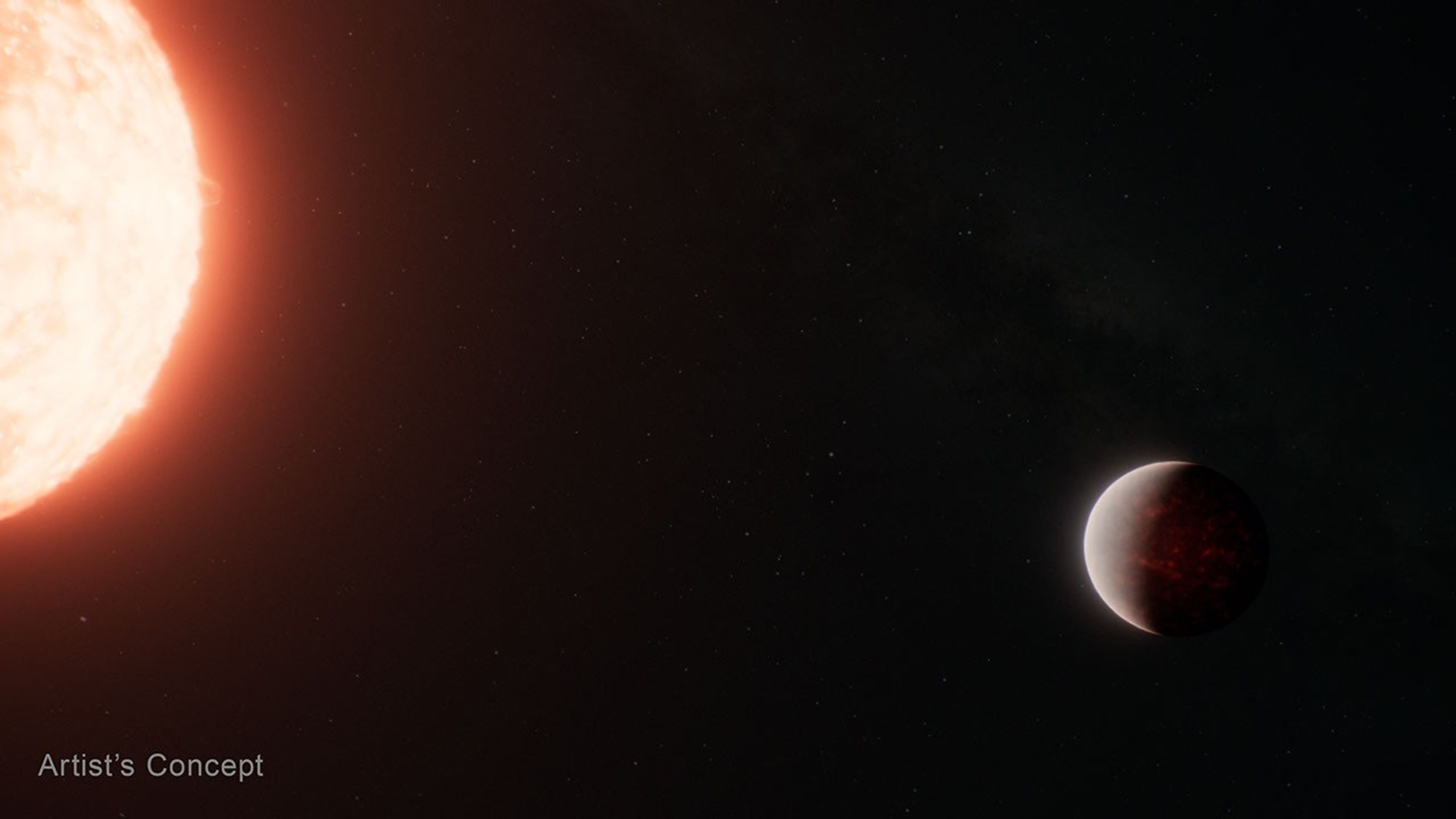
This artist's concept shows what the hot super-Earth exoplanet TOI-561 b and its star could look like based on observations from NASA's James Webb Space Telescope and other observatories. Webb data suggests that the planet is surrounded by a thick atmosphere above a magma ocean. Credit: NASA, ESA, CSA, Ralf Crawford (STScI)
"We looked at TOI-561 b while it was eclipsed behind its host star, when the light directly from the planet was blocked, so we could estimate how bright the planet itself is," says Dang. "The hotter the planet, the more luminous the planet is going to be, and the eclipse signal we saw was significantly smaller than expected."
They estimate that the dayside is about 1000°C cooler than predicted, given the exoplanet's proximity to its star. All this evidence suggests that heat is being distributed around the planet via a thick atmosphere, possibly one with strong winds, because vaporized rock alone couldn't explain the heat transfer from one side to another.
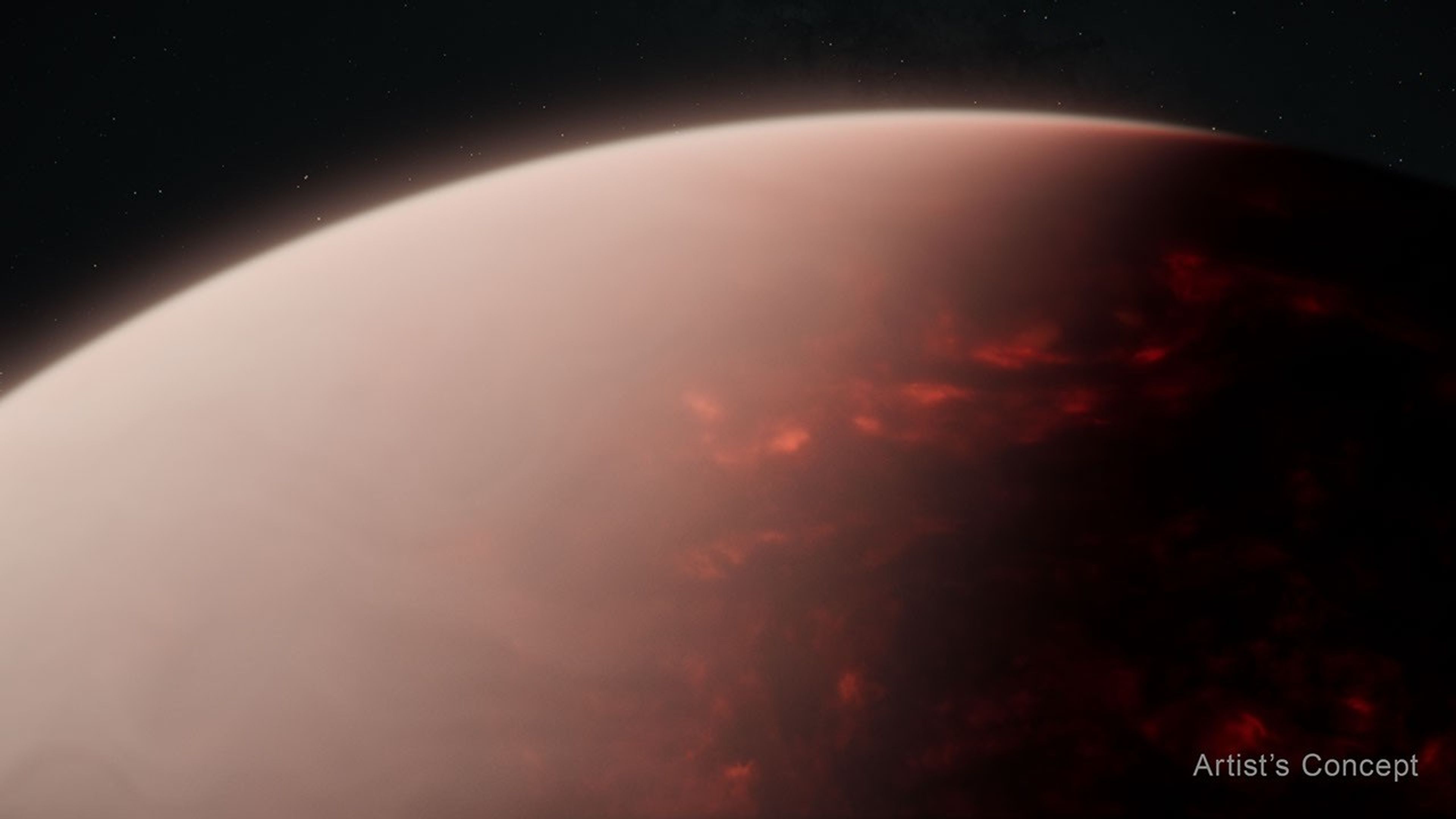
An artist's concept shows what a thick atmosphere above a vast magma ocean on exoplanet TOI-561 b could look like. Measurements captured by NASA's James Webb Space Telescope suggest that in spite of the intense radiation it receives from its star, TOI-561 b is not a bare rock. Credit: NASA, ESA, CSA, Ralf Crawford (STScI)
"Normally we see a lot of vaporized rock in the atmosphere of planets this hot, but vaporized rock isn't very efficient at bringing heat from the day side to the night side," says Dang. "Our hypothesis for TOI-561 b is that it must have stored volatile molecules (like water and carbon compounds) in its mantle to shield them from being lost in space. Eventually, those molecules were outgassed to form the atmosphere we've detected."
Dang contributed to the data analysis for this project and to interpreting how this result fits in the bigger picture. The team used all available tools to prove that the results they were seeing were correct because the story this data was telling was exciting. The next stage of the project involves reviewing the full 37 hours of JWST data to see what other mysteries TOI-561 b might be hiding.
"This discovery is a reminder that understanding atmospheric retention is equally important as atmospheric loss," says Dang. "With the amazing capabilities of Webb, we are finding evidence of extreme atmospheric retention on planets that were thought to have lost their atmospheres, in parallel to finding excessive atmospheric loss. All these discoveries are now expanding our understanding of what promotes atmospheric escape and retention on exoplanets at large."
The paper, "A Thick Volatile Atmosphere on the Ultrahot Super-Earth TOI-561 b," was published in The Astrophysical Journal Letters.