
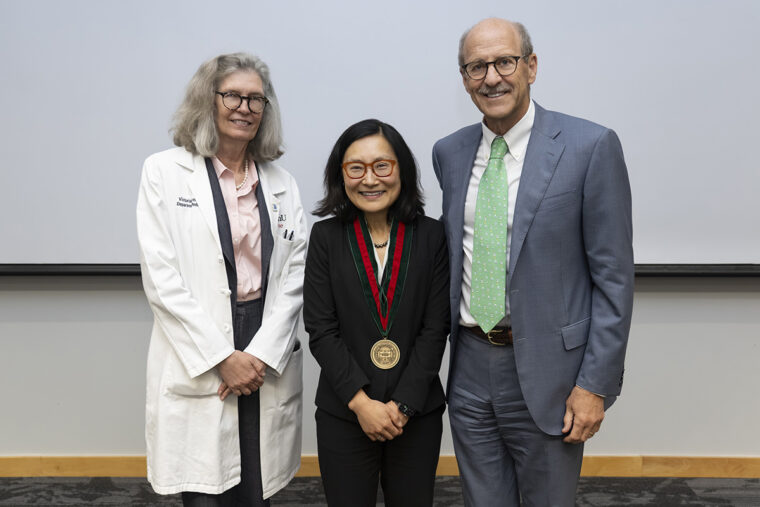
Janet S. Lee, MD, a highly regarded physician-scientist in pulmonary and critical care medicine, has been installed as the inaugural Selma and Herman Seldin Distinguished Professor of Medicine at WashU Medicine. The professorship is the second established by the Seldins.
Lee is director of the Division of Pulmonary & Critical Care Medicine in the John T. Milliken Department of Medicine and a professor of pathology and immunology. She was installed by David H. Perlmutter, MD, executive vice chancellor for medical affairs, the Spencer T. and Ann W. Olin Distinguished Professor and the George and Carol Bauer Dean of the School of Medicine.
"I'm deeply grateful to the Seldins for their vision and generosity in establishing this professorship," said Chancellor Andrew D. Martin. "Dr. Lee is an internationally recognized leader whose work is redefining how we understand and treat acute lung injury. Her ability to translate fundamental scientific discoveries into advances in patient care reflects the very best of WashU Medicine and will have a lasting impact on patients across the region."
Lee joined WashU Medicine in 2023 to develop innovative clinical programs aimed at improving approaches to treating lung diseases and strengthening the body's ability to fight infection, such as severe pneumonia and sepsis. Her research focuses on how the body responds to lung damage and how those responses can be guided to improve recovery.
"WashU Medicine has been home to many of the most important figures in lung disease research," Perlmutter said. "Dr. Lee is continuing that legacy. She has an exceptional ability to connect insights from basic science to the realities of patient care, driving innovation in how we prevent and treat serious lung disease. In leading our Division of Pulmonary & Critical Care Medicine, she is building on the strength of our clinical and translational research programs to shape the future of the field of pulmonary medicine."
In her lab, Lee has identified key molecules in the blood that help control inflammation and direct immune cells to the lungs after injury. For example, her team found that a certain protein on red blood cells helps regulate signals that draw immune cells where they are needed. They also discovered that another protein, thrombospondin-1, released during injury can reduce harmful inflammation in severe pneumonia, pointing to potential new treatment strategies.
Lee also is studying how toxins produced by bacteria can worsen lung damage and affect the survival of critically ill patients in intensive care units. This work is helping researchers better understand how severe infections can lead to long-term lung conditions such as chronic obstructive pulmonary disease and bronchiectasis.
Beyond her research, Lee is committed to addressing the significant health burden of lung diseases in Missouri and surrounding states. As division director, she has focused on strengthening programs for patients with chronic lung diseases and expanding access to care in the community.
Lee has been continuously funded by the National Heart, Lung and Blood Institute, part of the National Institutes of Health (NIH), and has served as a principal investigator on multiple grants. These include studies of how the body defends against enzymes produced by harmful microorganisms present in acute lung injury and how host mechanisms regulate lung infections. She also led grants focused on patient-oriented research in acute lung injury and on the complement system's role in fighting infections and inflammation.
In addition, Lee served as a project leader on research to investigate immunosuppression in acute lung injury. Her current research examines how thrombospondin-1, released after injury, helps protect the lung and influences outcomes in patients with acute respiratory distress syndrome.
Lee is an elected member of the American Society for Clinical Investigation and the Association of American Physicians. She was a recipient of the American Thoracic Society (ATS) Recognition Award for Scientific Accomplishment and served as the chair of the American Thoracic Society Membership Committee and the ATS Allergy, Immunology, and Inflammation Program Committee. In 2026, she is set to lead the Gordon Research Conference on the Biology of Acute Respiratory Infection.
"Dr. Lee is a stellar example of a physician-scientist who bridges basic and translational research," said Victoria J. Fraser, MD, the Adolphus Busch Professor of Medicine and head of the Department of Medicine. "Not only has she already contributed to our legacy of scientific discovery, but she's also a servant leader who has become an exceptional role model, mentor and colleague to many at WashU Medicine. She approaches everything she does with passion, enthusiasm and thoughtful inquiry."
Lee earned her undergraduate degree from Johns Hopkins University and her medical degree from Georgetown University. She completed an internal medicine internship and residency training at the University of Alabama at Birmingham, followed by a pulmonary and critical care medicine fellowship at the University of Washington in Seattle. Lee then joined the faculty of the University of Pittsburgh as assistant professor of medicine, rising through the ranks to become a professor of medicine. She also served as the director of the University of Pittsburgh's Acute Lung Injury Center of Excellence and the University of Pittsburgh Medical Center Endowed Chair in Acute Lung Injury.
About Selma and Herman Seldin
Selma Golman Seldin, an alumna of WashU, established the Selma and Herman Seldin professorship to support the work of the director of the Division of Pulmonary & Critical Care Medicine. In making the gift, she noted the family's gratitude for the care and concern of their physician and friend I. Jerome Flance, MD, who was a pulmonary specialist on the WashU Medicine clinical faculty.
After her husband, Herman Seldin, founder of Miss Elaine Inc., died in 1971, Selma Seldin led the women's sleepwear company and became known for her philanthropic efforts. Her contributions included setting up a pediatric care fund at St. Louis Children's Hospital and starting a hospice program at what was then Jewish Hospital. Numerous gifts also include the Herman Seldin Memorial Scholarship at WashU Olin Business School. A life member of the William Greenleaf Eliot Society and a recipient of the Robert S. Brookings Award in 1989, Selma Seldin died in 2000.


