Researchers at Concordia have developed an AI-assisted technique and a robotic platform that may one day help surgeons perform safer, faster and less invasive procedures to treat conditions such as blood clots located deep inside a patient's neurovascular pathways.
The method relies on small, soft, flexible robots that can manoeuvre through the delicate and complicated pathways of the human body to find and remove potentially dangerous obstacles to blood flow. The robots are made of a biocompatible rubber-like composite that contains microparticles that allow them to be wirelessly guided by external magnets.
The researchers believe their approach could substantially improve on current catheter-based interventions, as soft and magnetically guided robots could help surgeons avoid risks such as damage or perforation to vessel walls.
"Wireless magnetic fields open up a lot of applications for health care and minimally invasive surgery," says Ramin Sedaghati, a professor in the Department of Mechanical, Industrial and Aerospace Engineering at the Gina Cody School of Engineering and Computer Science, and one of the paper's authors.
"These tiny magnetic soft robots are attached to the tips of conventional catheters and surgical wires, allowing surgeons to steer the tethered robot toward obstructions, perform the intervention and bring it back with lower risk."
Compared to a standard approach, the system reduced tracking by as much as 77 per cent while also requiring less control effort.
The paper was published in the journal Smart Materials and Structures.
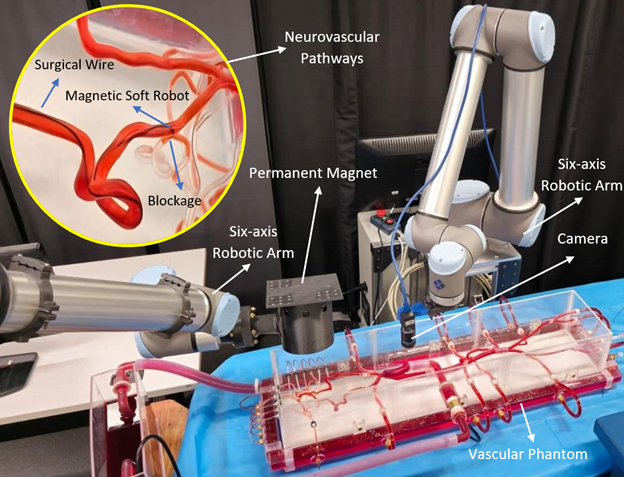 Overview of the developed robotic platform and its main subsystems, adapted from Alireza Moezi's PhD thesis.
Precision movements and measurements
The millimeter-sized robot is guided using a strong permanent magnet mounted on a six-axis robotic arm. By adjusting the angle and position of the magnet, the researchers can precisely control how the soft robot bends and moves.
Unlike many existing magnetic robotic systems that rely on bulky electromagnets and simpler open-loop control methods, the new system continuously measures the robot's position.
The researchers also developed an advanced model that combines analytical methods with deep learning to predict how the robot would behave under changing magnetic forces, gravity and fluid-flow conditions, like those found inside the human body.
They also trained another deep-learning model capable of detecting the robot's shape and tip position from high-speed camera images. This allowed the researchers to monitor the robot's position and deformation in real time and provide feedback for the closed-loop system.
Tests mimic surgical conditions
The researchers then tested the robotic platform using a series in vitro experiments designed to closely mimic real surgical conditions. They also built transparent fluidic channels that simulated vascular environments with flowing liquid.
The experiments evaluated how well the robot could follow precise motion paths under different magnetic conditions and fluid flow rates. The closed-loop control system consistently outperformed conventional control methods, showing greater accuracy, stability and resistance to disturbances caused by fluid flow.
The study demonstrated that the robot could maintain highly accurate tracking even when operating in fluid environments that simulate blood flow.
"This proof-of-concept paper is truly multidisciplinary, combining materials design, robotics, computational and experimental mechanics, AI and control," Sedaghati says.
Alireza Moezi, PhD 2026, is the paper's lead author. He is now a postdoctoral fellow at McGill University.
Subhash Rakheja, a professor in the Department of Mechanical, Industrial and Aerospace Engineering, also contributed research.
This research received funding from the Natural Sciences and Engineering Research Council of Canada and the Fonds de recherche du Québec - Nature et technologies.
Read the cited paper: "Robotic-assisted tracking control of magnetoactive soft continuum robots in magnetic gradients"