

NASA/JPL-Caltech/MSSS
While NASA imagery has shown evidence of ancient rivers and lakes on Mars that transitioned to dry dunes, uncertainty remains over the timing of the environmental changes that may have contributed to these shifts.
Now, data collected by NASA's Curiosity rover has revealed that individual crystals in the iron oxide hematite can be used as a mineralogical marker of changes to Mars' ancient climate. Because the shape and structure of these crystallites reflect the conditions - such as temperature and water presence - under which they were formed, they can serve as an indicator of when these changes occurred.
Scientists studied 20 samples collected by Curiosity across various elevations throughout Gale Crater for a paper published Thursday in Science. Gale Crater's walls reveal Mars' environmental history layer by layer, with deeper elevations capturing its earliest years. The team analyzed data from the rover's Chemistry and Minerology (CheMin) instrument and discovered that hematite showed different crystallite sizes at different elevations. They also discovered that goethite, a mineral that typically forms alongside hematite, was absent in samples from lower elevations but still present in samples from higher elevations. This suggests that warm groundwater might have remained for up to 4.7 million years in the deepest layers of Gale Crater and that during much of this time, these long-lived aquifers could have been potentially habitable.
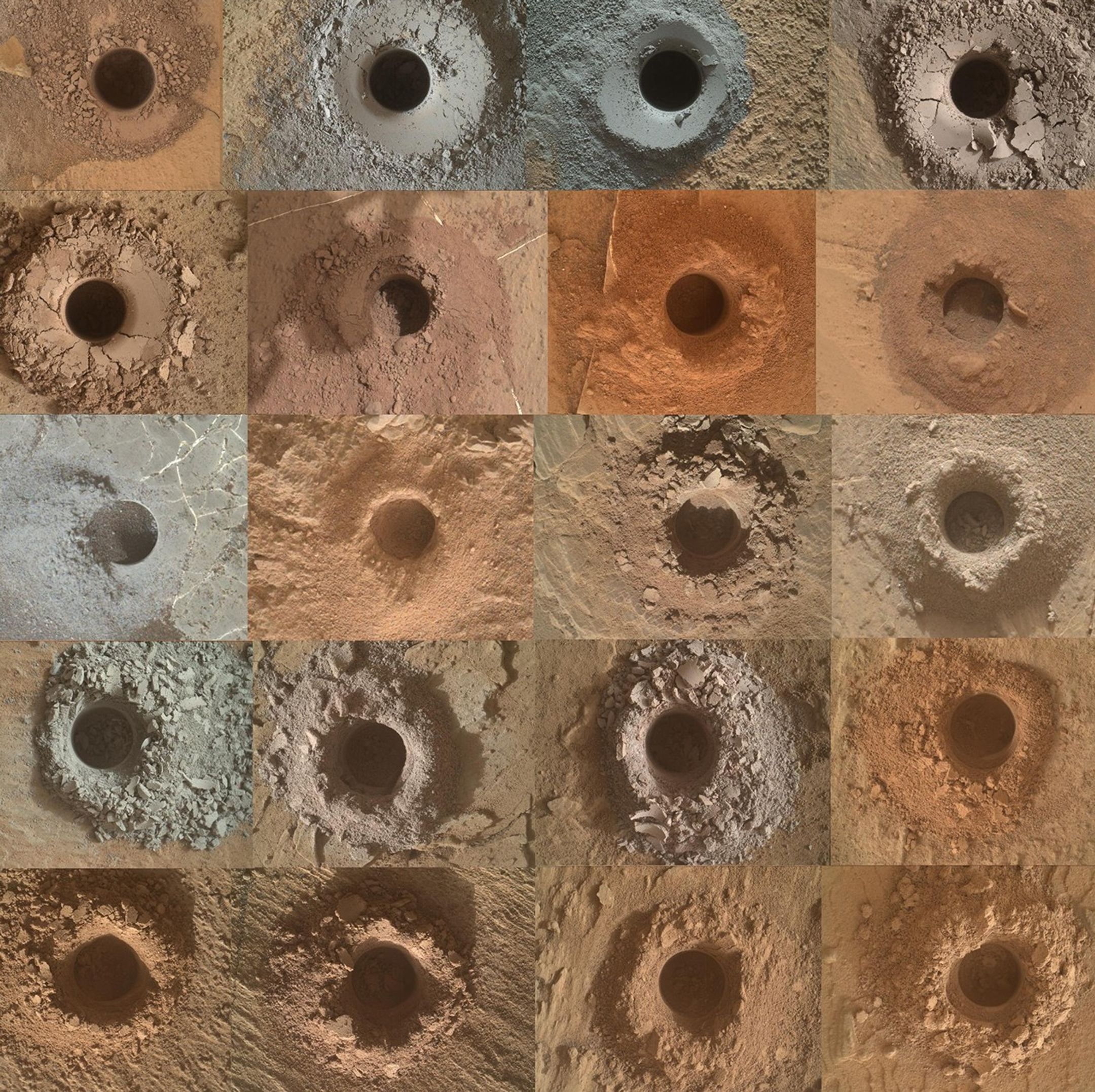
"What we found was that warm and wet conditions were present for extended periods in buried rocks, despite Mars' climate becoming colder," said Tanya Peretyazhko, co-first author of the study and planetary scientist in the Astromaterials Research and Exploration Science division at NASA's Johnson Space Center in Houston. "It means that deep in those rocks, those warmer conditions could have made for habitable conditions for much longer periods of time, provided that other essential factors were present."
Iron oxides are considered indicators of water activity because they form in its presence. This study shows that hematite can also be a marker of climate changes based on its crystallite sizes and structures, which change under different temperatures. The scientists found that hematite crystallites from higher elevations in Gale Crater were less than 10 nanometers in size, while crystallites from lower locations were generally larger, reaching up to 65 nanometers. These findings aligned with the observations that samples from higher elevations contained both hematite and goethite, while lower elevation samples lacked goethite.


