
Not every allergy antibody poses the same risk. A Hiroshima University-led research team has developed a more sensitive version of an allergy blood test designed to better detect functional allergen-specific IgE antibodies-the antibodies capable of triggering the immune processes behind allergic reactions.
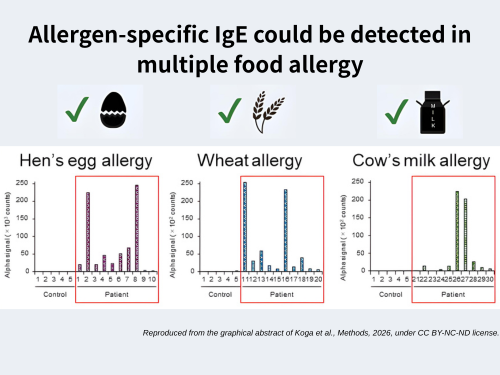
The improved AlphaCL method detected functional allergen-specific IgE in 28 of 30 patients who tested positive in oral food challenges. (Reproduced from the graphical abstract of Koga et al., Methods, 2026, under CC BY-NC-ND license)
Allergies can be minor or life-threatening, and current diagnostic blood tests are not always adequate at determining which substances patients need to avoid to prevent a reaction.
In the simplest terms, allergies are an overreaction of the immune system to something harmless, such as food, pollen, or house dust mites. The immune system is designed to, among other things, identify and neutralize pathogens that can infect and harm the body, keeping us healthy. In some cases, however, the immune system recognizes a completely harmless substance as a potential threat. When the immune system mounts a response to this threat, the reaction can be as minor as itchy skin, runny nose, or watery eyes, or as severe as anaphylactic shock.
Importantly, the immune system has a long memory, and allergies can last a lifetime, with symptoms often increasing and decreasing in severity over time. For people with very severe allergies, their lives may depend on the accurate identification of the allergens they react to. Currently, healthcare providers typically measure which allergens, or harmless substances, a patient's IgE antibodies react to in order to identify their allergies. This test does not, however, actually establish whether these antibodies are responsible for producing their symptoms, often creating a disconnect between allergen testing and the patient's clinical symptoms.
To address this issue, a group of researchers from Hiroshima University, Aichi Children's Health and Medical Center, and Shimane University in Japan recently developed a new allergen-specific IgE test that establishes whether a patient's IgE antibodies are capable of triggering an immune response, particularly in food allergies. This new test is based on the existing AlphaCL test, which was originally developed to detect the cross-linking of serum antibodies in patients with hives.
The team published their article on May 10 in the journal Methods.
"In order for allergic reactions to occur, IgE antibodies must bind to IgE receptors (FcεRI) on effector cells such as mast cells, and cross-linking of multiple FcεRI molecules by allergens is required to trigger the response. Consequently, conventional tests may classify individuals as having food allergies … when allergen-specific IgE is present but does not lead to actual symptom development. This discrepancy between test results and clinical symptoms represents a major challenge, contributing to diagnostic uncertainty and unnecessary dietary restrictions," said Yuki Koga, pharmacist in the Department of Pharmaceutical Services at Hiroshima University Hospital and primary author of the research paper.
Overcoming a major limitation of the conventional method
Today, functional IgE tests do exist, such as histamine release tests, to evaluate the activity of IgE antibodies. However, these methods require viable cells and specialized techniques, limiting their practicality in routine clinical practice. Oral food challenges continue to serve as the gold standard for food allergy diagnosis, which are highly reliable but carry the inherent risk of inducing potentially severe allergic reactions. A safer and more reliable diagnostic test that better reflects the actual risk of reaction is needed.
"[Our modified] AlphaCL method allows assessment of allergen-induced FcεRI cross-linking without the use of cells. In other words, it enables evaluation not only of how much IgE is present but also of how much functionally active IgE capable of inducing allergic reactions is present, using a simple and reproducible system. This study demonstrates the feasibility of detecting functional, [allergy-inducing] IgE through a more practical and accessible approach, highlighting the methodological significance of this technique," said Koga.
The team's modified AlphaCL method overcomes a major limitation of the conventional AlphaCL method to improve its detection sensitivity due to interference from serum components. In this method, modified allergens are used to facilitate the removal of serum components that interfere with serum IgE detection, allowing interfering serum components to be washed off a reaction plate.
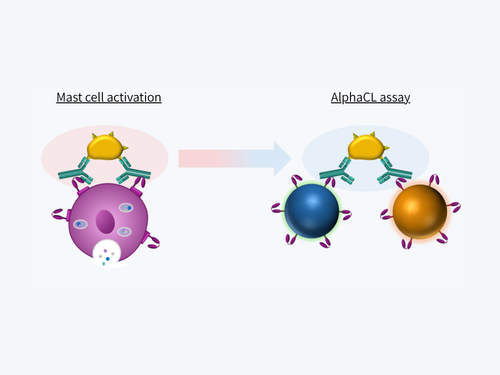
Mast cells are activated when allergens cross-link IgE receptors on their surface. The AlphaCL method mimics this process without the use of living cells. (Courtesy of Yuki Koga/Hiroshima University)
Assessing the new test's performance
To evaluate the performance of the improved AlphaCL method, the researchers compared it with the conventional assay under conditions that included serum components known to interfere with IgE detection.
Because the modified method allows these interfering serum components to be removed before detection, it was able to maintain substantially stronger signal responses. Under serum-containing conditions, the improved method retained 66% of its signal response observed in serum-free samples, whereas the conventional method retained only 3.3%, demonstrating a marked improvement in detection sensitivity.
The researchers then analyzed patient sera with allergies to representative food allergens, including egg, wheat, and milk. The improved AlphaCL method was capable of detecting allergen-sIgE in 93.3% (28/30) of patients with food allergy who were positive in oral food challenge (OFC). Their findings suggest that the method is not limited to specific allergens but can be adapted to a wide range of allergen targets.
Not every key 'unlocks the door'
As an analogy, the research team's new test was successful at identifying which keys (or IgE antibodies) are actually capable of "unlocking the door," or triggering clinical allergy symptoms. Most current tests are merely capable of counting how many "keys" can fit into a lock. By overcoming interference from blood serum, the improved AlphaCL test preserved substantially higher signal detection than the previous version.
Despite this success, however, their analyses were only performed on patients with positive OFC results, and the number of cases was limited.
"We seek to clarify the fundamental differences between assays that measure the quantity of IgE antibodies and those that assess functional IgE activity. Ultimately, our goal is to establish a new framework for evaluating food allergies by integrating both the quantity and the function of IgE antibodies, thereby enabling a more accurate and comprehensive assessment of clinical reactivity," said Koga.
Tomoharu Yokooji, Rina Aikawa and Ryohei Ogino from the Department of Frontier Science for Pharmacotherapy in the Graduate School of Biomedical and Health Sciences at Hiroshima University in Hiroshima, Japan; Teruaki Matsui and Komei Ito from the Department of Allergy in the Allergy and Immunology Center at Aichi Children's Health and Medical Center in Obu, Japan; Yuko Chinuki and Eishin Morita from the Department of Dermatology at Shimane University Faculty of Medicine in Izumo, Japan; and Takanori Taogoshi and Hiroaki Matsuo from the Department of Pharmaceutical Services at Hiroshima University Hospital in Hiroshima, Japan also contributed to this research.
This research was supported in part by JSPS KAKENHI [grant number 24 K08809].
About the study
- Journal: Methods
- Title: Detection of allergen-specific IgE in sera from pediatric patients with food allergy using AlphaCL
- Authors: Yuki Koga, Tomoharu Yokooji, Teruaki Matsui, Rina Aikawa, Ryohei Ogino, Takanori Taogoshi, Yuko Chinuki, Eishin Morita, Komei Ito, Hiroaki Matsuo
- DOI: 10.1016/j.ymeth.2026.05.006


