
Researchers at MIT and Stanford University have developed a new way to stimulate the immune system to attack tumor cells, using a strategy that could make cancer immunotherapy work for many more patients.
The key to their approach is reversing a "brake" that cancer cells engage to prevent immune cells from launching an attack. This brake is controlled by sugar molecules known as glycans that are found on the surface of cancer cells.
By blocking those glycans with molecules called lectins, the researchers showed they could dramatically boost the immune system's response to cancer cells. To achieve this, they created multifunctional molecules known as AbLecs, which combine a lectin with a tumor-targeting antibody.
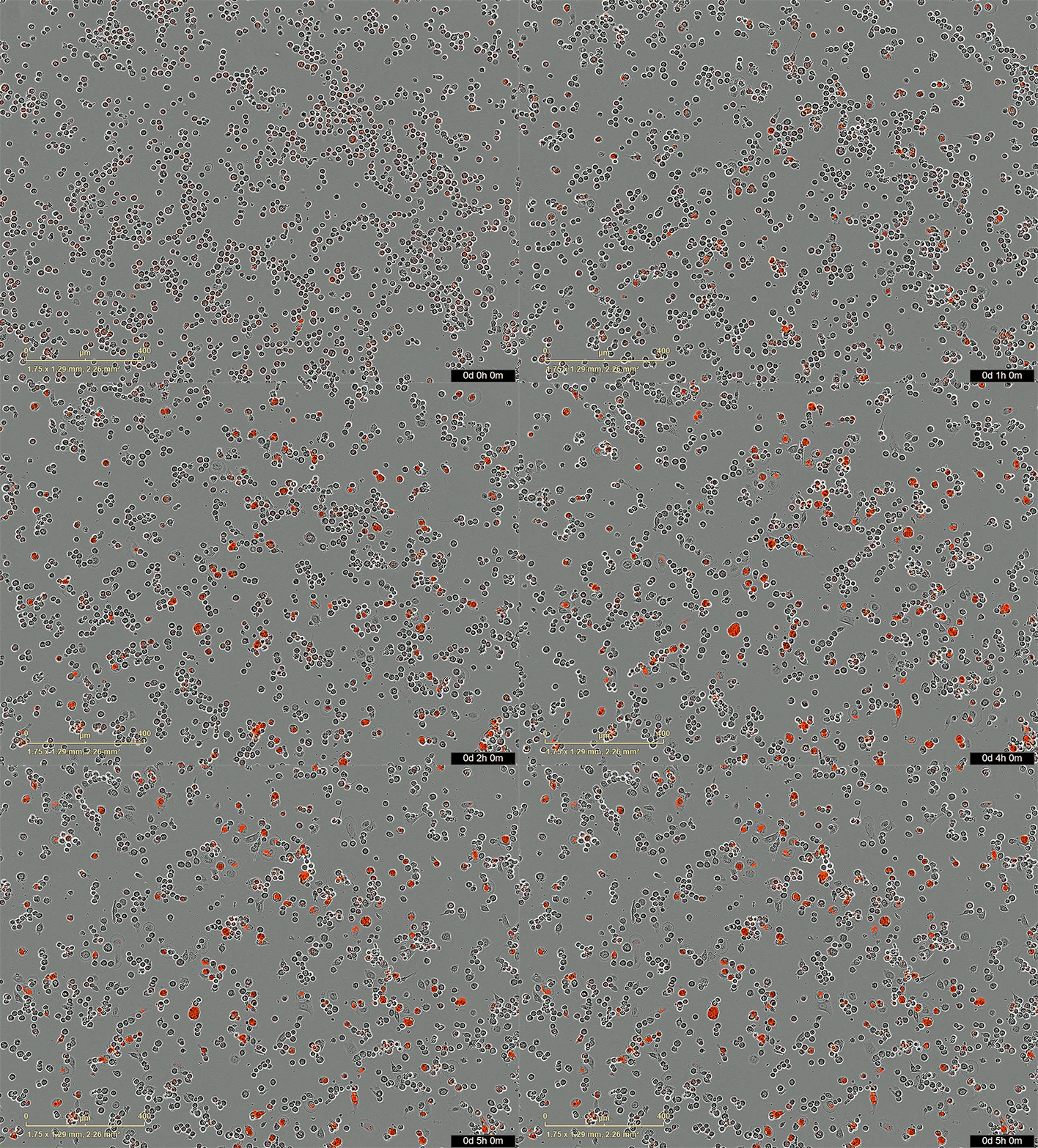
Image: Courtesy of the researchers
"We created a new kind of protein therapeutic that can block glycan-based immune checkpoints and boost anti-cancer immune responses," says Jessica Stark, the Underwood-Prescott Career Development Professor in the MIT departments of Biological Engineering and Chemical Engineering. "Because glycans are known to restrain the immune response to cancer in multiple tumor types, we suspect our molecules could offer new and potentially more effective treatment options for many cancer patients."
Stark, who is also a member of MIT's Koch Institute for Integrative Cancer Research, is the lead author of the paper. Carolyn Bertozzi, a professor of chemistry at Stanford and director of the Sarafan ChEM Institute, is the senior author of the study, which appears today in Nature Biotechnology.
Releasing the brakes
Training the immune system to recognize and destroy tumor cells is a promising approach to treating many types of cancer. One class of immunotherapy drugs known as checkpoint inhibitors stimulate immune cells by blocking an interaction between the proteins PD-1 and PD-L1. This removes a brake that tumor cells use to prevent immune cells like T cells from killing cancer cells.
Drugs targeting the PD-1- PD-L1 checkpoint have been approved to treat several kinds of cancer. In some of these patients, checkpoint inhibitors can lead to long-lasting remission, but for many others, they don't work at all.
In hopes of generating immune responses in a greater number of patients, researchers are now working on ways to target other immunosuppressive interactions between cancer cells and immune cells. One such interaction occurs between glycans on tumor cells and receptors found on immune cells.
Glycans are found on nearly all living cells, but tumor cells often express glycans that are not found on healthy cells, including glycans that contain a monosaccharide called sialic acid. When sialic acids bind to lectin receptors, located on immune cells, it turns on an immunosuppressive pathway in the immune cells. These lectins that bind to sialic acid are known as Siglecs.
"When Siglecs on immune cells bind to sialic acids on cancer cells, it puts the brakes on the immune response. It prevents that immune cell from becoming activated to attack and destroy the cancer cell, just like what happens when PD-1 binds to PD-L1," Stark says.
Currently, there aren't any approved therapies that target this Siglec-sialic acid interaction, despite a number of drug development approaches that have been tried. For example, researchers have tried to develop lectins that could bind to sialic acids and prevent them from interacting with immune cells, but so far, this approach hasn't worked well because lectins don't bind strongly enough to accumulate on the cancer cell surface in large numbers.
To overcome that, Stark and her colleagues developed a way to deliver larger quantities of lectins by attaching them to antibodies that target cancer cells. Once there, the lectins can bind to sialic acid, preventing sialic acid from interacting with Siglec receptors on immune cells. This lifts the brakes off the immune response, allowing immune cells such as macrophages and natural killer (NK) cells to launch an attack on the tumor.
"This lectin binding domain typically has relatively low affinity, so you can't use it by itself as a therapeutic. But, when the lectin domain is linked to a high-affinity antibody, you can get it to the cancer cell surface where it can bind and block sialic acids," Stark says.
A modular system
In this study, the researchers designed an AbLec based on the antibody trastuzumab, which binds to HER2 and is approved as a cancer therapy to treat breast, stomach, and colorectal cancers. To form the AbLec, they replaced one arm of the antibody with a lectin, either Siglec-7 or Siglec-9.
Tests using cells grown in the lab showed that this AbLec rewired immune cells to attack and destroy cancer cells.
The researchers then tested their AbLecs in a mouse model that was engineered to express human Siglec receptors and antibody receptors. These mice were then injected with cancer cells that formed metastases in the lungs. When treated with the AbLec, these mice showed fewer lung metastases than mice treated with trastuzumab alone.
The researchers also showed that they could swap in other tumor-specific antibodies, such as rituximab, which targets CD20, or cetuximab, which targets EGFR. They could also swap in lectins that target other glycans involved in immunosuppression, or antibodies that target checkpoint proteins such as PD-1.
"AbLecs are really plug-and-play. They're modular," Stark says. "You can imagine swapping out different decoy receptor domains to target different members of the lectin receptor family, and you can also swap out the antibody arm. This is important because different cancer types express different antigens, which you can address by changing the antibody target."
Stark, Bertozzi, and others have started a company called Valora Therapeutics, which is now working on developing lead AbLec candidates. They hope to begin clinical trials in the next two to three years.
The research was funded, in part, by a Burroughs Wellcome Fund Career Award at the Scientific Interface, a Society for Immunotherapy of Cancer Steven A. Rosenberg Scholar Award, a V Foundation V Scholar Grant, the National Cancer Institute, the National Institute of General Medical Sciences, a Merck Discovery Biologics SEEDS grant, an American Cancer Society Postdoctoral Fellowship, and a Sarafan ChEM-H Postdocs at the Interface seed grant.


