
'This approach allows us to collect molecular information from precise locations while minimizing disruption to the tissue, making it possible to monitor biological processes as they occur'
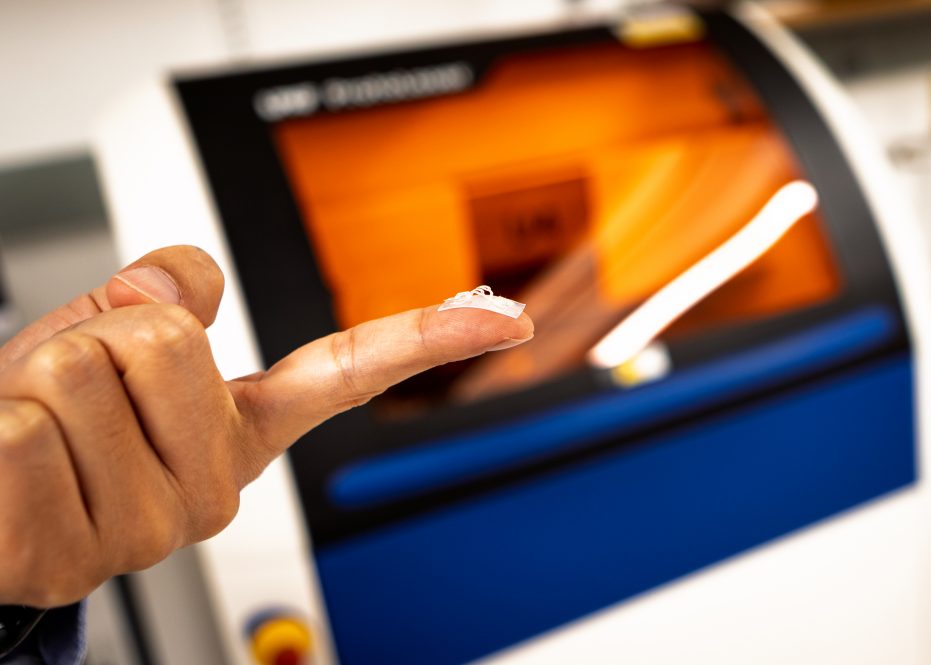
The implantable push-pull microfluidic probe. (Christopher LaRosa/UConn Photo).
A University of Connecticut faculty member has received funding from the Chan Zuckerberg Biohub to research inflammation in living tissue, a previously undeveloped area of science with potential to target serious autoimmune diseases, including inflammatory bowel disease, lupus, and psoriasis.
College of Engineering associate professor Yi Zhang's team will develop a microfluidic system for live tissue, allowing scientists and doctors to watch immune and metabolic activity unfold in real time.
Zhang's project, titled "3D Push-Pull Microsampling Networks for Spatiotemporal Omics," was selected as one of 15 projects globally for a new initiative focused on developing instrumentation to monitor inflammation in real time.
Zhang, a faculty member in the Department of Biomedical Engineering, which is a joint effort from UConn Health and the UConn College of Engineering, will act as PI, partnering with co-PIs Robert Kennedy of the University of Michigan and Sasan Jalili of the Jackson Laboratory.
"I am honored to be part of this global network alongside teams from institutions including Harvard, MIT, Columbia, University of Oxford, and Switzerland's EPFL," Zhang says. "Instead of cultivating mere 'snapshots' of cellular responses that only tell a retroactive story, we're looking at 'live video' of immune responses."
The Chan Zuckerberg Initiative was founded by Priscilla Chan and Mark Zuckerberg in 2015 to address complex world challenges, including reducing disease, improving education, increasing food security, and more.
The initiative's science-targeted focus area is called Biohub, which is helping scientists around the world use new technology to study how cells operate, organize, and work as part of systems to understand why disease happens and how to correct it.
The Biohub described inflammation as "biology's blind spot," because the dominant technologies for measuring proteins and molecules usually require biological tissue to be frozen, fixed, or otherwise destroyed.
According to the Chan Zuckerberg Initiative, 15 teams were chosen for proposing compelling, novel platforms that address key technical barriers to spatiotemporal omics, and demonstrate relevance to inflammation, immune regulation, and autoimmune disease models.
Spatiotemporal omics is a scientific approach to study what molecules are present, where they are located, and how they change over time.
Zhang's research uses "push-pull" microsampling to study the parts of the cell.
"Push-pull microsampling works by continuously delivering and withdrawing tiny volumes of fluid through microchannels embedded in living tissue," says Zhang. "This approach allows us to collect molecular information from precise locations while minimizing disruption to the tissue, making it possible to monitor biological processes as they occur."
In the future after validation in human ex vivo models, Zhang plans to expand to other mucosal and barrier tissues, such as skin, lung and oral epithelium, to analyze tissue-specific immune dynamics and disease mechanisms. Integration with AI models will enable predictive modeling of immune states and transitions.
"Ultimately, these advancements will pave the way for minimally invasive, in vivo immune-monitoring and precision diagnostic platforms for autoimmune and inflammatory diseases," Zhang says. "I'm grateful for the opportunity to potentially improve the lives of those plagued by chronic and serious diseases."


