
The University of Portsmouth has played a leading scientific role in a major new European Space Agency (ESA) mission designed to reveal the incredibly faint outer regions of galaxies.
ESA has officially adopted the ARRAKIHS mission, Europe's first space mission dedicated to detecting the extremely faint structures surrounding galaxies that hold the fossil record of their formation and evolution.
The mission marks a major milestone in European astrophysics and will explore one of the last largely uncharted frontiers of the Universe.
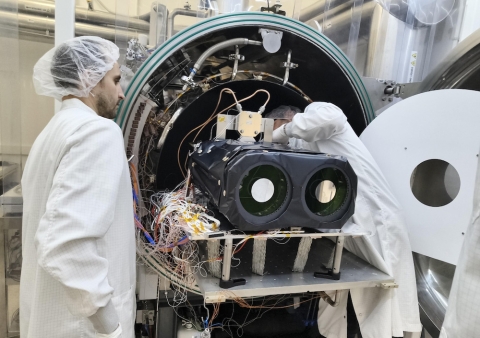
Members of the ARRAKIHS instrument team working on the scientific payload. Image credit: Satlantis/ IDR/ UPM
Professor Enrique Gaztañaga , from the University of Portsmouth's Institute of Cosmology and Gravitation (ICG), was Science Coordinator of ARRAKIHS from early 2024 until late 2025 and now serves as co-Chair of the mission's Science Committee.
He said: "The adoption of ARRAKIHS by ESA is a landmark moment for European astronomy. This mission will allow us to study parts of galaxies that have remained almost completely invisible until now, preserving the fossil record of how galaxies assembled over billions of years.
"These observations have the potential not only to transform our understanding of galaxy formation, but also to provide crucial clues about the nature of dark matter and the conditions that existed shortly after the birth of the Universe."
To uncover these hidden features, ARRAKIHS will use four highly sensitive cameras that observe simultaneously the same area of the sky in four different bands covering ultraviolet, visible and infrared light.
The adoption of ARRAKIHS by ESA is a landmark moment for European astronomy. This mission will allow us to study parts of galaxies that have remained almost completely invisible until now, preserving the fossil record of how galaxies assembled over billions of years.
Enrique Gaztañaga, Professor of Astrophysics
The University of Portsmouth played a key role in designing these camera's unique multi-wavelength filter system.
Professor Gaztanaga added: "This unique space-based capability will allow ARRAKIHS to detect signatures of star formation as well as black hole accretion in faint galactic structures - measurements that are extremely difficult, or impossible, to achieve from ground-based observatories.
"ARRAKIHS will therefore provide an unprecedented view of how galaxies, including our own Milky Way, formed and evolved over cosmic time."
The mission is planned for launch in 2030.


