
The physicist on complex systems, the emergence of life and intelligence, and what distinguishes living systems from machines.
I grew up in an academic environment. My dad is a now-retired professor of political science. When I was about three, I apparently approached Carl Sagan on the quad at Cornell and asked him questions.
I read a lot as a kid, and I really liked the Doctor Who series of novels. I think that's what got me interested in physics. The first time I saw E=mc2 was in one of those books.
I originally wanted to be an archaeologist, but around 10th grade, I saw a BBC interview with the famous physicist Richard Feynman. I was mesmerized. I'd never heard anyone speak with that kind of clarity of thought. I started reading books on quantum mechanics. It's the strange weirdness about quantum mechanics that got me.
I became interested in complex systems in grad school. I was planning to study high-energy physics, but I went to a talk by my eventual advisor where he used techniques from condensed-matter physics and applied them to things like social and economic systems. I realized I could combine my interests in socioeconomics, political science, anthropology, history, and physics under this umbrella of studying complex systems.
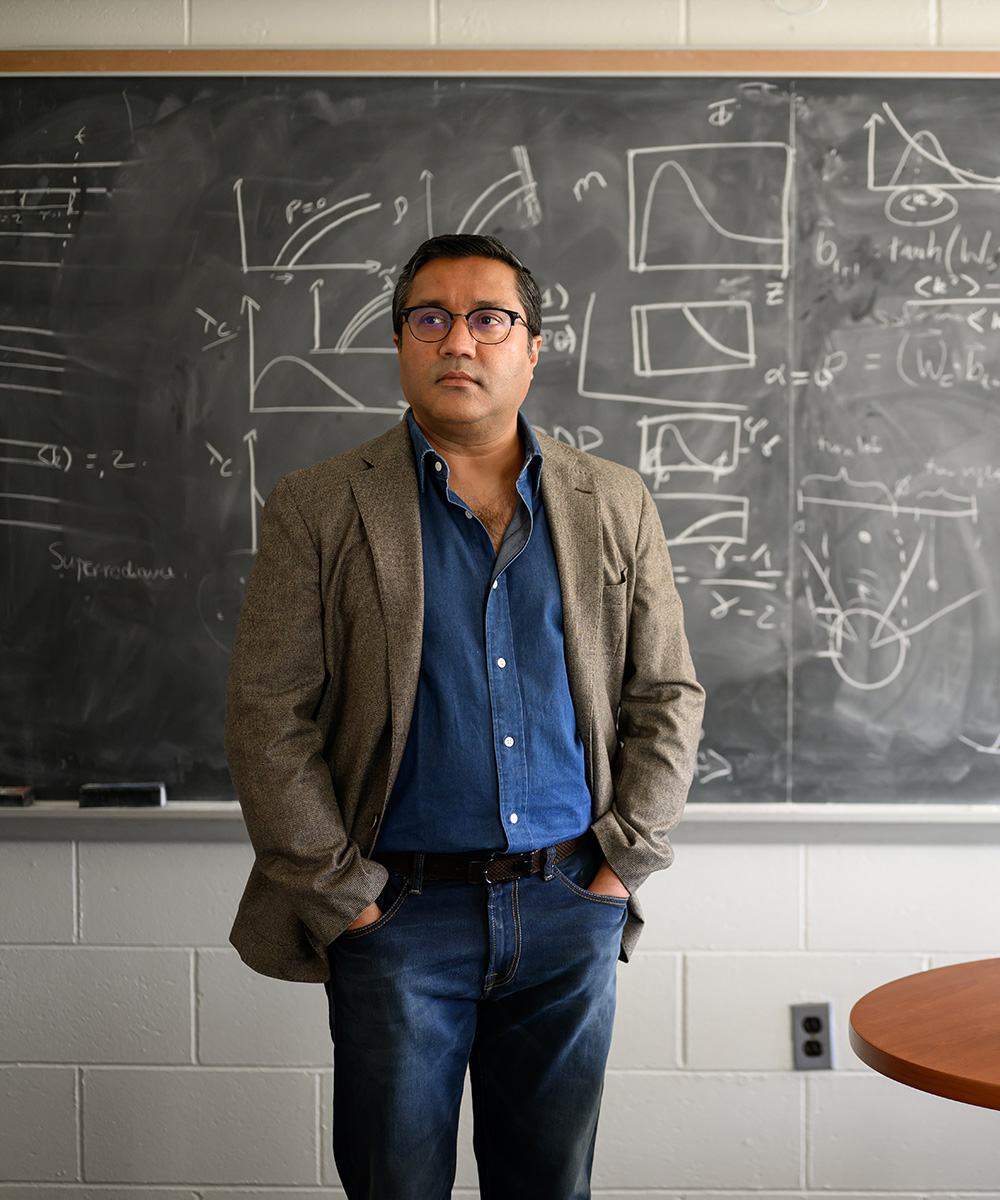
Complex systems are pretty much everywhere in the universe. A society, an economy, the human brain, the desk in my office-all are complex systems. When you have many interacting components, things get very complicated. But something interesting happens where there is this emergent global behavior, and things simplify. All of a sudden, you can understand a very complicated system through very reduced sets of variables.
I'm trying to understand a fundamental question: How does order emerge from very messy systems? Right now, through my Templeton Foundation grant, we're bringing together philosophers, evolutionary biologists, physicists, and computer scientists to study how life, intelligence, and agency emerge and what distinguishes living systems from machines.
We're trying to formalize some of these ideas mathematically. The first part of the project is a philosophical component, where we're trying to define concepts like agency and intelligence. The second part involves developing mathematical models of how these systems arise and sustain themselves and the energetic costs of that.
Agency is something I'm really interested in. Living systems are constantly trying to stay alive, and much of what they do is organized around self-maintenance, whereas engineered systems are designed to solve problems. But even more important is knowing which questions to ask. Living systems accrue a tremendous amount of knowledge but discriminate between relevant and irrelevant information.
There are tasks that AI can perform much better than humans, but think about the resources and computing power it takes to train AI. AI is very good at solving existing problems, but I don't see it advancing the frontier and asking truly original questions. Yet. You do have to be humble about these things and be open to what may come. And I honestly don't know what that may be.
I use AI, but I don't completely trust it. I use Claude and ChatGPT, mostly for mundane purposes, like accounting and travel research, or as a sounding board for ideas. I've trained it to be adversarial. Every time it agrees with me, I scold it, so it's a great way for me to sharpen my ideas.
I'm a scientist, but I have a love for the arts and humanities. I think it's important to have a holistic perspective. I love to travel and go to museums and the theater. I'm a huge history buff, and I'm beginning to appreciate philosophy more. I like learning new things and reinventing myself periodically.
This story appears in the fall 2026 issue of Rochester Review, the magazine of the University of Rochester.


