RICHLAND, Wash. - The Department of Energy's Pacific Northwest National Laboratory has broken ground on a new research facility that will be one of the world's largest and most fully autonomous biosciences laboratories, and the first that will be available to the broader scientific community.
The 30,800-square-foot Microbial Molecular Phenotyping Capability is an expansion of the Environmental Molecular Sciences Laboratory, a DOE national scientific user facility located on the PNNL-Richland campus. It has been designed to transform how we could put microbes to work for American manufacturing competitiveness, human health, adversary threat detection and response, food security and next-generation energy systems.
Leaders from DOE and PNNL, government officials and key research collaborators gathered on Oct. 20, 2026, on the PNNL-Richland campus to celebrate the start of construction, which is expected to take about two years.

"M2PC will bring together PNNL's strengths in microbial science, automation and computing to dramatically accelerate our understanding of what microbes can do and how we put those capabilities to work for the nation," PNNL Director Deb Gracio said at the groundbreaking event.
Progress at the speed of biology
M2PC will house more than 100 connected, automated instruments designed and supplied by PNNL industry partner Ginkgo Bioworks. Working together as a single integrated system, this array will be programmable via customized software to handle time-consuming tasks, including growing microbes and preparing samples, measuring how microbes grow and behave under precisely controlled conditions and running analyses to connect those observable traits (called phenotypes) to the molecular machinery inside the cells that controls them.
By automating these steps, M2PC will enable researchers to test more ideas, learn from results and guide subsequent experiments.
The DOE Office of Science Biological and Environmental Research Program Associate Director Dorothy Koch shared her vision for the facility at the groundbreaking event.

"M2PC will accelerate biological discovery and design and take on the mega-grand challenge of how complex microbial systems function at the genomic level both in the lab and under a range of environmental conditions," she said.
This approach will dramatically accelerate the process of understanding microbial behavior and identifying promising biological functions.
Why focus on microbes?
Humans have benefited from bacteria, yeast and other single-celled organisms since the dawn of civilization. Because of their sheer numbers, they collectively represent the single largest body of biological diversity and function on Earth and remain among the most powerful potential tools in modern science. Through human ingenuity and M2PC speed, researchers hope to efficiently produce bioproducts, create new materials, clean up contamination and help secure the nation's energy supplies. But understanding what each microbe can actually accomplish and how to put those abilities to work economically has traditionally taken years of painstaking laboratory effort.
Advancing DOE's Genesis Mission
M2PC will serve as a flagship component of DOE's Genesis Mission, the Department's directive to modernize and accelerate American science through autonomous, Super-Intelligence-driven laboratories. M2PC is funded by the DOE Office of Science's Biological and Environmental Research program and builds directly on PNNL's long-standing strengths in microbial phenotyping, systems biology, data analytics and software development.
PNNL's expertise in designing biological systems, measuring microbial traits, analyzing the full suite of molecules inside cells, integrating many types of data and building computational models helped inform the design of the facility. M2PC will also advance PNNL toward one of its most ambitious scientific goals: building and testing computer models that can predict and program the behavior of living systems.
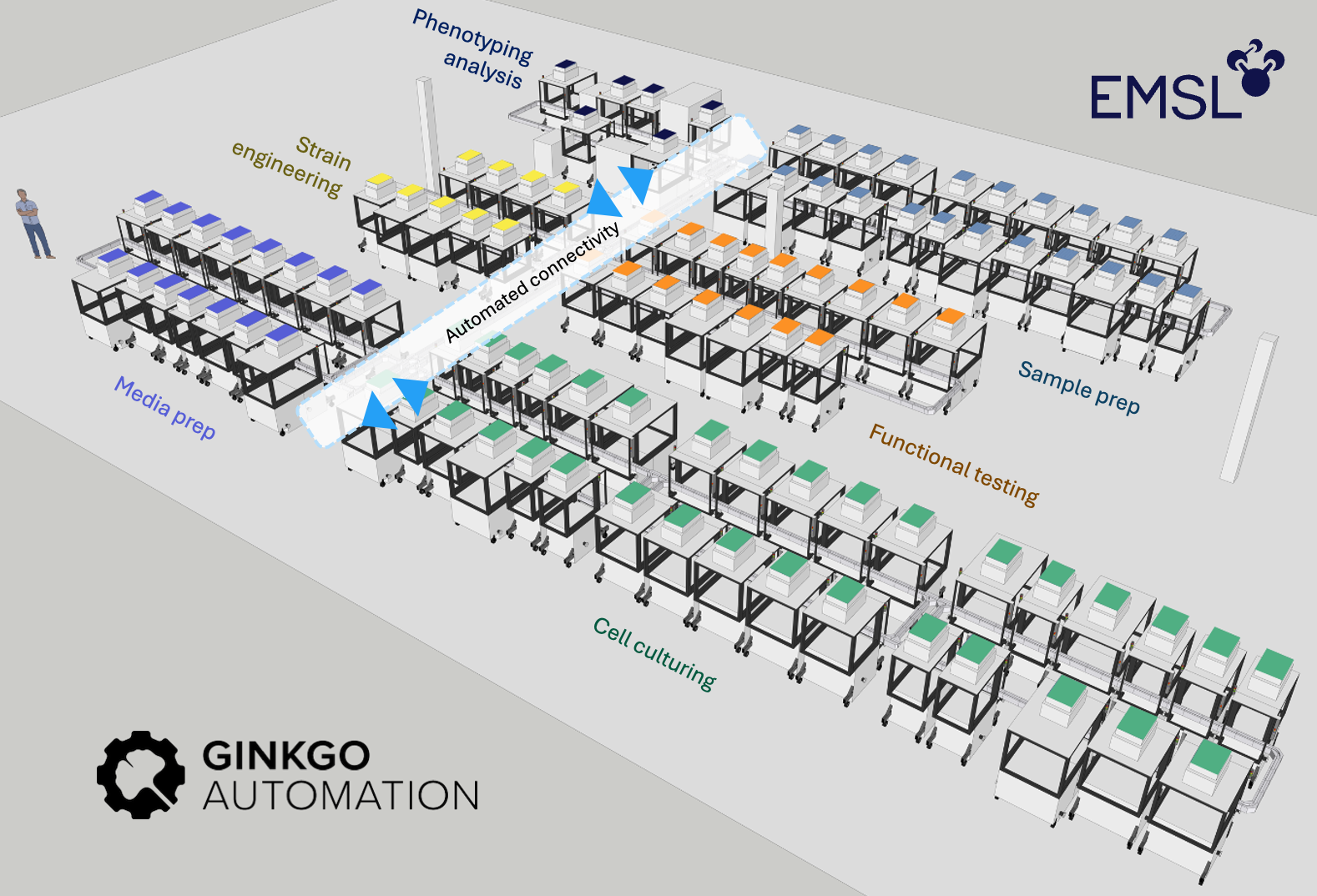
These capabilities will help lay the scientific foundation for advances in biotechnology, including the development of new materials, energy technologies and approaches to critical materials recovery.
"PNNL has a long history of developing scientific talent and partnering with universities and educational institutions to train and deploy the next-generation workforce at the forefront of advancing science," said Associate Laboratory Director for Integrated Discovery Science Douglas Mans. "M2PC will allow us to build on that foundation, giving students and early-career researchers experience with technologies that will increasingly shape and become the next frontier in scientific research."
Fueling a $4 trillion biotechnology industry
While M2PC is a research investment, the payoff is expected to extend well beyond the laboratory. Discoveries enabled by M2PC are expected to accelerate the rapidly growing industrial biotechnology industry, which has been valued at $4 trillion.
Open to the nation's scientists
When M2PC opens its doors in 2029, it will transform EMSL into a premier hub for next-generation microbial research. Like EMSL's other capabilities, M2PC will be available to the broader research community at no cost through EMSL's competitive user program proposal process. Scientists from universities, industry and other national laboratories across the country will be invited to submit proposals that address the nation's most pressing scientific challenges.
With shovels now turning soil, DOE, PNNL and EMSL have taken the first steps toward building the future of programmable biology, where discoveries that once took a career can happen in a year.